
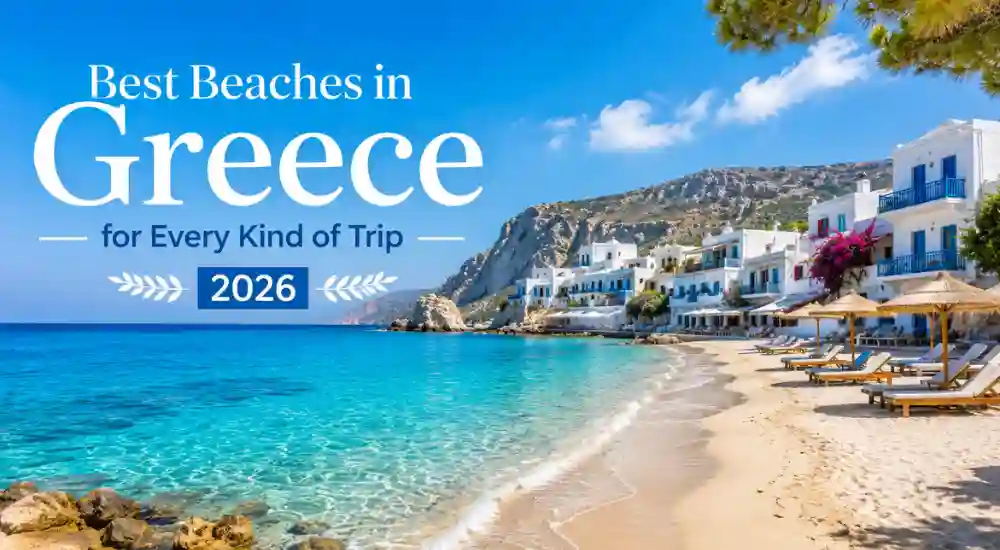
Greece doesn’t have one single type of great beach. Some travelers want soft sand and shallow water, while others would happily hike down a rocky trail for a quiet cove and clear snorkeling.
This guide compares 16 of the best beaches in Greece by swimming, scenery, sand, access, crowds, and traveler type. It covers Crete, Milos, Kefalonia, Lefkada, Corfu, Naxos, Paros, Rhodes, Karpathos, Koufonisia, Elafonisos, and mainland Greece.
Quick Answer: What Are the Best Beaches in Greece?
For the widest variety, Crete is difficult to beat. It gives you the pink-tinged shallows of Elafonissi, the lagoon scenery of Balos, and the broad sandy coast at Falassarna.
Choose Naxos for long sandy beach days, Kefalonia and Lefkada for dramatic Ionian cliffs, Milos for volcanic landscapes, and Koufonisia for a slower island escape.
For official destination planning, see Discover Greece and Visit Greece.
TL;DR
- Best overall variety: Crete
- Best for long sandy beaches: Naxos
- Best for dramatic cliffs: Kefalonia and Lefkada
- Best for unusual scenery: Milos
- Best for families: Elafonissi, Plaka, Kolymbithres
- Best for snorkeling: Apella and Anthony Quinn Bay
- Best for fewer peak crowds: June or September
- Best remote escape: Fteri or Porto Timoni
Best Beaches in Greece at a Glance
This quick comparison makes it easier to match each beach with your travel style before you start planning transport or accommodation.
| Beach | Region | Best For | Shore | Access |
|---|---|---|---|---|
| Elafonissi | Crete | Families, shallow swimming | Fine sand | Road + walk |
| Balos Lagoon | Crete | Scenery, photography | Sand/lagoon | Boat or road + hike |
| Falassarna | Crete | Sand, sunsets | Sand | Road |
| Sarakiniko | Milos | Photography, unusual scenery | White rock + small sandy areas | Road |
| Myrtos | Kefalonia | Cliff views | Pebbles | Road |
| Fteri | Kefalonia | Seclusion | Sand + fine pebbles | Boat or hike |
| Porto Katsiki | Lefkada | Ionian scenery | Pebbles/sand | Road + descent |
| Voidokilia | Messinia | Families, mainland trips | Fine sand | Road + short walk |
| Paleokastritsa | Corfu | Cove hopping | Mixed small coves | Road/boat |
| Porto Timoni | Corfu | Hiking, quiet coves | Sand/pebbles | Hike or boat |
| Apella | Karpathos | Snorkeling | Sand + fine pebbles | Road/boat |
| Plaka | Naxos | Long beach days | Sand | Road |
| Simos | Elafonisos | Soft sand | Fine sand | Ferry + road |
| Kolymbithres | Paros | Families, kayaking | Sand | Road/boat |
| Anthony Quinn Bay | Rhodes | Snorkeling | Fine sand + pebbles | Road/boat |
| Pori | Koufonisia | Slow island days | Sand | Walk/boat |
How to Choose the Right Greek Beach
The famous beaches of Greece aren’t interchangeable. A dramatic photo doesn’t always mean an easy family beach, and a remote cove isn’t necessarily the best place to spend a full day.
Before choosing an island around one famous beach, decide what matters most to you: sand, snorkeling, easy access, scenery, quiet surroundings, nightlife, family facilities, or adventure.
For Families With Younger Children
Prioritize shallow entry, sand, easier access, and nearby services.
- Elafonissi, Crete
- Plaka, Naxos
- Kolymbithres, Paros
- Voidokilia, Messinia
- Simos, Elafonisos
Water conditions can change anywhere, so shallow water should never be treated as a guarantee of safe swimming.
For Couples and Photographers
- Sarakiniko for white volcanic rock
- Porto Katsiki for cliffs
- Myrtos for a classic Ionian panorama
- Balos for lagoon views
- Porto Timoni for twin-cove scenery
If you’re comparing beach-led luxury trips elsewhere, see our guide to luxury beach resorts.
For Soft Sand
If sand underfoot matters, look first at Plaka, Elafonissi, Falassarna, Simos, Voidokilia, and Kolymbithres.
Travelers who dislike pebbles may find Myrtos and Anthony Quinn Bay less appealing despite their scenery.
For Snorkeling
Rocky coves often create more underwater interest than wide sandy beaches.
- Apella
- Anthony Quinn Bay
- Paleokastritsa
- Fteri
Bring your own mask if snorkeling matters to you, especially at less organized beaches.
The 16 Best Beaches in Greece
Each beach below has a different strength. Some are easy all-day bases, while others are better treated as scenic half-day stops or adventurous excursions.
Use the quick facts beneath each destination to compare who it suits, how long to allow, and what to know before you go.
1. Elafonissi Beach, Crete — Best for Pink-Tinged Sand and Shallow Water
Elafonissi feels different from almost every other beach on this list. Pale sand, shell fragments that can give parts of the shore a pink tint, and shallow lagoon water create a landscape that attracts families and photographers in equal numbers.
The shallows make it especially attractive for travelers with children, but its fame comes with a trade-off: summer crowds can be heavy. Its protected environment also deserves care, so don’t remove sand or shells and respect restrictions around sensitive areas.
2. Balos Lagoon, Crete — Best for Iconic Lagoon Scenery
Balos is the beach people often picture when dreaming about Crete: pale sand, shallow turquoise water, and rugged headlands meeting in an unusual lagoon landscape.
The view is extraordinary, but getting there takes more effort than reaching a roadside beach. Visitors commonly approach by boat from the Kissamos area or overland with a walk at the end. The exposure, summer heat, and uneven terrain make the land approach less suitable for travelers with mobility concerns.
3. Falassarna Beach, Crete — Best for Space and Sunset
If Elafonissi feels compact and Balos feels adventurous, Falassarna feels open. Its broad sandy shoreline makes it easier to settle in for several hours without treating the beach as only a photo stop.
Its west-facing position is a major reason travelers linger into the evening. Wind can affect swimming conditions, so check the sea rather than assuming every summer day will be calm.
4. Sarakiniko Beach, Milos — Best for Volcanic Scenery
Don’t choose Sarakiniko expecting a traditional mile-long sandy beach. Its appeal comes from smooth, chalk-white volcanic formations shaped around vivid Aegean water.
The sandy areas are relatively small, while the bright rock reflects intense sunlight. Morning and late afternoon usually feel more comfortable than the middle of a hot summer day.
5. Myrtos Beach, Kefalonia — Best for Classic Ionian Cliff Scenery
Myrtos belongs on this list because few beaches capture the scale of the Ionian coast so clearly. Pale pebbles curve beneath tall limestone slopes while the water changes color with depth and light.
This is a beach to choose for dramatic scenery, not because you’re searching for soft sand or a sheltered lagoon. The open setting can experience stronger sea conditions, so judge the water carefully before swimming.
6. Fteri Beach, Kefalonia — Best for Seclusion
Fteri is the beach to choose when you’re willing to trade convenience for a quieter setting. Pale sand and fine pebbles, limestone cliffs, and transparent water give it a more isolated feel than Kefalonia’s easy-access beaches.
Boat trips from the Agia Kiriaki area are a common way to visit, although hiking approaches also exist. Bring water, food, shade, and sun protection rather than assuming services will be available.
7. Porto Katsiki, Lefkada — Best for Towering Cliffs
At Porto Katsiki, the cliff is as memorable as the water. A huge pale rock wall rises behind a narrow shoreline, creating the kind of scale that makes Lefkada’s southwest coast instantly recognizable.
The beach attracts serious summer crowds, and access is less effortless than at flat resort beaches. Travelers who dislike midday congestion should aim for an earlier or later visit and check current parking and access arrangements before setting out.
8. Voidokilia Beach, Messinia — Best Mainland Beach
You don’t need a ferry to find one of Greece’s most recognizable beaches. Voidokilia, in the Peloponnese, forms an almost horseshoe-shaped bay beside the environmentally important Gialova Lagoon.
The fine sand and relatively shallow bay make it attractive for families, while the surrounding natural landscape appeals to hikers and photographers. It is largely a natural beach rather than a full-service resort strip, so arrive prepared for the day.
9. Paleokastritsa, Corfu — Best for Cove Hopping
Paleokastritsa isn’t one single beach experience. The area is made up of several coves, giving travelers options for swimming, small boat outings, water activities, and exploring Corfu’s green northwest coast.
You can spend the morning swimming, take a boat toward smaller coastal spots, then explore the surrounding area rather than staying on one strip of sand all day.
10. Porto Timoni, Corfu — Best for a Scenic Hike
Getting to Porto Timoni is part of the appeal. The coastal formation below Afionas is known for two neighboring bays separated by a narrow rocky peninsula.
The hike adds a sense of adventure but also makes this a poor match for anyone wanting effortless beach access. Carry water and wear proper footwear rather than beach flip-flops.
11. Apella Beach, Karpathos — Best for Clear-Water Snorkeling
Apella combines pine-covered slopes, pale shore, high rock walls, and clear Dodecanese water in one compact setting. The mix of sand and fine pebbles creates a very different beach day from the long sandy shores of Naxos.
Rocky edges and transparent water make snorkeling one of the main reasons to choose it. Karpathos rewards travelers willing to explore beyond resort areas.
12. Plaka Beach, Naxos — Best for Long Sandy Beach Days
Plaka is where Naxos becomes especially attractive for travelers who want their hotel-and-beach routine to stay simple. The long sandy shoreline gives visitors room to spread out, while accommodation and dining options sit around the wider beach area.
Naxos is exposed to the Aegean wind, and Plaka attracts wind- and kite-surfers when conditions cooperate. If your ideal Greek vacation means waking near a sandy beach, Plaka is one of the strongest choices here.
13. Simos Beach, Elafonisos — Best for Fine Sand
Simos wraps around a narrow landform on Elafonisos, creating neighboring beaches with fine golden sand, clear water, and dune-backed surroundings.
It works especially well for travelers exploring the southern Peloponnese who want to add a small island without building an entire island-hopping itinerary.
14. Kolymbithres Beach, Paros — Best for Families and Kayaking
At Kolymbithres, rounded granite formations break the coastline into small sandy coves. That gives the beach more character than a single open strip and creates sheltered-looking spaces that families often appreciate.
The beach sits close to Naoussa and can be approached by road or boat. Kayaks and other water activities are also associated with the area.
15. Anthony Quinn Bay, Rhodes — Best for Snorkeling
Anthony Quinn Bay is compact, rocky, and far more interesting for snorkeling than for travelers dreaming about miles of soft sand.
The shoreline mixes fine sand and pebbles, while rocky edges create underwater interest for swimmers with masks.
16. Pori Beach, Koufonisia — Best for Slow, Car-Free Beach Days
Pori fits the rhythm of Koufonisia: walk, swim, eat, and slow down. The crescent-shaped bay has pale sand and clear water without the large-resort atmosphere found on busier Greek islands.
One of Koufonisia’s biggest advantages is its compact scale. Pori can be reached on foot, with seasonal local boat options also forming part of island life.
Which Greek Island Has the Best Beaches?
There isn’t one answer for every traveler, but several islands stand out for specific reasons.
Use the comparison below to choose an island based on the kind of beach vacation you want—not just one famous photo.
| Island | Choose It If You Want | Standout Beaches |
|---|---|---|
| Crete | Maximum variety | Elafonissi, Balos, Falassarna |
| Naxos | Long sandy beaches | Plaka, Agios Prokopios, Agia Anna |
| Kefalonia | Cliffs and Ionian colors | Myrtos, Fteri |
| Milos | Unusual geology | Sarakiniko and coastal coves |
| Corfu | Green scenery and boat trips | Paleokastritsa, Porto Timoni |
| Paros | Beaches plus lively towns | Kolymbithres and Naoussa-area beaches |
| Karpathos | Clear water and quieter exploring | Apella |
Best Overall: Crete
Choose Crete if beaches are only one part of a longer trip. The island combines famous beaches with historic towns, mountain landscapes, food, hiking, and enough variety for a week or more.
Best for Sand: Naxos
Choose Naxos when long, usable sandy beaches matter more than collecting dramatic viewpoints.
Best for Scenery: Kefalonia or Lefkada
The Ionian Islands excel at high limestone cliffs, pale shorelines, and deep blue water.
Best for Something Different: Milos
Milos makes the strongest case for travelers bored with the idea of another standard sandy beach.
Best Time to Visit Greece for Beaches
For many travelers, June and September offer the best balance. You still get a strong summer beach atmosphere, but you can avoid some of the pressure associated with July and August.
May and October can work well for quieter travel, though sea temperatures and seasonal services become less predictable.
May
Good for sightseeing and quieter beaches, but the sea can feel cool to some swimmers.
June
One of the strongest all-around choices for beach weather, longer days, and fewer peak crowds.
July & August
Expect heavier crowds, greater accommodation demand, busier parking, and hotter midday conditions.
September
Often the sweet spot for swimming-focused travelers, with warm sea conditions and a slower pace.
Sandy Beaches vs Pebble Beaches in Greece
One of the easiest mistakes is assuming every famous Greek beach has soft sand.
Some of Greece’s most dramatic beaches are pebbly or rocky, while others offer the soft sand families often prefer.
Choose These for Sand
- Elafonissi
- Falassarna
- Voidokilia
- Plaka
- Simos
- Kolymbithres
- Pori
Expect Pebbles or Mixed Shore
- Myrtos
- Fteri
- Porto Katsiki
- Apella
- Anthony Quinn Bay
Pebbles aren’t necessarily a disadvantage. Water can look exceptionally clear against pale stone, although water shoes can make entering and leaving the sea more comfortable.
Best Beaches in Greece for Families
Families should look beyond photographs and focus on access, shallow entry, shade, food availability, and how much equipment must be carried.
Elafonissi, Plaka, Kolymbithres, Simos, and Voidokilia are stronger options for travelers seeking sand and relatively straightforward beach days.
Elafonissi
The shallow lagoon is the main attraction, although peak-season crowds require patience.
Plaka
A long sandy shore makes it easier to create an all-day beach base.
Kolymbithres
Small sandy coves give families more manageable beach spaces.
Voidokilia
Fine sand and shallow areas appeal to families, but bring your own supplies.
Best Quiet and Romantic Beaches in Greece
“Quiet” depends heavily on the month and hour. Even remote-looking beaches can become busy in July and August.
For a more relaxed experience, consider Fteri, Pori, Porto Timoni, Apella, and Plaka. June or September usually gives you a better chance of combining warm weather with lighter crowds.
If Greece inspires a wider island trip, compare it with our guide to the best Caribbean islands for a very different beach-vacation style.
Practical Tips for Visiting Greek Beaches
A small amount of planning can turn a frustrating beach day into one of the best parts of your trip.
Remote beaches especially reward travelers who prepare for heat, limited facilities, changing sea conditions, and more complicated access.
Bring More Than Swimwear
- Drinking water
- Sun protection
- Hat
- Towel
- Water shoes
- Snorkel mask
- Snacks
- Small trash bag
Respect Protected Coastal Areas
- Don’t remove shells or sand
- Don’t damage dunes
- Don’t drive onto beaches
- Don’t leave litter
- Use established paths
- Follow closure signs
Don’t Assume Access Is Easy
Some beaches involve steep trails, stairs, boat transfers, rough access roads, exposed walks, or limited parking.
Check Wind and Sea Conditions
The Aegean can be windy, especially in summer. Judge current conditions when you arrive rather than relying on reputation.
Before finalizing a multi-stop trip, keep the same rule in mind: choose fewer destinations and give each one enough time to enjoy properly.
Common Mistakes to Avoid on a Greece Beach Vacation
A great Greece beach trip is often less about adding more places and more about choosing the right pace.
These mistakes are especially common on first-time island itineraries.
Trying to Visit Too Many Islands
For most beach-focused vacations, one or two island groups explored well beats racing across the country.
Choosing Beaches Only From Photos
Photos don’t show the surface, shade, approach, crowd levels, or how exposed the swimming can be.
Arriving at Midday
Elafonissi, Balos, Porto Katsiki, and Kolymbithres can be far less comfortable when midday heat meets peak crowds.
Chasing a Famous Beach Every Day
Use famous beaches as highlights, not obligations. A beach near your hotel can become the easiest day of the trip.
Traveling in another season? You may also like our guide to best places to visit in July in the USA.
FAQs About the Best Beaches in Greece
What is considered the most beautiful beach in Greece?
There isn’t an objective winner, but Balos, Elafonissi, Myrtos, Porto Katsiki, Sarakiniko, and Voidokilia are among the beaches most associated with Greece’s iconic coastal scenery.
Choose according to landscape: Balos for a lagoon, Myrtos for cliffs, Sarakiniko for volcanic rock, or Elafonissi for shallow pink-tinged sand.
Which Greek island has the best sandy beaches?
Naxos is one of the strongest choices for travelers prioritizing long sandy beaches, especially around Plaka and the island’s western coast.
Crete offers more overall variety, while Elafonisos is worth considering for Simos.
Which Greek island has the clearest water?
Clear water appears throughout Greece, so assigning one island the title is difficult.
Kefalonia, Karpathos, Rhodes, Milos, Koufonisia, and Corfu all have coves known for transparent water and strong swimming or snorkeling conditions.
What is the best month to visit Greece for beaches?
June and September are excellent choices for many travelers.
July and August bring the strongest summer atmosphere but also the largest crowds, while September often combines warm sea conditions with a slower pace.
Are beaches in Greece sandy or rocky?
Both. Greece has fine-sand beaches, pebble beaches, mixed shores, rocky coves, and volcanic coastlines.
Check the surface before choosing accommodation if soft sand is important to you.
Are Greek beaches good for families?
Many are, but the experience varies enormously.
Elafonissi, Plaka, Kolymbithres, Simos, and Voidokilia are stronger options for families seeking sand and relatively straightforward beach days.
Do you need a car to visit the best beaches in Greece?
Not always. Some beaches can be reached by boat, walking, local transportation, or from nearby resorts.
A rental car becomes more useful when exploring Crete, Kefalonia, Lefkada, Corfu, Karpathos, and the Peloponnese.
Is Navagio Beach open in 2026?
No, not for normal beach access.
Current 2026 restrictions prohibit visitors from entering Navagio Beach and restrict swimming and vessel access around the bay through October 31, 2026 because of safety concerns.
Final Thoughts
The best beaches in Greece aren’t simply the ones with the most dramatic photographs. The right choice depends on whether you want soft sand, shallow swimming, snorkeling, remote scenery, easy access, or a beach you can build an entire vacation around.
Choose Crete for variety, Naxos for long sandy shores, Kefalonia and Lefkada for Ionian cliffs, Milos for unusual landscapes, or Koufonisia for a slower island rhythm. Then narrow your trip to one or two regions, verify current access, and leave enough time to enjoy the beach instead of rushing between them.