
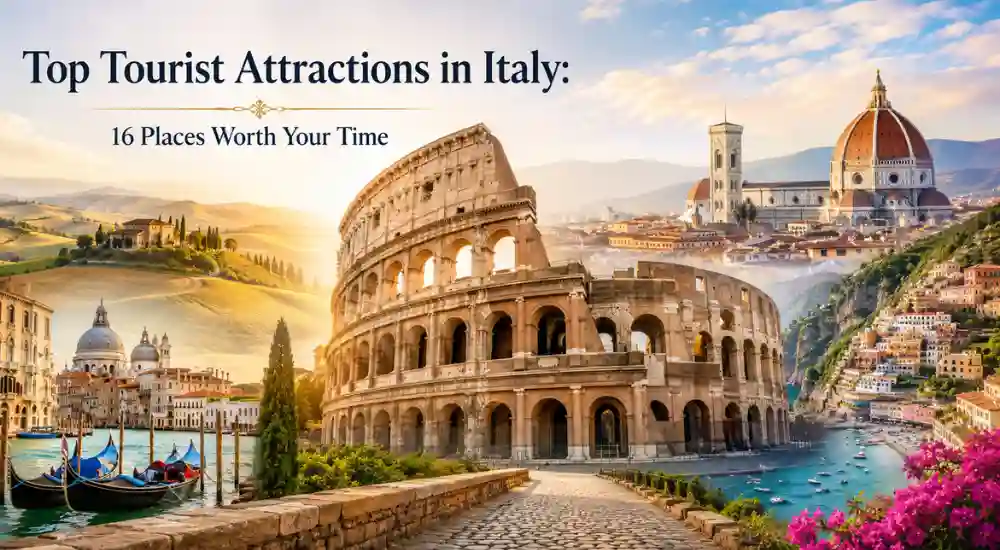
Planning a first trip to Italy creates one obvious problem: far too many places deserve your time. Rome can fill several days by itself, Florence rewards slow museum visits, and Venice is much better when you stop treating it like a race between landmarks.
This guide narrows the top tourist attractions in Italy to 16 places worth building a trip around. More importantly, it explains what deserves several hours, what works as a short stop, which sights should be booked early, and where staying overnight beats a rushed day trip.
If you’re still deciding which destinations belong on your route, explore our guide to the best cities in Italy before finalizing your itinerary.
Quick Answer
For most first-time visitors, the strongest starting point is Rome, Florence, and Venice, with the Colosseum, Florence Duomo, Uffizi Gallery, St. Mark’s area, and Grand Canal forming the cultural core.
With more time, add Pompeii for ancient history, the Amalfi Coast or Cinque Terre for coastal scenery, Lake Como for a slower northern escape, or the Dolomites for mountains and outdoor travel. For route ideas, see this 10-day Italy itinerary.
Italy Attractions at a Glance
Italy’s headline sights vary greatly in size. A landmark such as the Pantheon can fit into a walking route, while destinations such as Lake Como and the Amalfi Coast deserve much more time.
| Place | Region/City | Best For | Suggested Time | Book Ahead? |
|---|---|---|---|---|
| Colosseum & Roman Forum | Rome | Ancient history | 3–4 hours | Yes |
| Pantheon | Rome | Roman architecture | 30–60 minutes | Helpful |
| Trevi Fountain | Rome | Baroque landmark | 20–40 minutes | Depends on access |
| Florence Duomo | Florence | Architecture & views | 2–4 hours | Dome: Yes |
| Uffizi Gallery | Florence | Renaissance art | 2–3 hours | Yes |
| St. Mark’s & Doge’s Palace | Venice | Venetian history | Half day | Recommended |
| Grand Canal & Rialto | Venice | Canal scenery | 1–2 hours | No |
| Pompeii | Campania | Archaeology | 4–6 hours | Recommended |
| Pisa’s Piazza dei Miracoli | Tuscany | Architecture | 2–4 hours | Tower: Yes |
| Amalfi Coast | Campania | Coast & villages | 2–4 days | Transport varies |
| Cinque Terre | Liguria | Villages & hiking | 1–3 days | Trails vary |
| Milan Duomo | Milan | Gothic architecture | 2 hours | Recommended |
| Lake Como | Lombardy | Lakeside towns | 1–3 days | Ferries vary |
| Dolomites | Northern Italy | Mountains | 2–5 days | Seasonal |
| Capri | Campania | Island scenery | Full day–2 days | Ferries vary |
| Matera | Basilicata | History & stone city | 1–2 days | Usually no |
Which Italy Attractions Should You Prioritize?
You don’t need to visit all 16 to have a great Italy trip. In fact, trying to include too many regions is one of the easiest ways to turn a vacation into a series of train stations and hotel check-ins.
For a first visit, build around your strongest interest and available days.
Rome + Florence + Venice
Pompeii
Amalfi Coast or Cinque Terre
Lake Como
Dolomites
Matera
Pisa
Capri
1. Colosseum and Roman Forum: The Best Introduction to Ancient Rome
Few places explain ancient Rome as clearly as the Colosseum, Roman Forum, and Palatine Hill. The arena shows the scale of imperial entertainment, while the Forum reveals the temples, political buildings, and public spaces at the center of Roman life.
Treat them as one major sightseeing block, not three photo stops. If Rome is a major part of your trip, our guide to the best things to do in Rome can help you build the rest of your sightseeing days.
Why It Deserves Your Time
Inside the Colosseum, the structure becomes much easier to understand than it looks from the street. Moving into the Forum afterward gives the arena historical context rather than leaving it as an isolated monument.
Know Before You Go
- Best for: History lovers and first-time Rome visitors
- Time needed: At least 3 hours
- Book ahead: Recommended for preferred entry times
- Terrain: Uneven stone, stairs, and exposed areas
- Summer: Carry water and sun protection
- Good pairing: Capitoline Hill or Monti
2. Pantheon: Rome’s Most Impressive Short Visit
After the sprawling Roman Forum, the Pantheon delivers a completely different encounter with ancient Rome. You can understand its scale in less than an hour, yet its huge concrete dome remains one of the city’s most memorable architectural spaces.
The Pantheon also fits naturally into central Rome sightseeing because it sits close to Piazza Navona, Campo de’ Fiori, and Trevi Fountain.
Don’t Rush Past This Detail
Look upward once you’re inside. The oculus changes the building’s light throughout the day and is one of the details that makes the Pantheon feel so different from Rome’s other ancient landmarks.
3. Trevi Fountain: A Short Stop That Needs Smarter Timing
Trevi Fountain packs monumental Baroque sculpture into a surprisingly small urban space. That’s part of its appeal—and the main reason the area can feel crowded during busy sightseeing hours.
Rather than designing an entire morning around Trevi, include it in a central Rome walking route with the Pantheon and Spanish Steps.
The Better Way to Visit
- Time needed: Around 20–40 minutes for most visitors
- Best for: Architecture and first-time sightseeing
- Crowds: Earlier or later often feels easier than midday
- Pair with: Pantheon, Spanish Steps, Piazza Colonna
4. Florence Duomo: Renaissance Architecture From Street Level to the Dome
Florence’s Cathedral of Santa Maria del Fiore dominates the city’s historic center, but the real attraction is the entire Duomo complex. It includes Brunelleschi’s Dome, Giotto’s Bell Tower, the Baptistery, Opera del Duomo Museum, and Santa Reparata.
The complex is also one of Italy’s defining examples of Renaissance architecture, making it valuable even for travelers who aren’t normally drawn to churches.
Should You Climb Brunelleschi’s Dome?
Yes—if stairs, enclosed spaces, and height aren’t a problem for you. The climb rewards you with both a closer view of the dome’s structure and elevated views across Florence.
Better Planning Tip
Don’t try to finish every Duomo monument in one exhausting block. Spread the complex across your Florence stay when your ticket type allows it.
5. Uffizi Gallery: Florence’s Essential Renaissance Art Stop
If Renaissance art is one of your main reasons for visiting Florence, the Uffizi Gallery belongs near the top of your list. Its collection helps visitors understand how Florentine and Italian art developed across generations.
This is also one attraction where wandering without priorities can cause museum fatigue. Decide which artists and rooms matter most before entering.
6. St. Mark’s Basilica and Doge’s Palace: Venice’s Historic Core
If you only have one serious sightseeing block in Venice, spend it around Piazza San Marco. St. Mark’s Basilica represents Venice’s religious and artistic wealth, while Doge’s Palace reveals the government, justice system, and ceremonial power of the former Venetian Republic.
For more ideas beyond San Marco, explore our full guide to the best things to do in Venice.
Give This Area Half a Day
- St. Mark’s Basilica interior and mosaics
- Doge’s Palace ceremonial rooms
- Bridge of Sighs viewpoints
- St. Mark’s Campanile if time permits
- Riva degli Schiavoni waterfront
- Evening walk after daytime crowds ease
7. Grand Canal and Rialto Bridge: See Venice From the Water
Venice makes more sense once you stop viewing its canals as scenery and start treating them as streets.
The Grand Canal passes palaces, churches, docks, and neighborhoods built around water rather than roads. The Rialto Bridge gives you one of the classic elevated views across this constant movement.
Choose it mainly for the experience and atmosphere.
Better for budget-conscious travelers who also need transportation.
A Better Venice Strategy
- Take a Grand Canal ride
- Walk across Rialto Bridge
- Explore San Polo lanes
- Visit the Rialto market area
- Spend time away from the busiest bridge approaches
8. Pompeii: Italy’s Most Immersive Ancient City
Pompeii isn’t a single monument. It is an ancient city, which is why travelers who budget only an hour or two often underestimate it.
Its streets, homes, temples, baths, public spaces, and surviving decorations make Roman daily life easier to visualize than almost anywhere else.
How Long Do You Actually Need?
Give Pompeii at least four hours. History-focused visitors can easily spend most of a day.
- Wear: Comfortable shoes for ancient paving
- Bring: Water and sun protection in warm weather
- Plan: Follow a realistic route instead of seeing everything
- Best base: Naples or the Sorrento area
9. Leaning Tower and Piazza dei Miracoli: Pisa Is More Than One Photograph
The Leaning Tower of Pisa attracts most visitors, but stopping at the lawn for a photo misses much of what makes the site worthwhile.
The wider Piazza dei Miracoli includes the Tower, Cathedral, Baptistery, Camposanto, and museums. Seeing the entire complex makes Pisa feel far more substantial than a novelty stop.
10. Amalfi Coast: Cliffside Towns, Sea Views, and Slow Travel
The Amalfi Coast is a destination rather than one monument, which is why it deserves more time than many rushed itineraries give it.
Positano, Amalfi, and Ravello each offer a different experience. Positano is steep and dramatic, Amalfi is useful for regional connections and historic sightseeing, while Ravello trades the waterfront for gardens and elevated views.
Don’t Treat It Like Three Photo Stops
- Stay at least two nights when possible
- Choose one main base instead of moving luggage daily
- Use ferries when seasonal services suit your route
- Expect buses and roads to be busy during popular periods
- Check sea conditions before relying on boats
11. Cinque Terre: Five Villages Connected by Trains and Trails
Cinque Terre works best when you understand what it isn’t: a road-trip destination.
The five villages—Monterosso, Vernazza, Corniglia, Manarola, and Riomaggiore—are far easier to explore by train, boat, and foot than by trying to drive between them.
One Day or Overnight?
You can see several villages in one day, but one or two nights makes the region much more relaxed and lets you enjoy mornings and evenings outside the busiest visitor periods.
12. Milan Duomo and Rooftops: Gothic Architecture at Eye Level
Milan’s Duomo gives you something Florence’s cathedral doesn’t: the chance to walk among Gothic spires, statues, buttresses, and marble details high above the square.
The cathedral interior is impressive, but for many visitors the rooftop terraces are the part that makes the stop memorable.
13. Lake Como: Ferries, Villas, and a Slower Northern Italy Pace
The easiest mistake at Lake Como is trying to “complete” it.
Instead, choose two or three towns and let the ferry network shape the day. Varenna, Bellagio, and Menaggio form a practical central-lake combination without forcing you to chase every famous village.
Convenient for rail arrivals and waterfront walks.
Famous lanes, lake views, and central ferry connections.
A useful west-shore base with another perspective across the lake.
Yes if you want several towns without rushing.
14. The Dolomites: Italy’s Best Mountain Escape
The Dolomites prove that Italy is much more than historic cities and coastlines.
Jagged limestone peaks rise above valleys, alpine villages, hiking routes, ski areas, and mountain passes. Places such as Tre Cime, Cortina d’Ampezzo, Val Gardena, and Alta Badia can each anchor a trip.
Who Should Add the Dolomites?
- Hikers
- Mountain photographers
- Scenic-road travelers
- Cable-car viewpoint seekers
- Alpine village travelers
- Ski and winter-sport visitors
15. Capri and the Faraglioni: A Classic Island Escape
Capri makes sense when you want an island break without moving far from mainland Campania.
The Faraglioni sea stacks, Capri Town, Anacapri, gardens, cliffs, and coastal viewpoints give the island more variety than a quick boat excursion suggests.
For a deeper planning guide, see our full list of things to do in Capri, Italy.
Day Trip vs. Overnight
A day trip from Naples or Sorrento can work, especially when ferry schedules line up well. Staying overnight, however, gives you quieter streets, sunset views, and a less hurried morning.
Choose Two or Three Priorities
- Capri Town
- Anacapri
- Faraglioni viewpoints
- Gardens of Augustus area
- Coastal boat experience
- Higher island viewpoints
16. Matera’s Sassi: Southern Italy’s Ancient Stone City
Matera offers one of the strongest contrasts to northern Italy’s museums and grand cathedrals.
The Sassi contain houses, churches, monasteries, and other spaces developed around natural caves and rock-cut architecture.
Why Stay Overnight?
- Walk both Sassi districts
- Enter rock churches where accessible
- Explore viewpoints across the ravine
- See the stone landscape near sunset
- Experience the old city after day visitors leave
Bonus Near Rome: Vatican City
Vatican City is not part of Italy. It is an independent sovereign state surrounded by Rome, so it isn’t counted among the 16 Italian attractions above.
However, many first-time Rome itineraries naturally include the Vatican Museums, Sistine Chapel, and St. Peter’s Basilica. If Rome is one of your main bases, reserve at least half a day for the area.
Don’t Overlook Sicily
If your trip extends into southern Italy, Sicily deserves more than a passing mention.
Two headline experiences are Mount Etna and the archaeological heritage around Agrigento. Beach travelers should also explore our guide to the best beaches on Sicily, Italy.
Best for volcanic scenery, geology, and outdoor exploration.
A major ancient Greek archaeological experience near Agrigento.
Best Italy Attractions by Traveler Type
| Traveler | Strongest Choices |
|---|---|
| First-time visitors | Rome, Florence, Venice |
| Ancient-history lovers | Colosseum, Roman Forum, Pompeii, Pantheon |
| Art lovers | Uffizi, Florence Duomo, Venice |
| Couples | Venice, Amalfi Coast, Lake Como, Capri |
| Families | Rome, Pompeii, Pisa, Lake Como |
| Outdoor travelers | Dolomites, Cinque Terre, Amalfi Coast |
| Photographers | Venice, Matera, Dolomites, Lake Como |
| Slow travelers | Matera, Lake Como, Amalfi Coast |
| Limited-mobility travelers | Plan attraction by attraction before booking |
| Budget-focused visitors | City walks, public transport, regional rail, selective paid sights |
Which Attractions Should You Book First?
Not every famous Italian sight needs months of planning, but capacity-controlled attractions deserve priority.
- Colosseum — timed admission
- Brunelleschi’s Dome — reserved climb time
- Uffizi Gallery — useful for preferred times
- Pompeii — advance planning is sensible in busy periods
- Leaning Tower of Pisa — limited timed admission
- St. Mark’s Basilica — timed booking options available
How Many Days Do You Need for Italy’s Top Attractions?
Pick two major bases, such as Rome + Florence or Florence + Venice.
Rome + Florence + Venice plus one carefully selected extra stop.
Add one slower region such as Amalfi, Lake Como, Dolomites, Matera, or Sicily.
Use extra days to reduce rushing, not simply increase hotel changes.
Getting Around Italy’s Major Attractions
Use Trains Between Major Cities
Italy’s major city corridor makes rail especially convenient for routes involving Milan, Venice, Florence, Rome, and Naples.
That means a car is usually unnecessary for a classic Rome → Florence → Venice trip.
Rent a Car Selectively
- Rural Tuscany
- Parts of the Dolomites
- Less-connected southern areas
- Countryside itineraries
Use Ferries as Transportation, Not Just Sightseeing
Ferries can be a major part of trips around Lake Como, the Amalfi Coast, and Capri. Confirm current service before relying on a ferry for an important connection.
Best Time to Visit Italy’s Major Attractions
There isn’t one perfect month for every part of Italy. Match the season to your mix of cities, coasts, islands, or mountain activities.
Good for city walking and many coastal trips.
Long days, but also stronger heat and high visitor demand.
Useful for combining cities, coastlines, and outdoor sightseeing.
Cities remain appealing, while mountain and coastal logistics need more flexibility.
Practical Mistakes First-Time Italy Visitors Should Avoid
Trying to See Too Much
Four cities in five days doesn’t mean you’ve experienced four cities. Build in enough time to walk, eat, rest, and enjoy each destination.
Booking Hotels Before Designing the Route
Choose your travel sequence first, then book accommodation around it.
Assuming Every Famous Attraction Needs Half a Day
Trevi Fountain and the Pantheon fit into walking routes. Pompeii requires a much larger block of time.
Driving Where Trains Work Better
A rental car can add unnecessary stress in Rome, Florence, Venice, and Milan.
Ignoring Physical Demands
Dome climbs, ancient stone streets, mountain trails, and Matera’s steep lanes require different levels of mobility and fitness.
Using Old Screenshots for Transport
Ferry, seasonal bus, mountain lift, and trail information can change. Check current schedules close to your travel date.
FAQs About the Top Tourist Attractions in Italy
What are the top tourist attractions in Italy for first-time visitors?
For most first trips, prioritize the Colosseum and Roman Forum, Florence Duomo, Uffizi Gallery, St. Mark’s area, Grand Canal, and Pompeii.
Then add one landscape-focused destination such as the Amalfi Coast, Cinque Terre, Lake Como, or the Dolomites if your schedule allows.
What is the number one tourist attraction in Italy?
There isn’t one answer for every traveler, but the Colosseum is one of the strongest choices for a first visit because it combines famous architecture, ancient history, and easy access to the Roman Forum.
How many days are enough for a first trip to Italy?
Ten days works well for a focused multi-city trip. With 14 days, you can slow the pace and add a coast, lake, mountain, island, or southern destination.
Should I visit Rome, Florence, or Venice first?
Choose Rome for ancient history, Florence for Renaissance art, and Venice for canals and a unique urban experience.
Do I need a rental car to see Italy’s main attractions?
Usually not for Rome, Florence, Venice, Milan, Naples, and Pisa. A car becomes more useful in rural Tuscany, the Dolomites, and less-connected countryside areas.
Which Italy attractions should I reserve in advance?
Prioritize the Colosseum, Brunelleschi’s Dome, Uffizi Gallery, Pompeii, Leaning Tower of Pisa, and St. Mark’s Basilica when you want a specific date or entry time.
Is Vatican City one of Italy’s tourist attractions?
No. Vatican City is an independent sovereign state surrounded by Rome.
It still fits naturally into most first-time Rome itineraries because of the Vatican Museums, Sistine Chapel, and St. Peter’s Basilica.
What is the best Italy attraction for families?
It depends on children’s ages and interests. Older children interested in history may enjoy Pompeii or the Colosseum, while Lake Como, Venice, and Pisa can provide more variety and movement.
Which Italy attraction is best for nature lovers?
Choose the Dolomites for mountain scenery and hiking, or Cinque Terre for coastal villages and trails. Sicily’s Mount Etna is another strong choice for volcanic landscapes.
Conclusion
The top tourist attractions in Italy aren’t meant to be squeezed into one vacation. The strongest trips usually combine a few major cultural sights with one slower region that matches the way you actually like to travel.
For a first visit, start with Rome, Florence, and Venice. Then choose Pompeii for history, Amalfi or Cinque Terre for the coast, Lake Como for slower scenery, the Dolomites for mountains, Capri for island time, or Matera for southern culture.
The goal isn’t to collect the most famous places. It’s to leave enough time to actually experience the ones you choose.