

Boston is one of those cities where a sightseeing day can change direction without causing a planning disaster. You might start on the Freedom Trail, stop for lunch in the North End, and realize that Faneuil Hall and the waterfront are only a short walk away.
For first-time visitors, the best things to do in Boston are less about checking off every attraction and more about grouping the right experiences together. This guide covers the historic sites, neighborhoods, museums, parks, sports, food, family attractions, seasonal activities, and practical travel decisions that can turn a rushed Boston visit into a much better trip.
Quick Answer: What Should You Do in Boston?
If it’s your first visit, prioritize the Freedom Trail, Boston Common, Public Garden, Beacon Hill, North End, Boston Harbor, Fenway Park, and one major museum.
With more time, add Cambridge, the Black Heritage Trail, Charlestown, the Seaport, or Boston Harbor Islands. Three full days is a comfortable starting point for seeing Boston’s highlights without turning every day into a race.
Best Boston Experiences at a Glance
Not every attraction makes sense for every visitor. Use this quick comparison to decide where your time is best spent.
| Experience | Best For | Time to Allow | Indoor/Outdoor | Book Ahead? |
| Freedom Trail | First visits, history | Half to full day | Mostly outdoor | Optional |
| Beacon Hill & Public Garden | Couples, photos, free sightseeing | 2–3 hours | Outdoor | No |
| North End | Food, history, evening walks | 2–4 hours | Mixed | Dinner often |
| Fenway Park | Sports, Boston culture | 1–3+ hours | Mixed | Recommended |
| MFA | Major art collections | 2–4 hours | Indoor | Helpful |
| Gardner Museum | Art, architecture, atmosphere | 1.5–3 hours | Indoor | Strongly recommended |
| New England Aquarium | Families, rainy days | 2–3 hours | Indoor | Recommended |
| Black Heritage Trail | Deeper Boston history | 1.5–2 hours | Mostly outdoor | Ranger tour: yes |
| Harbor Islands | Nature, summer trips | Half/full day | Outdoor | Recommended |
| Harvard & Cambridge | Universities, architecture | Half day | Mixed | Tour: yes |
Walk the Freedom Trail, but Don’t Rush Every Stop
The Freedom Trail is still the best introduction to historic Boston. The marked 2.5-mile route connects 16 official historic sites, moving from Boston Common through downtown and the North End before finishing in Charlestown.
The mistake many first-time visitors make is trying to enter every building. Unless Revolutionary history is the entire purpose of your trip, choose a few interiors and enjoy the streets between them instead.
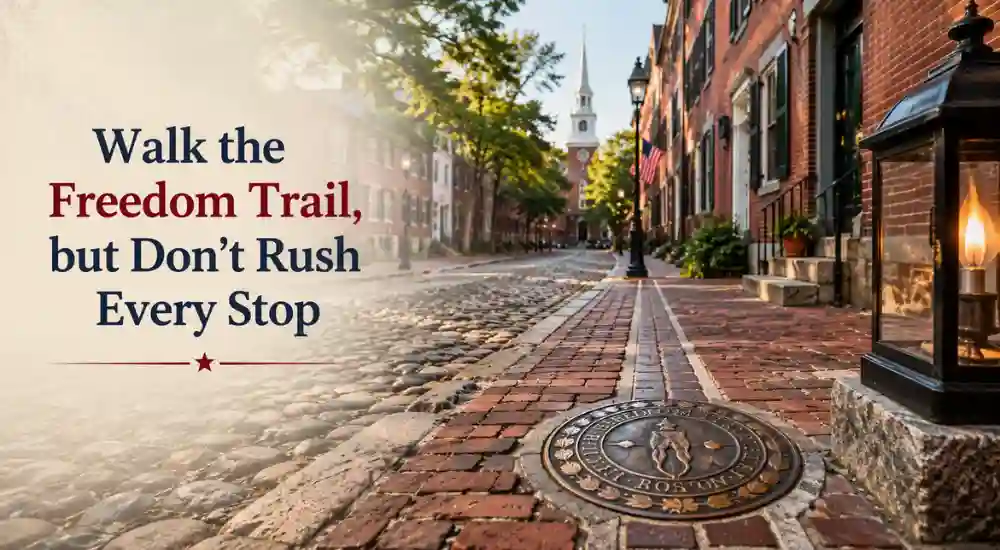
Freedom Trail Stops Worth Prioritizing
• Boston Common — the traditional starting point and an easy connection to Beacon Hill.
• Massachusetts State House — one of the city’s defining historic landmarks.
• Granary Burying Ground — a compact stop connected with several Revolutionary-era figures.
• Old State House — important for understanding colonial Boston and the events surrounding independence.
• Faneuil Hall — easy to combine with lunch, the Greenway, and the waterfront.
• Paul Revere House — a worthwhile interior if Paul Revere’s story interests you.
• Old North Church — among the trail’s most recognizable Revolutionary landmarks.
• USS Constitution — an excellent finale if you continue into Charlestown.
• Bunker Hill Monument — best for travelers who still have energy after the full route.
Practical tip: Don’t schedule a major museum immediately after walking the entire trail. The distance may look short on a map, but historic sidewalks, stops, and standing time make it a much longer experience.
Explore Boston Common, the Public Garden, and Beacon Hill
For an easy introduction to Boston that costs almost nothing, start around Boston Common and the Public Garden. They give you open space between the dense historic streets and are especially pleasant early in the morning.
From the Public Garden, cross into Beacon Hill. This is where Boston’s red-brick image becomes real: narrow streets, Federal-style homes, steep sidewalks, small squares, and gas-style lamps.
Don’t Miss
• Make Way for Ducklings statues if you’re visiting with children.
• Swan Boats when they are operating seasonally; the 2026 season opened April 18.
• Charles Street for small shops and cafes.
• Louisburg Square for classic Beacon Hill architecture.
• Acorn Street if you want the famous cobblestone view.
Beacon Hill remains a residential neighborhood, so treat it like one. Take photos from public areas, keep entrances clear, and don’t step onto private stoops or property for a better angle.
Best Time to Go
Early morning is ideal for quieter streets and photography. Late afternoon works well if you’re continuing toward the Esplanade or Back Bay afterward.
Eat Your Way Through the North End
The North End is where a history-focused day can slow down over pasta, espresso, pastries, seafood, and old neighborhood streets. It also overlaps naturally with some of the most interesting Freedom Trail stops.
Don’t make the visit only about finding one famous cannoli. Give yourself time to wander between Hanover Street, Salem Street, Old North Church, Paul Revere Mall, and the smaller side streets.
A Better North End Plan
Start with historical sightseeing, then stop for lunch or an afternoon snack. If you’re coming for dinner, book a restaurant that matters to you rather than joining the longest line you happen to see.
Pair the neighborhood with:
• Paul Revere House
• Old North Church
• Copp’s Hill area
• Boston Public Market
• Faneuil Hall
• Christopher Columbus Waterfront Park
Food tip: Boston Public Market near Haymarket is a useful indoor stop for travelers who want New England ingredients and prepared food without committing to a long restaurant meal.
Walk From Faneuil Hall to the Greenway and Harbor
One of Boston’s easiest free sightseeing routes begins around Faneuil Hall, crosses the Rose Kennedy Greenway, and ends along the waterfront.
What makes this walk worthwhile is the contrast. Within a relatively short distance, colonial streets give way to landscaped green space, public art, modern Boston, and open water.
What to See Along the Way
• Browse Faneuil Hall and Quincy Market, but don’t plan an entire day around them.
• Walk sections of the Rose Kennedy Greenway for gardens and seasonal installations.
• Continue toward Long Wharf for harbor views.
• Follow part of the Boston Harborwalk rather than attempting the entire route.
• Add the New England Aquarium if rain or extreme temperatures change your plans.
Around sunset, waterfront walks become especially appealing. Even during warmer months, carry a light layer because harbor breezes can feel cooler than inland streets.
Experience the Boston Tea Party, Seaport, and Children’s Museum

The Boston Tea Party Ships & Museum works best for travelers who prefer interactive history to reading plaques. Its presentation makes the events surrounding the Tea Party easier to follow, especially for families with school-age children.
The nearby Seaport and Fort Point districts provide a sharp contrast to colonial Boston. You’ll find waterfront paths, modern architecture, contemporary art, restaurants, and family attractions.
Traveling With Kids?
The Boston Children’s Museum deserves much stronger consideration than it gets on many adult-focused Boston lists. It is especially useful on rainy, very hot, or cold days when young children need hands-on activities instead of another long walking tour.
For summer 2026, the museum is operating daily summer hours and advises families to plan around heavy waterfront crowds and major events.
Nearby Pairings
• Boston Tea Party Ships & Museum
• Boston Children’s Museum
• Fort Point Channel
• Institute of Contemporary Art
• Seaport waterfront
• Harborwalk
Trying to do every one of these is unnecessary. Families should usually choose one major indoor attraction and leave enough time for outdoor breaks.
Visit the New England Aquarium or Go Whale Watching
The New England Aquarium is a reliable family attraction and one of the easiest indoor anchors for a Boston waterfront day. It becomes particularly valuable when rain disrupts plans built around walking.
Advance tickets are worth considering because the Aquarium says weekends can sell out. It also operates seasonal whale watches from Central Wharf.
Aquarium or Whale Watch?
Choose the Aquarium if:
• You have younger children.
• Your schedule is tight.
• Weather looks uncertain.
• You want an indoor experience.
Choose a whale watch if:
• You can dedicate much of a half-day.
• You’re visiting during the operating season.
• You enjoy boat trips and wildlife experiences.
• Offshore conditions won’t ruin the experience for you.
The Aquarium’s 2026 whale-watch season began in May, with boats heading toward Stellwagen Bank National Marine Sanctuary. Wildlife sightings and sea conditions naturally vary.
Tour Fenway Park or See a Red Sox Game
You don’t need to follow baseball closely to understand why Fenway Park matters to Boston. The small scale, neighborhood setting, old grandstands, Green Monster, and game-day streets make it feel woven into the city rather than placed there for tourists.
If the Red Sox are home, a game delivers the fullest atmosphere. If they’re away—or you simply want the history without spending an entire evening at the ballpark—take a stadium tour.
Official Fenway tours operate year-round, with the standard public tour lasting about 60 minutes. Access can vary around games, concerts, and other events.
What to Pair With Fenway
Fenway sits close enough to several major cultural attractions to build a full day around the neighborhood:
• Museum of Fine Arts
• Isabella Stewart Gardner Museum
• Back Bay Fens
• Kenmore Square
• Lansdowne Street
First-timer tip: Don’t combine Fenway, both major art museums, and a Red Sox game unless your goal is a very long day. Pick one museum and leave breathing room.
Choose the MFA or Isabella Stewart Gardner Museum
Boston’s two best-known art museums deliver very different experiences, so short-stay travelers don’t need to automatically visit both.
The Museum of Fine Arts, Boston (MFA) is the better choice when you want breadth. The collection spans cultures, centuries, and media, and you can easily spend several hours there.
The Isabella Stewart Gardner Museum feels smaller, stranger, and more personal. Its palace-like rooms, courtyard, and distinctive display style make the building part of the experience.

MFA vs. Gardner Museum
| Choose | Best If You Want |
| MFA | Large collections, variety, several hours of art |
| Gardner | Architecture, atmosphere, intimate galleries |
| Both | A dedicated art-focused day |
The Gardner currently recommends advance timed tickets because popular entry periods can sell out. It is closed Tuesdays and has extended Thursday hours.
The MFA is also closed Tuesdays under its current schedule.
Explore Copley Square, Boston Public Library, and Newbury Street
Back Bay offers a good change of pace after Boston’s Revolutionary sites. Begin at Copley Square, where historic and modern architecture sit within a few blocks.
The standout free interior is the Boston Public Library’s Central Library. It is worth visiting even if you have no interest in borrowing a book.
You can explore the library independently for free, while official art and architecture tours are offered on selected dates with advance registration.
Build a Back Bay Walk
A simple route could include:
Copley Square → Boston Public Library → Newbury Street → Commonwealth Avenue Mall → Public Garden
This works particularly well when you want a flexible half-day with cafes, architecture, shopping, and indoor weather backups.
Newbury Street changes character as you walk. Don’t feel obliged to shop; the brownstones and side streets are part of the appeal.
Follow the Black Heritage Trail for a Deeper Boston Story
Visitors who only follow Revolutionary history leave Boston with an incomplete picture of the city.
The Black Heritage Trail explores the free Black community that lived around Beacon Hill’s north slope and played major roles in abolition, education, the Underground Railroad, and struggles for civil rights.
The trail is roughly 1.4–1.5 miles and can be explored independently. For the 2026 season, ranger-led tours run Wednesday through Sunday through September 27, with advance registration required.
Important Stops and Themes
• Robert Gould Shaw and 54th Massachusetts Regiment Memorial
• Abolition and antislavery organizing
• Underground Railroad history
• African Meeting House
• Abiel Smith School
• Beacon Hill’s historic Black community
Allow around 90 minutes for a ranger-led tour.
The route includes narrow and uneven sidewalks in places, so travelers with mobility concerns should review current accessibility guidance before going.
Finish the Freedom Trail in Charlestown
Plenty of visitors reach the North End and decide they’ve seen enough of the Freedom Trail. If you’re interested in military or maritime history, continuing into Charlestown is worth the additional walking.
The major stops are USS Constitution, the USS Constitution Museum, Charlestown Navy Yard, and Bunker Hill Monument.
Know Before You Go
USS Constitution remains an active commissioned U.S. Navy ship. Visitors go through security, and adults should be prepared to show valid government-issued photo identification.
As of August 20, 2026, nearby USS Cassin Young is closed for Pier One maintenance and is tentatively expected to reopen near the end of August. Check its current status before making it a reason to visit Charlestown.
This is exactly the kind of Boston area where old paving, steps, ship access, and long walking distances matter. Travelers with mobility needs should verify individual attraction accessibility before arriving.
Slow Down on the Charles River Esplanade
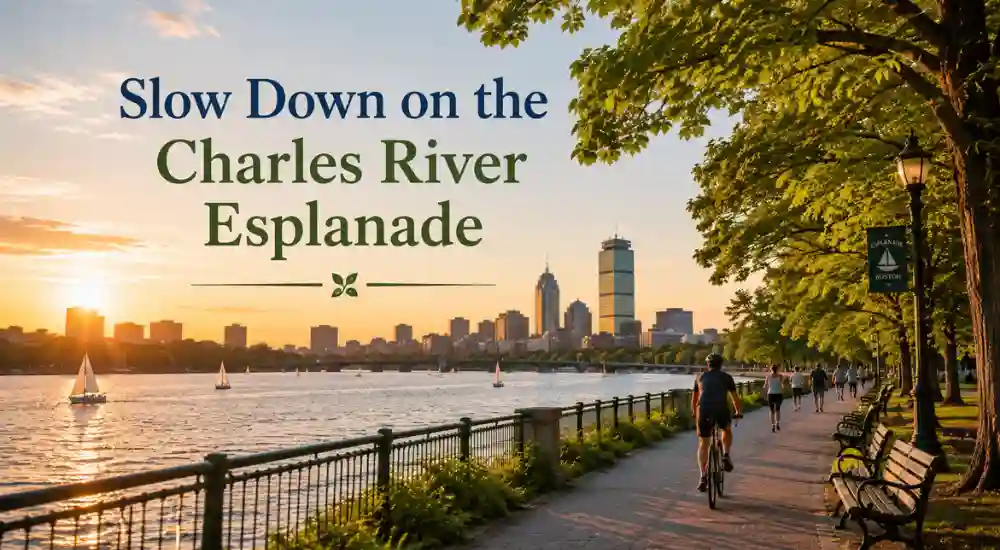
After several hours inside museums or historical buildings, the Charles River Esplanade can be an easy reset. There is no exhibit schedule to follow and no pressure to complete a route.
Come here for riverside walking, jogging, cycling, picnics, skyline views, or simply a quieter hour outside.
When the Esplanade Works Best
Morning: cooler walking and running conditions.
Late afternoon: easy to combine with Back Bay or Beacon Hill.
Sunset: river views become the main attraction.
During summer, bring water and sun protection. In colder months, exposed conditions along the river can feel noticeably colder than nearby streets.
If cycling, remember that the paths are shared with walkers and runners. Ride at a comfortable speed when sections become busy.
Cross Into Cambridge for Harvard, MIT, and Harvard Square
Boston itself can easily fill three days, but Cambridge is the most logical nearby addition for first-time visitors.
Begin around Harvard Square, explore public areas of Harvard’s campus, and leave time for bookstores, cafes, museums, and streets around the university rather than treating Harvard Yard as a quick photo stop.
Official Harvard student-led historical tours run around 45–60 minutes and require advance registration. Harvard also offers self-guided options for visitors who prefer flexibility.
Harvard or MIT?
Choose Harvard for:
• Historic campus atmosphere
• Harvard Square
• Traditional architecture
• University history
Choose MIT for:
• Modern architecture
• Science and technology culture
• Kendall Square
• A different view of Cambridge
With half a day, focus on one campus and its surrounding neighborhood. Trying to see both universities deeply in a couple of hours usually produces more transit than experience.
Take a Ferry to the Boston Harbor Islands
If you’re visiting in warm weather and already have two or three city days, the Boston Harbor Islands offer one of the clearest changes of scenery without leaving the Boston area.
Public ferries operate seasonally from May through October in 2026, with separate spring, summer, and fall schedules.
Which Island Should You Choose?
Spectacle Island is the easiest choice for travelers seeking trails, open space, harbor views, and a straightforward outing from downtown Boston.
Georges Island suits visitors interested in Fort Warren and military history.
Peddocks Island takes more planning and works better for travelers specifically interested in a less urban island experience.
Harbor Islands Tips
• Reserve ferry tickets early for popular summer dates.
• Check the return schedule before exploring.
• Bring water and sun protection.
• Pack a layer for changing harbor weather.
• Wear shoes that can handle uneven ground.
• Never enter closed structures or restricted areas.
• Recheck ferry information shortly before departure.
Ferry service occasionally changes around major harbor events, which happened during Sail Boston in July 2026.
Explore Boston Beyond the Main Tourist Route
Boston’s historic core deserves attention, but it isn’t the whole city. Travelers with an extra day should spend time in neighborhoods where everyday culture matters more than landmark collecting.
Chinatown is easy to reach from downtown and works well for food-focused travelers. The South End adds brownstone streets, dining, galleries, and a more residential feel.
Other neighborhoods may appeal depending on your interests, including Jamaica Plain, Dorchester, Roxbury, East Boston, and Allston-Brighton.
Official Boston tourism resources emphasize the city’s broader neighborhood, Black, Latinx, and Asian cultural experiences rather than treating Boston only as a Revolutionary-era destination.
The goal isn’t to squeeze five additional neighborhoods into a short trip. Choose one that matches your interests and give it enough time to feel different from downtown.
Best Free Things to Do in Boston
Boston can become expensive quickly if every day includes museum tickets, tours, games, and boat trips. Fortunately, several of the city’s defining experiences cost nothing outdoors.
Some of the strongest free options include:
• Walk the Freedom Trail route independently.
• Explore Boston Common.
• Wander through the Public Garden.
• Walk Beacon Hill from public streets.
• Explore the Rose Kennedy Greenway.
• Follow part of the Boston Harborwalk.
• Visit the Boston Public Library.
• Walk the Charles River Esplanade.
• Explore Harvard Square and permitted campus spaces.
• Follow the Black Heritage Trail independently.
• Walk around Copley Square and Back Bay.
• Explore public areas of the Charlestown Navy Yard.
Remember that a free trail does not mean every museum or historical building along it has free admission.
Best Things to Do in Boston With Kids
Boston works particularly well for families when adults resist the temptation to make every day a history lesson.
Alternate structured attractions with parks, food stops, waterfront walks, or places where children can move around.
Strong Family Choices
• Boston Children’s Museum for hands-on play.
• New England Aquarium for an indoor half-day.
• Public Garden and Make Way for Ducklings statues.
• Seasonal Swan Boats.
• Selected Freedom Trail stops rather than the entire route for young children.
• USS Constitution Museum for maritime history.
• Boston Common for an outdoor break.
• Harbor Islands for older children who enjoy outdoor exploration.
• Boston Public Library Children’s Library as a quieter indoor reset.
• Tea Party Ships & Museum for school-age children interested in history.
Family Planning Tip
Don’t measure a family itinerary by the number of attractions completed.
A day with the Aquarium, Greenway, lunch, and Public Garden may work much better than four museums with tired children.
What to Do in Boston When It Rains
Boston is heavily walkable, which is great until the weather turns.
Instead of losing a day, keep two or three indoor options available and move outdoor neighborhoods to another part of the trip.
Best Rainy-Day Options
• Museum of Fine Arts
• Isabella Stewart Gardner Museum
• New England Aquarium
• Boston Children’s Museum
• Boston Public Library
• Institute of Contemporary Art
• Boston Tea Party Ships & Museum
• Boston Public Market
Official Boston tourism planning resources maintain a dedicated rainy-day guide, reinforcing how useful weather flexibility is when building a city itinerary.
Light rain doesn’t necessarily ruin the Freedom Trail, but slick brick and uneven paving can make long walking routes less comfortable.
Things to Do in Boston at Night

Boston isn’t a city where every major attraction stays open late, so evenings work better when you plan around sports, performances, food, and neighborhoods.
Good evening choices include:
• Attend a Red Sox game at Fenway.
• See the Celtics or Bruins when their seasons and schedules align.
• Have dinner in the North End.
• Walk the waterfront or Seaport in comfortable weather.
• Check performances in the Theater District.
• Spend an evening around Back Bay.
• Look for museum late-night programs on your travel dates.
Don’t assume daytime attraction schedules extend into evening hours. Check any venue that is central to your plans.
How to Get Around Boston Without Wasting Time
Boston is one of the easier major U.S. cities to explore without a rental car. Central neighborhoods are highly walkable, while the MBTA, commonly called the T, connects major visitor areas and Cambridge.
Meet Boston recommends a mix of walking, subway, buses, commuter rail, ferries, and bike options depending on the trip.
When to Walk
Walk between:
• Boston Common and Beacon Hill
• Public Garden and Back Bay
• Faneuil Hall and the waterfront
• North End and downtown
• MFA and Fenway
When Public Transportation Helps
Use transit for longer jumps such as:
• Downtown to Fenway
• Boston to Harvard Square
• Downtown to farther neighborhoods
• Trips where repeated walking would drain your energy
Do You Need a Car?
For a short first-time Boston trip, usually no.
Downtown traffic and parking can add unnecessary stress. A car becomes more useful if Boston is only one stop on a larger New England road trip.
How Many Days Do You Need in Boston?
Three full days gives most first-time visitors the best balance.
Two days can cover the essential historic core and one additional interest. Four days gives you space for Cambridge, museums, Harbor Islands, or neighborhoods without rushing.
A Simple 3-Day Boston Itinerary
Day 1: Historic Boston
Morning
Start at Boston Common and follow the Freedom Trail through downtown.
Afternoon
Continue into the North End for lunch and historic sites.
Evening
Stay in the North End or walk toward the waterfront.
Day 2: Beacon Hill, Back Bay, and Fenway
Morning
Explore the Public Garden and Beacon Hill.
Afternoon
Visit Copley Square and Boston Public Library, then choose the MFA or Gardner Museum.
Evening
Tour Fenway or attend a Red Sox game when available.
Day 3: Choose Your Boston
History
Black Heritage Trail and Charlestown.
Family
Aquarium, Greenway, Children’s Museum, or Public Garden.
Warm Weather
Boston Harbor Islands.
Universities
Harvard Square and Cambridge.
This approach is intentionally flexible. Your third day should reflect what you actually enjoy rather than another universal checklist.
Best Time to Visit Boston
There isn’t one best season for every traveler.
Spring
Best for: walking, flowers, baseball, moderate sightseeing weather.
Spring can change quickly, so keep an indoor backup.
Summer
Best for: Harbor Islands, whale watching, boats, outdoor events, and long daylight hours.
Expect higher visitor demand and occasional heat.
Fall
Best for: walking, cooler temperatures, New England atmosphere, and regional fall trips.
October can be especially popular, so book important accommodations and attractions early.
Winter
Best for: museums, indoor history, sports, holiday trips, and lower-intensity sightseeing.
Cold, wind, snow, and ice can affect walking-heavy plans. Leave extra flexibility when conditions are poor.
First-Time Boston Mistakes to Avoid
A better Boston trip often comes from removing unnecessary plans.
Don’t Try to Enter Every Freedom Trail Site
Choose the interiors that interest you most.
Don’t Put Both Major Art Museums Into a Packed Day
Unless art is your priority, choose the MFA or Gardner.
Don’t Rent a Car Just for Downtown Sightseeing
Walking and public transportation usually make more sense.
Don’t Treat Cambridge as a 30-Minute Photo Stop
Give Harvard Square and the surrounding streets at least half a day if you’re going.
Don’t Forget How Much Walking Adds Up
Boston looks compact because it is compact. That doesn’t mean your feet won’t notice 20,000 steps.
Don’t Build a Ferry Day Without Checking the Return
Island transportation is schedule-dependent.
Don’t Ignore Weather Backups
Keeping one museum or indoor attraction flexible can save an entire afternoon.
FAQs About Things to Do in Boston
What Is Boston Most Famous For?
Boston is best known for Revolutionary American history, the Freedom Trail, prestigious universities, Fenway Park, historic neighborhoods, museums, and its waterfront.
The city also has deeper Black history, contemporary cultural neighborhoods, parks, food traditions, and easy access to New England day trips.
Is Boston Worth Visiting for a Weekend?
Yes. Boston is especially well suited to a two- or three-day city break because many major attractions sit close together.
For a weekend, prioritize the Freedom Trail, Beacon Hill, North End, waterfront, and one interest such as Fenway or a museum.
Can You Walk the Freedom Trail for Free?
Yes. You can follow the marked Freedom Trail route without paying for a guided tour.
However, some museums and historic interiors along the route charge admission or operate separate schedules.
Is Boston Easy to Visit Without a Car?
Yes. Walking and public transportation cover most attractions that first-time visitors prioritize.
A car is usually more useful for regional day trips than central Boston sightseeing.
What Is the Best Free Thing to Do in Boston?
For first-time visitors, walking the Freedom Trail delivers the most historical value without requiring an admission ticket for the outdoor route.
Boston Common, Public Garden, Beacon Hill, Harborwalk, Esplanade, and Boston Public Library are also strong free choices.
What Should Families Do in Boston?
The strongest family options include the Boston Children’s Museum, New England Aquarium, Public Garden, Swan Boats in season, Boston Common, USS Constitution Museum, and selected Freedom Trail stops.
Build shorter activity blocks for younger children rather than expecting them to enjoy an entire day of historical walking.
What Should You Reserve Ahead in Boston?
Consider advance reservations for Fenway tours, Gardner Museum timed entry, New England Aquarium tickets, seasonal ferries, whale watches, Harvard tours, and ranger-led Black Heritage Trail tours when those experiences are important to your trip.
Requirements change, so verify the official attraction page shortly before traveling.
Final Thoughts
The best things to do in Boston aren’t scattered randomly across the map. Many of the city’s strongest experiences naturally fit together: the Freedom Trail leads toward the North End, Beacon Hill connects with the Public Garden, Fenway pairs with major art museums, and the harbor creates an entirely different sightseeing day.
For a first trip, choose three or four experiences you care about most and build nearby attractions around them. Leave enough room for a long lunch, an unexpected historic stop, or an evening walk by the water. Boston is compact enough to see a lot—but it becomes a much better city when you don’t try to see everything at once.