

My first hostel bed in Hanoi cost six dollars a night and came with a free bowl of pho for breakfast — cheaper than the airport coffee I’d bought twelve hours earlier. That gap, between what a trip “should” cost and what it actually costs somewhere like Vietnam, is the whole reason this guide exists.
Picking one of the cheapest countries to visit in 2026 isn’t about settling for less. It’s about finding the places where a modest budget still buys a genuinely great trip: fresh street food, mountain treks, ancient ruins, and coastlines that haven’t been priced for a Western European crowd yet.
This guide covers 16 countries across six regions, with real daily budget ranges, visa basics, and the season that makes each one cheaper and more comfortable to visit. No vague “affordable” marketing language — just the numbers, the timing, and the practical details that change how much your trip actually costs.
Quick Answer
Vietnam, Cambodia, Laos, Nepal, Bolivia, and Albania are among the cheapest countries to visit in 2026, with realistic daily budgets between $20 and $45 for food, lodging, and local transport. The single biggest variable isn’t the destination — it’s the flight. A $25-a-day country can end up costing more overall than a $45-a-day country if the airfare is double, so total trip cost matters more than the daily number alone.
TL;DR: Fast Facts
- Southeast Asia remains the cheapest region overall, often $20–$35 a day
- Albania and Georgia are Europe’s best-value picks for 2026
- Guatemala and Bolivia lead budget travel in Latin America
- Most destinations on this list don’t require a US visa purchased in advance — but rules change often, so verify before booking
- Shoulder-season travel cuts both flight and hotel prices, sometimes by 30% or more
- Compare total trip cost (flight + ground costs), not daily budget in isolation
Cheapest Countries to Visit in 2026: Comparison Table
Use this table to jump straight to the region that fits your budget and travel style. Full details for each country follow below.
| Country | Region | Daily Budget (USD) | US Visa Status | Best Months |
| Vietnam | Southeast Asia | $20–$35 | E-visa required | Mar–May, Sep–Nov |
| Thailand | Southeast Asia | $25–$40 | Visa-free, 60 days | Nov–Feb |
| Cambodia | Southeast Asia | $20–$25 | Visa on arrival | Nov–Feb |
| Laos | Southeast Asia | $20–$25 | Visa on arrival | Nov–Feb |
| Nepal | South Asia | $25–$35 | Visa on arrival | Mar–May, Sep–Nov |
| Sri Lanka | South Asia | $30–$45 | E-visa (ETA) | Dec–Mar |
| India | South Asia | $20–$35 | E-visa required | Nov–Feb |
| Indonesia | Southeast Asia | $25–$40 | Visa-free, 30 days | Apr–Oct |
| Guatemala | Central America | $25–$40 | Visa-free, 90 days | Nov–Apr |
| Belize | Central America | $35–$55 | Visa-free, 30 days | Nov–Apr |
| Bolivia | South America | $25–$40 | Visa required | May–Sep |
| Peru | South America | $30–$50 | Visa-free, 90 days | May–Sep |
| Colombia | South America | $30–$45 | Visa-free, 90 days | Varies by region |
| Albania | Europe | $30–$45 | Visa-free, extended stay | May, Jun, Sep |
| Georgia | Caucasus | $25–$40 | Visa-free, extended stay | Apr–Jun, Sep–Oct |
| Morocco | North Africa | $30–$45 | Visa on arrival | Mar–May, Sep–Nov |
Note: Visa rules and stay limits change more often than most guides admit. Always confirm current requirements on the destination’s official immigration or embassy website within a few weeks of travel — not from any single blog post, including this one.
What Actually Makes a Country Cheap Right Now
A country becomes genuinely cheap to visit when two things line up at once: low local cost of living and an exchange rate that favors your currency. When both happen together, that’s when a $25-a-day trip becomes realistic rather than aspirational.
Flights are the variable most budget guides underplay. A country with rock-bottom ground costs can still end up pricier overall than a slightly more expensive destination with a direct, discounted flight route. Before locking in a country, price out the full trip, not just the daily spend.
A few forces are shaping 2026 specifically:
- Currency swings have made parts of Southeast Asia, South Asia, and Latin America noticeably cheaper for US dollar holders than they were two or three years ago
- New budget airline routes have opened cheaper access to places that used to require expensive connecting flights
- Growing hostel and homestay networks are keeping accommodation costs low even as tourism numbers rise
- Countries with simple e-visa or visa-free entry save both money and planning time compared to embassy-visa destinations
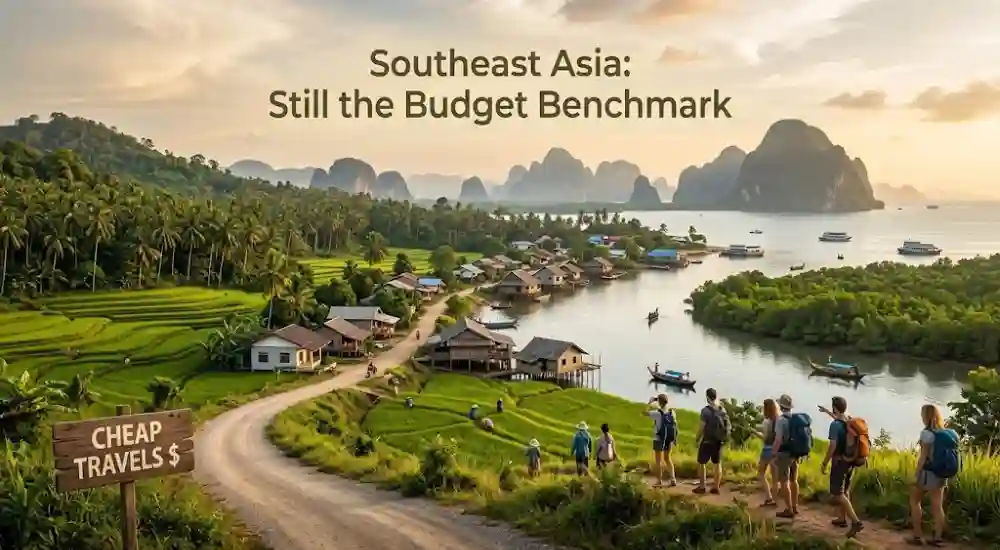
Southeast Asia: Still the Budget Benchmark
If you’re new to international budget travel, Southeast Asia is the region that makes the math feel almost unfair — in a good way. Comfortable trips here regularly run under $35 a day, including food and lodging.
Vietnam: The Best Overall Value in the Region
Vietnam tops most budget-travel lists for a simple reason: the quality-to-cost ratio is hard to beat anywhere else in the world. A bowl of pho runs under $2, and a clean, private guesthouse room typically costs $10 to $15 a night.
Daily budget: $20–$35, food and lodging included. Best for: First-time long-haul travelers who want variety — cities, mountains, and coastline — without country-hopping.
- Hanoi’s Old Quarter for street food stalls and lakeside walks
- Ha Long Bay for a budget overnight boat trip through limestone karsts
- Hoi An’s ancient town for lantern-lit evenings and same-day tailoring
- Sapa’s rice terraces for multi-day trekking on a shoestring
- Visa note: US travelers need an e-visa in advance. Vietnam’s exemption list was revised more than once in 2026, so check the official immigration portal, not a forum post, before booking flights.
Thailand: The Easiest Entry Point
Thailand pairs low costs with genuinely good infrastructure, which is why it’s often recommended as a first international trip. Buses, trains, and domestic flights connect the country well enough that first-timers rarely feel stranded.
As of 2026, US travelers get 60 days visa-free, with a possible 30-day extension inside the country — a real advantage if you want a slower, longer trip instead of a rushed two-week loop.
Daily budget: $25–$40, depending on how much you island-hop.
| Region | What It’s Known For | Budget Fit |
| Bangkok | Temples, street food, river transport | Great value city base |
| Chiang Mai | Slower pace, cooking classes | Lower cost than Bangkok |
| Krabi & southern islands | Beaches | Higher in peak season |
| Isaan | Local culture, few tourists | Cheapest region in the country |
Cambodia and Laos: Even Lower, Even Quieter
Cambodia and Laos sit just below Thailand and Vietnam on cost, with daily budgets that can dip toward $20–$25 away from the biggest tourist towns. Both reward a slower pace over a rushed highlight-reel itinerary.
Cambodia centers naturally around Angkor Wat, near Siem Reap — one of the few “bucket list” sites anywhere that still costs less to visit than a weekend in most US cities. Laos, by contrast, rewards travelers who want quiet river towns and mountain scenery with a fraction of the crowds of its neighbors.
- Phnom Penh for history and riverside cafés
- Luang Prabang’s morning alms-giving ceremony and night markets
- Vang Vieng for budget tubing and karst scenery
- Visa note: Visa-on-arrival is common for US citizens in both countries — bring passport photos and small-denomination cash for the fee.
South Asia: Dense, Diverse, and Deeply Affordable
South Asia packs an enormous amount of history, scenery, and culture into some of the lowest travel costs on the planet. It also demands a bit more planning patience than Southeast Asia, since distances and logistics are bigger.
Nepal: Mountains at a Fraction of the Usual Price
Nepal offers some of the most dramatic scenery anywhere at a cost that would be unthinkable in the Alps or the Rockies. Kathmandu’s temple squares and Pokhara’s lakeside setting both work well on a tight budget, even if you never lace up trekking boots.
Daily budget: $25–$35, including basic teahouse lodging on trekking routes.
Trekking here needs a little extra respect. Altitude sickness becomes a real risk above roughly 2,500 meters, so build in acclimatization days rather than rushing the itinerary. Trekking permits, and in some regions a licensed guide, are required — confirm current rules before you commit to a route.
- Kathmandu’s Durbar Square for old-city temple architecture
- Pokhara for shorter, lower-altitude hikes and lake views
- Annapurna and Everest region treks for experienced hikers with time to acclimatize
Sri Lanka and India: South Asia’s Two Anchors
Sri Lanka and India combine low costs with an enormous density of things to see, which makes both efficient choices if you want a lot packed into one trip. Trains aren’t just transport here — they’re part of the experience.
Sri Lanka fits a compact loop of beaches, hill country, and wildlife into a country roughly the size of West Virginia. India rewards travelers willing to plan around its scale; a two-week trip realistically covers one region well, not the whole country.
- Sri Lanka’s hill-country train through tea plantations
- Galle’s fort town for a walkable coastal history stop
- Kerala’s backwaters for a slower, scenic pace
- Rajasthan’s forts and palaces for architecture and history
- Best months for both: roughly November through February, avoiding peak heat and monsoon rains
Indonesia: Beyond Bali’s Rising Prices
Indonesia’s sheer size means costs vary enormously by island. Bali draws the most visitors and, not coincidentally, now carries the highest prices in the country — Java and Sumatra remain noticeably cheaper.
Daily budget: $25–$40, lower outside Bali’s tourist zones.
If Bali is non-negotiable, areas like Sidemen or Amed cost meaningfully less than Ubud or Seminyak while staying close enough for day trips. Warungs (local eateries) keep meal costs low almost everywhere in the country.
- Yogyakarta for the Borobudur and Prambanan temple complexes
- Lombok and the Gili Islands for quieter beaches than Bali’s main strip
- Visa note: Visa-free entry for US travelers typically runs around 30 days — confirm the current limit before booking, since Indonesia has adjusted exemption terms for several nationalities in the past two years.
Central America: Ruins, Reefs, and a Short Flight

For US-based travelers, Central America solves the “long flight” problem that Southeast Asia and South Asia can’t. Guatemala and Belize deliver Mayan ruins, volcanoes, and Caribbean coastline within a few hours of most US gateway cities.
Guatemala: Central America’s Best Daily Value
Guatemala tends to run cheaper day to day than almost anywhere else in the region. Chicken buses — retrofitted former US school buses — are famously cheap, if crowded, and remain the backbone of budget travel here.
Daily budget: $25–$40. Standout stops: Antigua’s colonial streets and volcano-view cafés, Lake Atitlán’s string of distinct lakeside villages, Tikal’s ruins rising above the jungle canopy, and the turquoise pools of Semuc Champey.
Visa note: US citizens don’t need a visa for stays up to 90 days. That said, entry rules shift periodically across Central America’s CA-4 agreement countries, so a quick check before departure is worth the two minutes it takes.
Belize: A Pricier, English-Speaking Alternative
Belize costs more than Guatemala day to day, but still undercuts most Caribbean islands significantly. English as the official language and a laid-back island pace (especially around Caye Caulker) make it a comfortable choice for first-time budget travelers who want less of a culture-shock learning curve.
South America: Altitude, Ruins, and the Continent’s Best Value
Bolivia and Peru: The Andes Without the Alps Price Tag
Bolivia and Peru pair some of the most dramatic landscapes on Earth with genuinely low costs. Bolivia is the more affordable of the two; Peru costs slightly more, largely because of Machu Picchu’s popularity and the infrastructure built around it.
Altitude is the honest caveat here. Many top sights — La Paz, Cusco, Lake Titicaca — sit well above 3,000 meters, and altitude sickness is common regardless of fitness level. Build in acclimatization days, especially before any multi-day trek.
Daily budget: $25–$40 (Bolivia), $30–$50 (Peru).
- Uyuni Salt Flats for otherworldly landscape photography
- La Paz’s cable car network and market streets
- Cusco as a base for Machu Picchu and the Sacred Valley
- Booking note: Machu Picchu requires advance ticket reservations with a daily visitor cap — this is not a same-day, show-up-and-buy-a-ticket destination.
Colombia: From Cautionary Tale to Budget Favorite
Colombia’s reputation has shifted dramatically over the past decade, and it’s now one of Latin America’s most popular budget destinations — walkable colonial cities, coffee-region scenery, and genuinely low costs.
Daily budget: $30–$45.
- Medellín’s Comuna 13 for street art and cable-car neighborhoods
- Cartagena’s walled old city and nearby beaches
- The Coffee Triangle for farm stays and hiking
A practical safety note: ask your hostel or hotel which specific neighborhoods to avoid after dark. It’s a two-minute conversation on arrival, and it matters more than any single blog post, including this one.
Europe on a Budget: Albania, Montenegro, and the Caucasus
Western Europe rarely makes a “cheapest countries” list anymore, but a handful of destinations still deliver European scenery at Southeast Asia–adjacent prices.
Albania: Europe’s Standout Value Pick for 2026
Albania has become the region’s clearest budget winner, offering Adriatic coastline and mountain villages at prices well below neighboring Croatia. Guesthouses often start around $15 to $20 a night.
Daily budget: $30–$45. Best time to go: May, June, or September — avoiding the peak summer crush along the coast.
- Ksamil and the Albanian Riviera for beach time
- Berat’s UNESCO-listed old town of Ottoman-era houses
- Theth for mountain-village hiking in the Albanian Alps
Georgia and Armenia: Europe Meets Asia, Cheaply
Georgia and Armenia remain two of the least crowded, most affordable destinations bridging Europe and Asia. Both combine mountain scenery with wine traditions that predate most of what’s celebrated in Western Europe — Georgia’s Kakheti region has been making wine for roughly 8,000 years.
Daily budget: $25–$40.
- Tbilisi’s old town and sulfur bathhouses
- Kazbegi for mountain views and the Gergeti Trinity Church hike
- Armenia’s Geghard Monastery, carved partly into a mountainside
Marshrutkas (shared minivans) handle intercity travel cheaply, though don’t expect a fixed schedule — they typically leave once full.
North Africa: Morocco and Egypt
Morocco and Egypt combine centuries of history with costs that stay low for both US and European travelers. Morocco suits shorter trips built around a handful of key cities; Egypt rewards travelers willing to plan around its major sites, often including a Nile cruise.
Daily budget: $30–$45 for both.
- Marrakech’s medina and the nearby Atlas Mountains
- Chefchaouen’s blue-painted streets
- Giza’s pyramids and Luxor’s temple complexes along the Nile
Heat is the real planning variable in both countries. Summer temperatures in the desert and the Nile Valley can be extreme, so spring and fall are the more comfortable windows for sightseeing rather than a purely cost-driven decision.
Best Time of Year to Travel Cheap, by Region

Timing shapes your budget almost as much as the destination itself. Shoulder season — the weeks just before or after a region’s busiest months — usually brings lower flights, cheaper hotels, and smaller crowds all at once.
| Region | Best Value Season | Why |
| Southeast Asia | Nov–Apr (varies by country) | Dry season, though exact months shift |
| South Asia | Nov–Feb | Avoids peak heat and monsoon rains |
| Central America | Nov–Apr | Dry season, lower storm risk |
| Andean South America | May–Sep | Dry season at high altitude |
| Balkans & Caucasus | May–Jun, Sep | Avoids summer heat and peak coastal prices |
| North Africa | Mar–May, Sep–Nov | Avoids extreme summer heat |
Always check current forecasts and advisories close to your travel dates — hurricane, monsoon, and wildfire seasons shift year to year and shouldn’t be planned around last year’s calendar alone.
10 Ways to Make Any Budget Trip Cheaper
These habits apply regardless of which country you choose, and most take only a little extra planning up front.
- Book flights weeks to months ahead, staying flexible on exact dates when possible
- Compare total trip cost, not daily budget alone — flights can outweigh destination savings entirely
- Use overnight buses or trains to save on both transport and a night of lodging at once
- Travel during shoulder season for lower flights and hotel rates
- Check visa requirements early — rules and fees change more often than most travelers expect
- Carry a mix of cash and cards, since rural areas often expect cash only
- Set a rough daily spending target and track it loosely to avoid budget creep
- Pack for the specific climate and altitude of your destination, not a generic packing list
- Buy a local SIM card or eSIM on arrival — usually far cheaper than international roaming
- Confirm reservation-only sites (treks, ruins, national parks) well before your trip dates
Frequently Asked Questions
Is it safe to travel to cheap countries?
Safety varies by country, region, and even neighborhood — no destination is completely safe, and none should be dismissed as entirely unsafe based on reputation alone. Most countries on this list welcome large numbers of international travelers every year without incident, but conditions do shift.
Check current travel advisories before you go, stick to well-traveled areas after dark, and ask your accommodation for up-to-date local guidance once you arrive — that on-the-ground advice is usually more current than any article.
What is the cheapest country in Asia to visit?
Cambodia and Laos typically edge out even Vietnam for the lowest daily costs in Asia, with ground budgets sometimes as low as $20 a day outside the biggest tourist hubs. Vietnam and Thailand cost only slightly more and offer stronger transport infrastructure in exchange.
What is the cheapest country in Europe to visit?
Albania is widely considered Europe’s best-value destination in 2026, with Adriatic coastline and mountain scenery at prices well below Croatia or Italy. Georgia, though technically straddling Europe and Asia, competes closely on cost.
How much money do I need for a two-week international trip?
For most destinations in this guide, a two-week trip can run $500 to $1,200 for ground costs alone, depending on travel style and country. Flights are typically the largest separate expense and vary widely by season and route, so add that on top rather than folding it into a daily estimate.
Do I need a visa for these budget destinations?
Requirements vary by country and change more often than travelers expect. Some, like Guatemala, allow visa-free entry for US citizens for up to 90 days, while others, like Vietnam, require an e-visa arranged in advance. Always confirm current entry requirements on the destination’s official government or embassy site close to your travel dates.
What is the best time of year for budget travel?
Shoulder season — just before or after a destination’s busiest months — generally offers the best mix of lower prices and manageable weather. This timing differs sharply by region, so Southeast Asia’s ideal months don’t match the Balkans or the Andes; check the region-specific table above rather than assuming one global “best time.”
Is $50 a day enough to travel comfortably?
In most countries covered here, $50 a day covers comfortable budget travel — decent lodging, meals, local transport, and some room for activities. In pricier stops like Peru or parts of Belize, $50 a day is workable but leaves less cushion for extras like guided tours or entrance fees.
Conclusion
The cheapest countries to visit in 2026 span nearly every region on the map, from Vietnam’s street-food cities to Albania’s coastline to Guatemala’s jungle-shrouded ruins. What ties them together isn’t just low prices — it’s the combination of affordable ground costs and, in most cases, reasonable flight access from the US.
Start with the comparison table above, match a region’s costs and season to how you like to travel, and confirm current visa rules before you book anything. A little research up front is what turns a tight budget into a trip that feels, if anything, like you got away with something.