

The Louvre turned away a family of four in front of me last spring. Not because the museum was full — because they didn’t know they needed a reservation, and by the time they found out, every slot for the day was gone. They stood at the Pyramid entrance for twenty minutes arguing with security before giving up and heading to a café instead.
That’s the real risk with Paris attractions in 2026. It isn’t that you’ll run out of things to see. It’s that you’ll lose hours to a mistake that took someone else five minutes to avoid: a reservation you didn’t know existed, a monument with no elevator, a day trip that needed six hours when you’d budgeted three.
This guide walks through the top tourist attractions in Paris, but more importantly, it tells you exactly what each one requires before you show up — what to book, how far ahead, and which sites quietly operate under rules that trip up even experienced travelers. Everything below reflects current 2026 booking policies, cross-checked against official sources, plus what I’ve actually watched work (and fail) on the ground.
Quick Answer
The top tourist attractions in Paris center on five anchors: the Eiffel Tower, the Louvre, Notre-Dame Cathedral, the Palace of Versailles, and Sacré-Cœur in Montmartre. Most now require advance reservations, especially from June through September, and booking your key sites two to eight weeks ahead is the single most useful thing you can do before you land.
Fast facts before you plan:
- Best overall time to visit: April–June or September–October
- Minimum days for the essentials: 3 full days
- Do you need a car: No — walking and the metro cover almost everything
- Biggest booking trap: Assuming Notre-Dame’s towers work like the cathedral (they don’t)
Booking Cheat Sheet: What Needs a Reservation and When
This is the table I wish someone had handed me before my first Paris trip. Bookmark it.
| Attraction | Reservation Required? | How Far Ahead to Book | Cost If You Skip It |
| Eiffel Tower (summit) | Yes, effectively mandatory | 6–8 weeks in peak season | Sold out or hours-long standby line |
| Louvre Museum | Mandatory Jul–Aug; strongly recommended year-round | 2–4 weeks | May not be admitted at all |
| Notre-Dame Cathedral (nave) | Free, recommended not mandatory | A few days | Longer outdoor queue |
| Notre-Dame Towers | Mandatory, no walk-up line exists | 1–3 weeks | Cannot enter |
| Palace of Versailles | Mandatory for all ticket types, including free entry | 2–4 weeks | Turned away at the gate |
| Sainte-Chapelle | Recommended | 1–2 weeks | Longer security line |
| Arc de Triomphe | Recommended | A few days | Long ticket-counter wait |
Rules like these shift from one season to the next, so treat this table as a planning starting point and confirm current policy on each site’s official page before you finalize dates.
The Essential Paris Attractions, Ranked by First-Timer Priority
If you only have three days, this is the order I’d tackle them in, based on booking difficulty and how much each one anchors a Paris trip:
- Eiffel Tower — the city’s defining silhouette, and the hardest ticket to get last-minute
- Louvre Museum — the world’s largest art museum, home to the Mona Lisa
- Notre-Dame Cathedral — reopened December 2024, free to enter, genuinely moving in person
- Palace of Versailles — a full-day trip outside the city, built around scale rather than one icon
- Sacré-Cœur & Montmartre — a hilltop basilica with the city’s best free skyline view
- Musée d’Orsay — Impressionist masterpieces inside a former train station
- Arc de Triomphe — climb for a Champs-Élysées view; stairs only, no elevator
- Sainte-Chapelle — smaller stop, famous for floor-to-ceiling stained glass
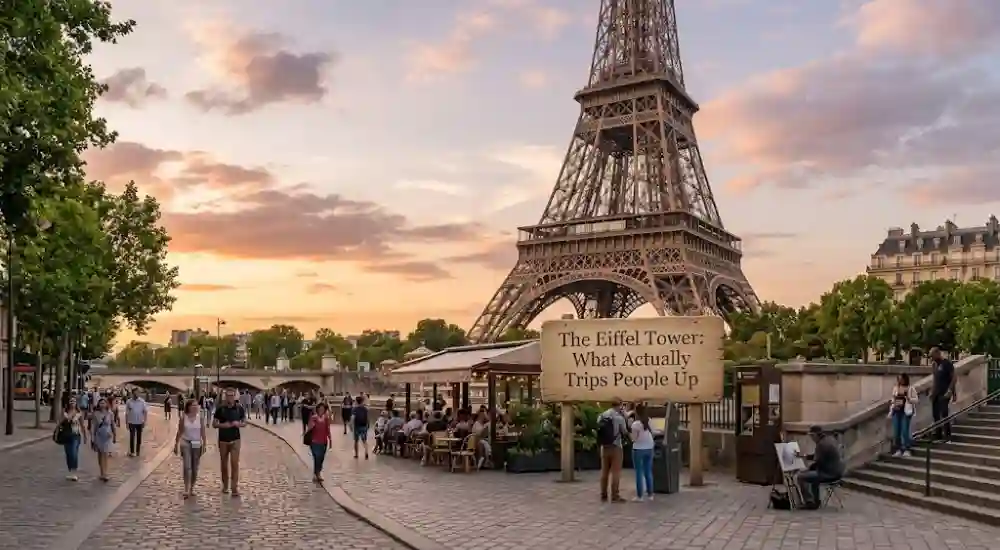
The Eiffel Tower: What Actually Trips People Up
Gustave Eiffel’s tower has pulled in visitors since the 1889 World’s Fair, and more than 130 years later it still anchors nearly every Paris itinerary. What surprises most first-time visitors isn’t the tower itself — it’s how far in advance you need to plan around it.
Getting to the Summit
Here’s the detail that catches almost everyone off guard: there’s no direct elevator to the summit. You always ride to the second floor first, then transfer to a separate summit elevator. Summit tickets sell out fast — often within minutes of release — so build in flexibility on your travel dates if the summit specifically matters to you.
Booking Timeline
- Summit access: Book 6–8 weeks ahead during spring and summer
- Second floor only: Easier to secure, considerably cheaper, and still delivers a genuinely strong panoramic view
- Stair access to the second floor: This one’s not sold online — you buy it same-day at the ticket office, and it’s the cheapest way up
My Honest Take
If you can’t get a summit slot, don’t panic and don’t overpay a reseller. The second-floor view is, in my experience, nearly as impressive, and you’ll skip the second queue that summit visitors wait through at the top of the second-floor elevator bank. Budget two to three hours total for security, elevators, and time to actually enjoy the view — this is not a 45-minute stop.
Sunset draws the heaviest crowds by far. If quiet matters more to you than golden light, go right at opening.
The Louvre Museum: Don’t Try to See It All
The Louvre holds thousands of years of art and history inside a former royal palace, and no single visit — not even a full day — comes close to covering it. Trying anyway is the fastest way to leave exhausted and unsatisfied.
Reservation Rules for 2026
Reservation is mandatory from July through August 2026, and daily visitor caps mean the museum can and does close its doors once capacity is reached, even to visitors who traveled a long way to get there. Outside those two months, a reservation is still strongly recommended rather than optional in practice.
Which Entrance to Use
Most visitors default to the glass Pyramid — the famous one — but it’s also the busiest. The Carrousel du Louvre entrance, reached via the underground shopping mall near the Arc de Triomphe du Carrousel, routinely moves faster and is climate-controlled while you wait.
Timing Your Visit
| Visit Window | What to Expect |
| Right at opening | Calmest galleries, shortest security wait |
| Midday, any day | Peak crowds, especially near the Mona Lisa |
| Wednesday or Friday evening | Extended hours, noticeably quieter |
| Tuesday | Closed — don’t plan a visit |
Plan two to four hours minimum for a focused visit built around two or three wings you actually care about. A Louvre-Delacroix combined ticket is a smart add-on if you want a smaller, far quieter museum in the same afternoon. And a practical note from recent summers: extreme heat has prompted the Louvre to close early on short notice more than once, so check the day-of schedule if you’re visiting in July or August.
Notre-Dame Cathedral and Its Towers: Two Different Visits
Notre-Dame reopened to the public in December 2024, after the 2019 fire and five years of restoration work. Walking back into the nave — the restored stonework catching light through the rose windows — is, honestly, one of the more emotional five minutes I’ve had in this city, and I say that as someone who’s been dozens of times since it reopened.
Here’s the distinction that confuses nearly every first-time visitor: the cathedral and the towers are two completely separate experiences with two separate sets of rules.
- The cathedral (nave): Free to enter. A timed-entry reservation is recommended to skip the outdoor line, but it isn’t strictly mandatory.
- The towers: Reservation is mandatory, full stop. There is no walk-up line. The towers reopened with a redesigned visitor route in September 2025, and you’ll climb roughly 400 spiral stairs with no elevator.
A few more things worth knowing before you go: large bags aren’t permitted and there’s no baggage storage on-site, so travel light. Mass schedules affect visitor access on the cathedral side, so if you want a purely tourist visit, check the schedule and time around it. And just outside on the square sits Point Zéro, the marker from which every distance in France is officially measured — easy to miss, worth a photo.
The Palace of Versailles: Plan a Full Day, Not a Detour
Versailles sits roughly 20 kilometers southwest of central Paris, and it represents a genuinely different kind of visit — built around scale and grandeur rather than one single icon. The Hall of Mirrors, a 73-meter gallery lined with 357 mirrors, justifies the trip on its own for most first-time visitors.
Getting There
The RER C train gets you there in roughly 40 minutes to an hour from central Paris, and it’s by far the simplest option for most travelers.
The Schedule Trap
The palace, the gardens, and the Trianon estate each run on separate opening schedules. This is the single most common planning mistake I see: visitors assume they can breeze through all three in an afternoon, then realize halfway through that the Trianon closes earlier than they expected.

Timed entry is now required for every ticket type, including free-admission categories for under-18 and eligible EU visitors. A full visit covering the palace, gardens, and Trianon estate genuinely needs six to seven hours — treat it as a dedicated day, not a half-day add-on to something else.
A couple of scheduling bonuses worth building a trip around: the Musical Fountain Shows run select days from April through early November, turning a garden walk into something closer to a live performance. The palace is closed on Mondays, so don’t build a Monday Versailles trip.
Paris Museum Pass: Is It Actually Worth It?
This is one of the most-searched questions among Paris planners, and it deserves a straight answer instead of a vague “it depends.”
The Paris Museum Pass grants entry to dozens of museums and monuments, including the Louvre, Musée d’Orsay, Arc de Triomphe, and the Palace of Versailles, over a set number of consecutive days.
It’s worth it if:
- You’re visiting four or more paid attractions covered by the pass within its validity window
- You value skip-the-line access at participating sites (note: it doesn’t remove the need for timed-entry reservations at reservation-mandatory sites like the Louvre and Versailles — you still book a slot, the pass just covers admission)
- You’re staying long enough actually to use a multi-day window
It’s probably not worth it if:
- You’re only planning to visit the Eiffel Tower and a couple of free sites
- Your trip is under two days
- You mainly want art museums outside the pass’s core list
Check current pricing and the full list of included sites on the official Paris Museum Pass website before buying, since both the price and the participating attractions are updated periodically.
Beyond the Louvre: Choosing the Right Museum for You
The Louvre gets all the attention, but it isn’t necessarily the right first stop for every traveler. Here’s how the major alternatives actually compare.
| Museum | Best For | Typical Visit Time | Standout Feature |
| Musée d’Orsay | Impressionist and Post-Impressionist fans | 2–3 hours | Housed in a converted Belle Époque train station |
| Centre Pompidou | Modern and contemporary art lovers | 2–3 hours | Distinctive “inside-out” architecture |
| Musée Rodin | Sculpture, quieter pace | 1.5–2 hours | Garden setting, much smaller crowds |
| Musée de l’Orangerie | Monet specifically | 1 hour | Monet’s large-scale water lily murals |
| Sainte-Chapelle | Architecture and stained glass | 45 minutes | Floor-to-ceiling 13th-century glass |
My honest recommendation: if you have to choose just one museum beyond the Louvre, make it Musée d’Orsay. It’s roughly a third the size of the Louvre, which means you can actually see the whole thing in an afternoon without the fatigue that swallows so many Louvre visits. Sainte-Chapelle also pairs naturally with a Notre-Dame visit, since both sit within a few minutes’ walk on Île de la Cité.
Historic Landmarks and Monuments Worth the Extra Stop
Beyond the headline sites, Paris holds a layer of historic monuments that round out a longer trip without repeating themselves. Each one covers a different chapter of the city’s history.

- Arc de Triomphe — Napoleon-era monument with rooftop Champs-Élysées views; stairs only, no elevator; book online to skip the ticket-counter line
- Panthéon — a domed mausoleum honoring notable French figures, including a live pendulum demonstration
- Hôtel des Invalides — Napoleon’s tomb alongside a substantial military history museum
- Conciergerie — a former royal palace turned Revolution-era prison, on Île de la Cité
- Basilica of Saint-Denis — the royal burial site, slightly outside central Paris and noticeably less crowded
- Place de la Concorde — one of the city’s largest public squares, free to visit any time
- Palais Garnier — the ornate opera house, viewable on a self-guided or guided tour
Space these across your trip rather than stacking three or four in one day. They start to blur together if you don’t.
Montmartre and Sacré-Cœur
Montmartre sits on a hill in northern Paris and somehow keeps its village character despite the tourist volume that flows through it daily. The steep streets and stairways here genuinely reward slow exploration over a rushed checklist.
Sacré-Cœur’s white domes anchor the district, and the front steps give you one of the city’s best free views — no ticket required. Two ways up: climb, or take the funicular from Place Saint-Pierre, which uses the same ticket as the metro.
A few practical notes from repeat visits: basilica entry is free, though the dome climb carries a small separate fee. Place du Tertre, the square where street artists work, gets genuinely crowded by midday — go early if you want to watch without elbow-to-elbow company. Rue Lepic and the surrounding side streets show a quieter, more residential side of the neighborhood if the main tourist strip starts to feel overwhelming. Wear real shoes; this district is hilly and almost entirely walking-only.
Parks, Gardens, and Scenic Viewpoints
Paris balances its dense, ornate architecture with genuinely generous green space, and after two or three museum-heavy days, you’ll want it.
Jardin du Luxembourg and the Tuileries Garden are the two most central options — both free, both good for a bench and twenty minutes of doing nothing between attractions. If you want something less touristed, Parc des Buttes-Chaumont in the 19th arrondissement has real hills, a lake, and a dramatic viewpoint most visiting travelers never find. Champ de Mars, the lawn beneath the Eiffel Tower, is the default picnic spot, though it fills up fast on warm evenings.
For something different, the Promenade Plantée — an elevated, converted rail line that predates and inspired New York’s High Line — offers a quiet walking route above street level, largely ignored by the main tourist flow.
Seine River Experiences
The Seine cuts through the center of Paris, and seeing the city’s landmarks from the water genuinely changes how they feel — Notre-Dame and the Louvre both look different from river level than they do from the street.
Boat cruises typically run 45 minutes to an hour, with several operators clustered near the Eiffel Tower. Evening cruises show the monuments illuminated after dark, which is worth the slightly higher price if your schedule allows it. If you’d rather skip the boat entirely, walking the riverside quais near Notre-Dame and the Louvre costs nothing and works just as well for photos — Pont Alexandre III is widely considered the most ornate bridge in the city and a reliable photo stop.
One practical note: high water levels have occasionally affected cruise service in past years, so check current conditions before booking, especially in early spring.
Free Things to Do in Paris
Some of the best hours you’ll spend in this city won’t cost a euro beyond your metro fare.
- Notre-Dame Cathedral’s main sanctuary — free entry
- Sacré-Cœur Basilica interior — free (dome climb has a small fee)
- Jardin du Luxembourg and Tuileries Garden — free public gardens
- Père Lachaise Cemetery — free to explore, known for notable graves and quiet tree-lined paths
- Window-shopping along Rue Saint-Honoré and through Le Marais
- Walking across the city’s bridges, especially near sunset
- Many national museums offer free entry to certain galleries on the first Sunday of the month — confirm current participating sites before you plan around it
Family-Friendly Attractions
Traveling with kids changes how much ground you can realistically cover in a day, and Paris has enough genuinely interactive sites to balance the museum-heavy stretches most itineraries default to.
Disneyland Paris
This deserves its own mention, not a footnote: Disneyland Paris is a full-day trip outside the city and, realistically, its own separate excursion rather than something you squeeze in alongside central Paris sightseeing. Plan transportation and timing accordingly.
Other Kid-Focused Stops
- Cité des Sciences et de l’Industrie — interactive science exhibits and a planetarium
- Jardin d’Acclimatation — an amusement park and garden combination in the Bois de Boulogne
- Ménagerie du Jardin des Plantes — a compact, historic zoo within walking distance of central sites
- Puppet shows in Jardin du Luxembourg — a low-cost, genuinely charming local tradition
- Eiffel Tower’s second floor — shorter lines than the summit and still a big payoff for younger kids
One rule of thumb that’s saved more than one family trip I’ve watched unfold: pick one major attraction per day when traveling with young children, and build real rest breaks around it. Two major sites in one day with kids under eight rarely goes well.
Underrated and Local Experiences
Beyond the landmark checklist, Paris rewards travelers willing to wander into its quieter corners — and these spots don’t come with the reservation pressure of the city’s biggest draws.
Canal Saint-Martin is a laid-back, canal-side neighborhood genuinely popular with locals rather than tour groups. Marché des Enfants Rouges, one of the city’s oldest covered food markets, is a good lunch stop that doubles as a slice of everyday Parisian life. Rue Mouffetard in the Latin Quarter keeps a similar market-street energy. And Belleville, a multicultural neighborhood with strong street art and a hilltop park, offers skyline views without the crowds you’ll find at Sacré-Cœur or the Eiffel Tower.
If you want museum-style content without museum-style crowds, Musée Carnavalet — free entry, entirely focused on the history of Paris itself — is one of the best-kept secrets on this list.
Best Time to Visit Paris for Sightseeing
Paris stays busy year-round, but crowds, prices, and weather shift enough by season that timing genuinely changes how the same trip feels.

Spring (April–June)
Spring days typically run in the 50s and 60s Fahrenheit, with occasional rain, especially in April and May. June delivers the most consistently pleasant weather of the year — long evenings, manageable crowds building toward the summer peak, and gardens in full bloom.
Summer (July–August)
This is peak season: the warmest weather, the longest lines, and the highest prices. Late-summer heat waves have pushed the Louvre and other sites to shorten hours on short notice more than once in recent years, so build flexibility into a July or August itinerary if you’re visiting then.
Fall (September–October)
A strong alternative to spring, with similarly mild weather and noticeably thinner crowds once the summer peak clears out.
Winter (November–March)
January and February bring the thinnest crowds and the lowest prices of the year, along with shorter days and a real chance of rain or cold. If avoiding lines matters more to you than warm weather, this is genuinely the best window.
Getting Around Paris
Central Paris is compact enough that walking covers a surprising amount of ground between major attractions — you’ll likely walk more than you expect, in a good way.
Airport to City
From Charles de Gaulle (CDG), the RER B train runs directly into central Paris, and it’s the most reliable option during rush-hour traffic. From Orly, the metro line 14 extension and the Orlyval shuttle both connect efficiently to the city center. Airport taxi and rideshare options exist but are subject to traffic that public transit simply bypasses.
Within the City
The metro network runs from roughly 5:30 a.m. to around 1:15 a.m. on weeknights and Sundays, with later service on Friday and Saturday nights. A car adds more hassle than convenience in the city center — parking is limited and streets are narrow, and almost nothing you’ll want to see requires one.
Single tickets, multi-trip carnets, and rechargeable Navigo passes are all available; weekly or multi-day passes generally make sense once your trip runs several days or more. RER trains extend service out to Versailles and other day-trip destinations beyond the metro’s reach. Fares and pass pricing change periodically, so confirm current rates on the official RATP site rather than relying on older figures you might find elsewhere.
Where to Stay Near the Top Attractions
Your neighborhood choice shapes how much of each day gets eaten by commuting versus actually sightseeing.
| Neighborhood | Best For | Proximity to Major Sights |
| Le Marais | First-timers, walkable charm | Central, near Notre-Dame and the Seine |
| Saint-Germain-des-Prés | Couples, café culture | Left Bank, near Musée d’Orsay |
| Latin Quarter | Budget travelers, students | Central, near Sainte-Chapelle and the Panthéon |
| Champs-Élysées area | Luxury travelers, shopping | Near the Arc de Triomphe |
| Montmartre | Local atmosphere, photography | Slightly removed, near Sacré-Cœur |
Want to walk everywhere? Base yourself in Le Marais or the Latin Quarter. Prefer a quieter evening at the cost of a slightly longer metro ride to the Louvre or Eiffel Tower? Montmartre is the trade-off worth considering.
A Sample 3-Day Paris Attractions Itinerary
This is a realistic starting structure, not a rigid script — build in slack, especially around meals and transit.
Day 1 — Islands and Icons: Notre-Dame Cathedral (morning), Sainte-Chapelle, a Seine riverside walk, Eiffel Tower at sunset.
Day 2 — Museums: Louvre Museum (morning, right at opening), Tuileries Garden for a break, Musée d’Orsay (afternoon).
Day 3 — Versailles Day Trip: Full day at the Palace of Versailles, palace and gardens, returning to Paris by early evening for dinner in Saint-Germain-des-Prés.
If you have a fourth day, add Montmartre and Sacré-Cœur in the morning, followed by a free afternoon in one of the underrated neighborhoods above.
Practical Safety and Money Tips
A few basics worth knowing before you go, none of which should discourage the trip — just plan around them.
- Pickpocketing is a real, documented risk around major tourist sites, the metro, and popular queues (the Eiffel Tower and Louvre lines especially). Keep bags zipped and in front of you in crowds.
- Most restaurants and shops accept card payments widely, though carrying some cash is still useful for smaller markets and older establishments.
- Tipping in France isn’t obligatory the way it is in the US, since service is typically included; rounding up is appreciated but not expected.
- Tap water is safe to drink throughout Paris, including from the city’s public drinking fountains.
Frequently Asked Questions
Is Notre-Dame Cathedral open to visitors in 2026?
Yes. Notre-Dame reopened to the public in December 2024 after its post-fire restoration. The main cathedral is free to enter, with a timed reservation recommended but not mandatory, while the towers require a separate, mandatory booking with no walk-up option.
Do you need reservations for the Louvre?
Reservations are mandatory during peak summer months, including July and August 2026, and strongly recommended year-round because of daily visitor caps. Without a booked slot in peak season, you may not be admitted at all — check the museum’s official site before your travel dates.
How many days do you need in Paris?
Three full days lets most visitors cover the major landmarks and one or two museums without rushing. Add a fourth day if you want to include Versailles without cramming it into an already packed schedule, or a fifth if Versailles and Montmartre both make the list.
What is the best month to visit Paris?
April through June and September through October offer the most balanced mix of mild weather, manageable crowds, and reasonable prices. July and August are warmest but also the most crowded and most expensive months to visit.
Is the Paris Museum Pass worth buying?
It generally pays off if you’re visiting four or more paid attractions on the pass’s list within its validity window. For shorter trips focused mainly on the Eiffel Tower and free sites, individual tickets usually make more sense.
Do you need a car in Paris?
No. A car typically adds more hassle than convenience in the city center, given limited parking and narrow streets. Walking, the metro, and RER trains comfortably cover the city and nearby day trips like Versailles.
Is Versailles worth a day trip from Paris?
Yes, for most travelers interested in history or architecture — though it works best as a dedicated full day rather than a quick stop. The palace, gardens, and Trianon estate together typically need six to seven hours to see properly.
Can you visit the Eiffel Tower without a reservation?
Walk-up tickets exist but often mean long waits, especially in peak season, and summit access regularly sells out entirely without advance booking. Reserving online several weeks ahead remains the more reliable route.
How do you get from the airport to central Paris?
From Charles de Gaulle, the RER B train runs directly into the city center and is usually the most reliable option during traffic. From Orly, the metro line 14 extension and the Orlyval shuttle both connect efficiently.
Is Paris safe for tourists in 2026?
Paris is generally safe for tourists, with the main practical concern being pickpocketing around crowded attractions, the metro, and popular queues rather than more serious crime. Standard precautions — zipped bags, awareness in crowds — cover most of the real risk.
Conclusion
You will not see all of Paris on this trip. Nobody does — not in three days, not in three weeks. The travelers who leave happiest usually aren’t the ones who saw the most sites; they’re the ones who booked the right handful early, understood which attractions play by different rules than they expected, and left enough room in the schedule to get pleasantly lost in between.
Start with two or three anchor sights per day. Book the Eiffel Tower and Louvre before anything else. Treat Versailles as its own day. And when you find yourself with an unplanned hour, spend it in a garden instead of a line — that’s usually where Paris shows you the most, anyway.