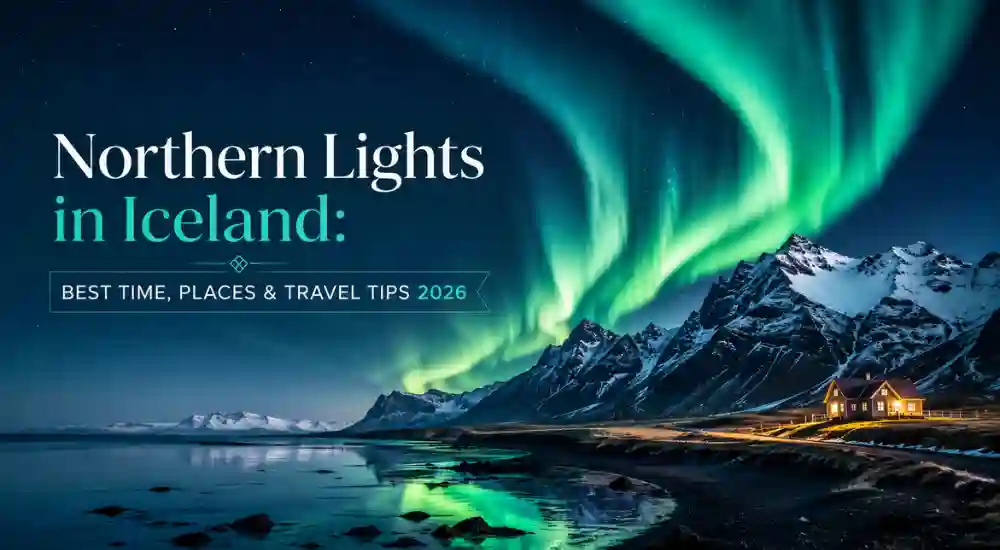
Seeing the Northern Lights in Iceland isn’t as simple as choosing a famous waterfall and waiting for the sky to turn green. Clouds can hide an active aurora, while a quieter forecast can produce a memorable display when you’re under a clear patch of sky.
That uncertainty is part of the experience, but it doesn’t mean you have to rely on luck alone. This guide explains the best time to see the Northern Lights in Iceland, where to go, how to read the official forecast, what to pack, where to stay, and when a guided tour makes more sense than driving yourself.
Quick Answer: Iceland’s broad aurora borealis season runs from late August through late April, when the sky becomes dark enough. Your best strategy is to stay several nights, prioritize clear skies over a famous location, move away from direct artificial light, and check the Icelandic Meteorological Office forecast before heading out.
Northern Lights in Iceland at a Glance
| Trip Question | Best Starting Point |
|---|---|
| Aurora season | Late August through late April |
| Longest dark nights | November–January |
| Good balance of darkness and sightseeing | September–October and February–March |
| Easy base without a car | Reykjavík |
| Dark skies near Reykjavík | Þingvellir or Reykjanes |
| Best dramatic photography setting | Jökulsárlón or Kirkjufell |
| Best North Iceland base | Akureyri or Lake Mývatn |
| Most remote experience | Westfjords |
| Simplest option for first-time winter visitors | Guided aurora tour |
| Key forecast factor | Clear or partly clear sky |
Visit Iceland identifies late August through late April as Iceland’s main aurora season, while the Icelandic Meteorological Office stresses that darkness and clear or partly clear skies are essential.
Why Iceland Is So Good for Seeing the Aurora Borealis
Iceland combines northern latitude, dark winter nights, and unusually varied landscapes in a relatively compact country. That means you don’t have to spend every evening at the same viewpoint. If clouds cover one region, another may offer clearer skies.
The scenery matters too. Lava fields, mountains, glacier lagoons, waterfalls, fjords, and black-sand coastlines can turn even a short aurora display into a memorable travel experience.
What Causes the Northern Lights?
The aurora borealis begins with activity from the Sun. Solar particles interact with Earth’s magnetic environment and eventually collide with gases high in the atmosphere, producing visible light.
NASA explains that oxygen commonly contributes green and red light, while nitrogen can produce blue and purple tones.
The Four Things You Actually Need
For travelers, the science can be reduced to four practical conditions:
- Darkness
- Clear or partly clear sky
- Enough geomagnetic activity
- A view with limited direct artificial light
A famous location doesn’t compensate for thick clouds. This is why flexible travelers often do better than travelers who commit to one landmark months in advance.
Best Time to See the Northern Lights in Iceland
The official Iceland tourism season for aurora viewing runs from late August until late April. Summer nights stay too bright for dependable viewing, even though solar activity itself continues year-round.
There is no single month that guarantees success. The best month depends on whether you value maximum darkness, easier sightseeing, milder shoulder-season conditions, or a winter landscape.
Iceland Northern Lights Month-by-Month
| Month | Aurora Planning Value | What to Expect |
|---|---|---|
| Late August | Fair | Darkness begins returning; viewing windows are shorter |
| September | Excellent balance | Darker nights with more daylight for road trips |
| October | Excellent balance | Long evenings without the deepest winter darkness |
| November | Strong | Long nights and increasing winter conditions |
| December | Strong | Very long darkness; limited sightseeing daylight |
| January | Strong | Long nights with full winter driving considerations |
| February | Excellent balance | Plenty of darkness with improving daytime sightseeing |
| March | Excellent balance | Dark evenings plus longer days |
| April | Fair to good | Aurora remains possible before nights become too bright |
| May–July | Poor | Nights generally remain too light for practical viewing |
This table is a planning guide rather than a prediction. Cloud cover can matter more than the month you choose. Visit Iceland’s official guidance emphasizes darkness and clear skies rather than naming a guaranteed “best” month.
September and October: Best for a Balanced Trip
These months work well if your trip includes more than aurora chasing. You still have useful daylight for waterfalls, geothermal areas, city exploration, and road trips.
The nights are dark enough for aurora attempts, but you avoid the shortest daylight periods of midwinter.
November Through January: Best for Maximum Darkness
These months provide very long nights, giving you a large window in which an aurora could become visible.
The tradeoff is winter weather and limited daylight. Travelers planning independent road trips need to be comfortable changing or canceling plans when conditions deteriorate. SafeTravel warns that winter-like road conditions can also occur outside the traditional winter months.
February and March: Excellent for First-Time Visitors
For many travelers, February and March offer one of the strongest compromises.
You retain dark evenings for aurora hunting while gaining additional daylight for sightseeing. Northern Iceland tourism information likewise identifies February and March as strong shoulder-season viewing periods around Akureyri.
What Is the Best Time of Night to See the Northern Lights?
The aurora doesn’t operate on a fixed nightly schedule. It can appear whenever the sky is sufficiently dark and the necessary space-weather conditions align.
Visit Iceland says aurora activity is most frequent on average around 11 p.m., and suggests being outside roughly between 10 p.m. and 1 a.m. when circumstances allow. This is a useful planning window, not an appointment with the sky.
A Better Strategy Than Waiting for 11 p.m.
Check the forecast before dinner, then look again closer to departure.
If the sky clears earlier, don’t ignore it because your tour isn’t scheduled for another hour. Likewise, don’t automatically give up at midnight if the forecast remains promising.
Aurora chasing rewards flexibility more than clock watching.
How to Read Iceland’s Aurora Forecast
Many first-time visitors focus almost entirely on the aurora activity number.
That’s a mistake.
Start with clouds. A strong aurora behind a solid cloud layer is still invisible.
The Icelandic Meteorological Office’s official aurora forecast shows green areas as cloudier and white areas as clearer sky. It also displays an auroral activity forecast on a 0–9 scale.
Check These in This Order
1. Cloud Cover
Find the nearest area with clear or partly clear sky.
A less famous location under clear sky is usually a better choice than Kirkjufell, Jökulsárlón, or another landmark beneath thick clouds.
2. Darkness
The aurora itself can occur in daylight, but you need sufficient darkness to see it from the ground.
This is why Iceland’s bright summer nights are unsuitable for normal aurora viewing.
3. Aurora Activity
The Met Office activity indicator runs from 0 to 9.
Importantly, its own instructions note that even grade 2 activity can be attractive and grade 3 can produce a strong-looking display. Don’t abandon an otherwise clear night just because the number seems low.
4. Road and Weather Conditions
Only after you’ve found promising sky should you decide whether reaching it is sensible.
Check current travel conditions rather than making a long night drive based on aurora numbers alone.
What Does the Kp Index Mean?
The Kp index measures planetary geomagnetic activity on a scale from 0 to 9.
NOAA explains that higher values generally correspond with a more active aurora and an auroral oval that expands farther from the poles. However, the relationship is approximate, and lower activity can still produce worthwhile auroras in high-latitude regions.
Don’t Chase a Number Instead of the Sky
For an Iceland traveler, this matters:
A modest Kp reading plus clear Icelandic sky can be more useful than a high reading beneath clouds.
Use Kp as one part of the decision, not your entire aurora strategy.
Does a Full Moon Ruin the Northern Lights?
No moon phase guarantees or eliminates an aurora sighting.
Moonlight can brighten the landscape and make a faint display less visually dominant, while also creating interesting foreground illumination for photography.
The Icelandic Meteorological Office includes moonlight information alongside cloud cover, darkness, and auroral activity in its forecasting tools, which is a good reminder that moonlight is a factor rather than an automatic dealbreaker.
What Will the Northern Lights Actually Look Like?
This is one of the most useful expectations to set before your first night outside.
Not every aurora looks like an intensely saturated photograph. Some displays begin as a pale arc or faint band before becoming brighter, greener, or more active. Stronger auroras can form curtains, rays, arcs, and moving patterns across the sky.
NASA explains that auroral colors come from interactions with atmospheric gases, with green among the most familiar visible colors.
Why Your Camera May Show More Color
Modern phones and cameras can collect light differently from the human eye, particularly through longer exposures and computational night modes.
That doesn’t make the experience less real. It simply means your photograph and your visual memory may not look identical.
Tip: If you’re unsure whether a faint gray-green patch is aurora or cloud, take a stable phone photo in night mode. The camera may make the color easier to distinguish.
Best Places to See the Northern Lights in Iceland
There is no single “best spot.” Your best location depends on cloud cover, transportation, where you’re sleeping, winter road conditions, and what kind of foreground you want.
The table below makes that choice easier.
| Location | Best For | Car Helpful? | Planning Difficulty | Standout Feature |
|---|---|---|---|---|
| Reykjavík | Easy first attempt | No | Easy | Convenience |
| Þingvellir | Darker skies near capital | Yes/tour | Moderate | Open landscape |
| Vík & South Coast | Scenic road trip | Yes/tour | Moderate | Waterfalls and coast |
| Jökulsárlón | Photography | Yes/tour | Higher | Glacier lagoon |
| Kirkjufell | Mountain photography | Yes | Moderate | Iconic mountain |
| Reykjanes | Arrival/departure nights | Helpful | Moderate | Lava and coastline |
| Akureyri | North Iceland base | Optional | Moderate | Services + dark surroundings |
| Lake Mývatn | Low light pollution | Helpful | Moderate | Rural northern skies |
| Westfjords | Remote travel | Usually | Higher | Very limited artificial light |
Best Places to See the Northern Lights in Reykjavík
You don’t have to leave Reykjavík every time the forecast improves.
Strong displays can be visible from the city, though escaping direct streetlights helps with weaker auroras. Visit Reykjavík specifically recommends Grótta, Öskjuhlíð, and the Old Harbour among local possibilities.
Grótta
Grótta at Seltjarnarnes is one of the most popular nearby choices because it combines an open coastal horizon with less intense lighting than central Reykjavík.
Visit Reykjavík describes it as a local winter favorite for Northern Lights viewing.
Öskjuhlíð
The wooded hill around Öskjuhlíð gives travelers another relatively accessible option away from the brightest downtown streets.
Who Should Stay in Reykjavík?
Reykjavík makes sense if you:
- don’t want to drive in winter
- want numerous organized tour departures
- prefer restaurants and attractions nearby
- are only visiting Iceland briefly
- want an easy fallback when weather ruins an evening
A city stay also gives you something useful to do when the sky stays cloudy.
Þingvellir and the Golden Circle
Þingvellir National Park is close enough to fit naturally into a Golden Circle trip while offering darker surroundings than central Reykjavík.
Rather than rushing from Reykjavík after dark, explore the route in daylight and decide later whether conditions justify staying outside the city.
Smart Golden Circle Aurora Plan
Spend the day around:
- Þingvellir
- Geysir
- Gullfoss
- nearby geothermal or countryside areas
Then check clouds before committing to a night location.
Don’t assume the place you visited comfortably at noon will be equally simple after dark in winter. Weather, ice, visibility, and parking conditions can change the experience considerably. SafeTravel recommends checking current weather and road information before driving.
Vík and Iceland’s South Coast
The South Coast works especially well for travelers who want their aurora trip to feel like a full Iceland vacation rather than a series of nighttime excursions from Reykjavík.
Waterfalls, coastal cliffs, black sand, mountains, and rural accommodation create numerous daytime and nighttime possibilities.
Why Base Yourself in Vík?
Vík gives you access to South Coast scenery without requiring a late-night return all the way to Reykjavík.
More importantly, staying locally means that if your hotel’s surroundings are dark and the sky suddenly clears, you may not need a major drive at all.
Important Reynisfjara Safety Note
Do not treat Reynisfjara black-sand beach as an ordinary night photography location.
SafeTravel warns about sneaker waves, changing hazard levels, and closures. Current conditions can change quickly, and warning lights and restricted areas must be respected.
Never move closer to the sea simply because the aurora appears behind it.
Jökulsárlón Glacier Lagoon
Few Icelandic foregrounds are as visually distinctive as Jökulsárlón Glacier Lagoon.
Floating ice and reflective water can create extraordinary compositions when aurora appears above the lagoon. But the location makes far more sense as part of a South Coast overnight journey than as a rushed nighttime mission from Reykjavík.
Make Jökulsárlón Safer and Easier
- Arrive during daylight and learn the layout.
- Find legal parking before darkness.
- Stay back from water and unstable ice.
- Carry spare camera batteries.
- Consider accommodation nearby.
- Check Route 1 conditions before committing to the journey.
The purpose isn’t to reach the lagoon at any cost. The purpose is to be there only when the trip itself remains reasonable.
Kirkjufell and the Snæfellsnes Peninsula
On the Snæfellsnes Peninsula, Kirkjufell gives photographers one of Iceland’s most recognizable mountain silhouettes.
Its popularity is also a reason to plan carefully. Rather than arriving for the first time in darkness, scout your composition earlier and understand where you can safely stand.
Don’t Build the Whole Night Around Kirkjufell
Clouds may make another part of Snæfellsnes better.
Keep alternatives around:
- Grundarfjörður
- Búðir
- open coastal areas
- darker rural locations with safe parking
Photography improves when you’re willing to abandon the famous composition and follow better conditions.
Reykjanes Peninsula Near Keflavík Airport
Reykjanes is useful because it can turn your arrival or final night into another possible aurora opportunity without requiring a trip deep into Iceland.
Visit Reykjanes identifies Garðskagi, Krýsuvík, Bridge Between Continents, and Kálfatjarnarkirkja among regional viewing options.
Why Reykjanes Needs Extra Planning in 2026
The Reykjanes Peninsula remains an area where volcanic conditions and access can change.
As of July 3, 2026, the Icelandic Meteorological Office reported continued magma accumulation beneath Svartsengi, while SafeTravel continues to publish specific guidance for affected areas.
Never walk on fresh lava, bypass closures, or enter restricted terrain for an aurora photograph.
Check current official conditions on the actual day of your visit.
Akureyri and Lake Mývatn in North Iceland
Travelers often focus so heavily on Reykjavík and the South Coast that they overlook North Iceland.
That can be an advantage if you want a longer winter trip with fewer urban lights.
Visit North Iceland highlights Lake Mývatn for its limited light pollution and promotes Northern Lights viewing across the region from late August into spring.
Akureyri
Choose Akureyri if you want:
- restaurants and accommodation
- a comfortable regional base
- organized Northern Lights tours
- easier access to daytime attractions
- less dependence on Reykjavík
Lake Mývatn
Choose Mývatn if you value:
- dark rural skies
- geothermal landscapes
- quieter surroundings
- photography
- a slower multi-night stay
A useful compromise is to base part of your trip in Akureyri and part around Mývatn rather than constantly driving long distances at night.
Westfjords for Remote Northern Lights Viewing
The Westfjords offer one of Iceland’s strongest combinations of darkness and isolation.
Regional tourism guidance highlights late September through early April for Northern Lights viewing there.
Who Are the Westfjords Best For?
They suit travelers who:
- have more than a few days
- aren’t building their first Iceland trip around Reykjavík
- value quiet landscapes over convenience
- are prepared to modify plans around winter conditions
Ísafjörður is the most practical base for many visitors because it provides local services while maintaining access to darker landscapes.
The Tradeoff
Remote darkness also means more demanding logistics.
Don’t choose the Westfjords simply because they look empty on a light-pollution map. In winter, road and weather conditions should drive your itinerary.
Northern Lights Tour vs Self-Drive
This is one of the most important trip decisions.
Neither option creates an aurora. They simply change who handles the transportation, forecast interpretation, and nighttime logistics.
| Option | Best For | Main Advantage | Main Drawback |
|---|---|---|---|
| Large bus tour | Budget-conscious visitors | Simple logistics | Less personalized |
| Small-group tour | First-time visitors | More flexible experience | Higher cost |
| Private tour | Couples, photographers, groups | Customized pacing | Premium pricing |
| Self-drive | Confident winter drivers | Maximum independence | You manage all road/weather risk |
| City viewing | No-car travelers | Cheapest and easiest | More light pollution |
Choose a Guided Tour If…
A tour is usually better when:
- you’ve never driven on snow or ice
- you don’t want to drive after midnight
- you’re staying in central Reykjavík
- you’re traveling solo and prefer company
- you want someone else interpreting weather conditions
Visit Reykjavík lists numerous organized Northern Lights options from the capital, while Visit North Iceland also promotes region-specific guided experiences.
Before Booking
Check:
- group size
- trip duration
- pickup arrangements
- cancellation terms
- what happens after a no-sighting night
- whether warm clothing or photography help is included
Policies vary by operator, so never assume free rebooking is universal.
Choose Self-Drive If…
Self-driving works better if:
- you’re genuinely comfortable with winter conditions
- several people can share driving
- you value photography flexibility
- your accommodation is already outside Reykjavík
- you’re willing to turn around
The last point matters most.
Freedom only helps when you’re prepared to abandon the plan.
Where to Stay for a Northern Lights Trip
You don’t necessarily need a hotel marketed as a “Northern Lights hotel.”
A more useful question is:
Can I get to dark sky easily without creating a difficult nighttime drive?
Reykjavík — Best for Convenience
Choose Reykjavík for:
- first visits
- short trips
- no-car travel
- tours
- restaurants
- rainy or cloudy-night alternatives
Golden Circle Countryside — Best for Escaping City Light
A countryside stay lets you combine daytime sightseeing with darker evenings.
It’s useful for travelers who want to reduce the repeated drive back into Reykjavík.
Vík — Best for the South Coast
Vík works especially well on a multi-day route because it places you near major South Coast landscapes without forcing Reykjavík as your base every night.
Jökulsárlón Area — Best for Photographers
Staying in southeast Iceland allows you to scout the lagoon in daylight and return when the sky improves.
Mývatn — Best for Dark-Sky Atmosphere
The area has little urban light and pairs naturally with a longer North Iceland itinerary.
How Many Nights Should You Stay?
If the Northern Lights are an important reason for your Iceland trip, one night is a risky plan.
Visit Reykjavík recommends allowing at least four to five nights to improve your opportunities because weather and solar conditions vary.
That doesn’t mean four nights guarantee anything.
It means you have several chances for the ingredients to align.
A Useful Planning Rule
Three nights: possible, but weather can easily defeat the plan. Four to five nights: much better flexibility. Seven nights or more: lets you combine regions and weather windows.
More nights are most valuable when your itinerary remains flexible.
How to Photograph the Northern Lights
You don’t need professional gear to bring home a useful aurora photograph.
What matters most is stability, focus, exposure, and preparation before the display becomes active.
Camera Checklist
- Tripod
- wide-angle lens
- manual exposure controls
- spare batteries
- clean lens cloth
- headlamp
- gloves you can operate controls with
Visit Reykjavík recommends wide-angle lenses and stable shooting, especially when photographing both landscape and sky.
Simple Starting Workflow
Rather than copying one fixed setting:
- Put the camera on a tripod.
- Focus carefully on a distant light or star.
- Use a wide aperture if your lens allows it.
- Begin with a moderately high ISO.
- Adjust shutter speed based on aurora movement.
- Review the image.
- Shorten the exposure when the aurora moves quickly.
A fast-moving aurora needs a shorter exposure than a faint, static arc.
Smartphone Photography
Modern phones can produce surprisingly useful aurora images.
Visit Reykjavík recommends stabilizing the phone or using a tripod and taking advantage of appropriate low-light features.
Most Important Phone Tip
Don’t handhold a long night exposure if you can avoid it.
Lean the phone against something stable or use a small tripod.
What to Wear for an Aurora Night
The hardest part of aurora watching is often not the photography.
It’s standing outside while almost nothing happens.
Wind makes that wait much harder, so dress for stationary cold, not for a five-minute walk from the car.
Northern Lights Packing Checklist
- thermal base layer
- insulating fleece or wool layer
- windproof outer jacket
- waterproof shell where conditions require it
- warm pants
- insulated boots
- wool or thermal socks
- warm hat
- gloves
- scarf or neck warmer
- spare phone/camera battery
- power bank
- headlamp
- water
- simple warm drink if practical
SafeTravel advises travelers to carry warm clothing and rain/windproof outer layers because conditions can change quickly.
Protect Your Batteries
Cold weather can reduce battery performance.
Keep spares in an inside pocket rather than leaving everything exposed in your camera bag.
Northern Lights With Kids
An aurora trip can work well for families, but adults should plan around waiting time, cold, sleep schedules, and roadside safety.
Don’t expect children to happily stand outdoors for three hours because the forecast looks promising.
Make Family Aurora Nights Easier
- Choose accommodation with dark surroundings.
- Keep at least one viewing attempt close to your hotel.
- Bring extra layers and snacks.
- Alternate outdoor waiting with warm indoor breaks.
- Avoid dangerous coastlines at night.
- Don’t overload daytime sightseeing before a late evening.
At Reynisfjara specifically, SafeTravel says children should always be accompanied by an adult and visitors must stay well back from the water.
Accessibility Considerations
Aurora viewing doesn’t always require a remote hike.
Travelers with limited mobility may have an easier experience using:
- Reykjavík waterfront locations
- organized tours with vehicle-based viewing
- accommodation in darker rural areas
- viewpoints accessed from established parking areas
Avoid assuming famous photography spots are accessible simply because they appear close to a road on a map.
Snow, ice, darkness, gravel, uneven ground, and wind can change practical accessibility significantly.
When accessibility is important, contact the attraction, hotel, or tour operator directly before booking.
How to See the Northern Lights on a Budget
You do not need an expensive private tour every night.
The aurora itself has no admission fee.
Budget-Friendly Strategy
- Stay in Reykjavík for easy logistics.
- Check the official forecast yourself.
- Try darker local locations such as Grótta when conditions support it.
- Book a tour for only one or two nights.
- Avoid renting a car solely for aurora chasing if you don’t need one.
- Give yourself multiple nights rather than paying a premium for one “special” forecast.
Visit Reykjavík identifies several local viewing locations that can be reached without joining a countryside tour.
Winter Driving and Northern Lights Safety
An aurora photograph is never worth ignoring a closure, weather warning, unsafe parking situation, or fatigue.
SafeTravel says Icelandic weather and road conditions can change quickly, and its winter guidance emphasizes checking conditions before travel.
Before Driving at Night
Check:
- Weather
- Road conditions
- Travel alerts
- Cloud cover
- Aurora activity
That order matters.
Never Stop in the Road for the Aurora
SafeTravel specifically warns against stopping in the road or at unsafe roadside locations for photographs. Find a proper place to pull off and park.
Don’t Let Fatigue Decide the Route
Aurora viewing can push travelers well past their normal bedtime.
If you’re jet-lagged, exhausted, or struggling to stay alert, return to your accommodation. SafeTravel treats driver fatigue as a serious travel issue.
Current Iceland Safety Notes for 2026
Because this article was fact-checked on August 11, 2026, several changing conditions deserve special attention.
Reykjanes Volcanic Activity
The Icelandic Meteorological Office reported on July 3, 2026 that magma accumulation and uplift continued beneath Svartsengi, with a renewed intrusion or eruption remaining a possible future scenario.
SafeTravel continues to publish area-specific guidance.
Always check again immediately before your trip.
Sólheimajökull
SafeTravel currently carries a 2026 warning about dangerous conditions at Sólheimajökull and advises against going onto the glacier under the current conditions.
Do not enter a glacier independently simply because you want an aurora foreground.
Reynisfjara
The beach uses changing hazard guidance and can be partly or fully restricted depending on ocean conditions.
A Practical 5-Night Iceland Northern Lights Itinerary
The best itinerary doesn’t assign one single evening as “Northern Lights Night.”
Every night should be a possible viewing night.
Night 1 — Reykjavík
Settle in and make your first attempt locally.
If conditions are promising:
- try Grótta
- visit Öskjuhlíð
- join a guided countryside tour
If it’s cloudy, get an early night.
Night 2 — Golden Circle
Explore the Golden Circle during daylight.
If road and cloud conditions remain good, stay outside Reykjavík longer or use a countryside base.
Night 3 — Vík
Move along the South Coast.
Use daylight for waterfalls and coastal landscapes, then check whether viewing close to your accommodation makes sense after dark.
Night 4 — Southeast Iceland
Continue toward Jökulsárlón if current road and weather conditions support the journey.
Scout the lagoon while you can see where you’re walking.
Night 5 — Flexible Weather Night
This is the most valuable night in the itinerary.
Don’t pre-assign it months in advance.
Choose among:
- Reykjavík
- Golden Circle
- Reykjanes
- South Coast
- another practical area with clearer sky
Let clouds decide the final region.
What to Do If Every Aurora Night Is Cloudy
This is a possibility travelers need to accept before booking.
A strong Iceland itinerary shouldn’t collapse simply because the Northern Lights stay hidden.
Cloudy-Night Alternatives
Use the evening for:
- geothermal bathing
- Reykjavík restaurants
- museums
- indoor cultural attractions
- an earlier dinner and sleep
- reorganizing the following day’s route
The goal is to book a trip you’d still enjoy without an aurora guarantee.
That mindset removes a great deal of pressure from each forecast.
Common Northern Lights Mistakes to Avoid
Chasing Only a High Kp Number
Fix: Check clouds first.
Booking Only One Viewing Night
Fix: Build several chances into the trip.
Driving Too Far After Dark
Fix: Choose a closer clear-sky region when possible.
Stopping on the Road
Fix: Find proper parking before getting out.
Arriving at a Photography Spot for the First Time in Darkness
Fix: Scout during daylight.
Watching Your Phone Instead of the Sky
Fix: Check forecasts when needed, then let your eyes adjust.
Assuming a Tour Guarantees a Sighting
Fix: Treat a guide as a logistics advantage, not control over nature.
Spending the Entire Trip in the Car
Fix: Choose accommodations that already put you near dark skies.
FAQs About the Northern Lights in Iceland
What is the best month to see the Northern Lights in Iceland?
There is no guaranteed best month. Iceland’s broad Northern Lights season runs from late August through late April.
September–October and February–March are especially appealing if you want a balance between dark evenings and daytime sightseeing. November through January provide much longer nights.
Can you see the Northern Lights from Reykjavík?
Yes. Strong aurora displays can be visible from Reykjavík, though direct city lighting makes weaker displays harder to see.
Visit Reykjavík recommends locations such as Grótta and Öskjuhlíð for darker surroundings within or near the capital.
Are Northern Lights sightings guaranteed in Iceland?
No.
Aurora visibility depends on darkness, cloud cover, geomagnetic conditions, and your location. Visit Reykjavík explicitly notes that sightings cannot be guaranteed.
How many nights should I spend in Iceland to see the aurora?
If the Northern Lights are a major goal, four or five nights gives you far more flexibility than a one-night stop.
Visit Reykjavík also recommends allowing multiple nights because conditions change.
Can you see the Northern Lights in Iceland in August?
Sometimes, toward late August, when usable nighttime darkness begins returning.
Visit Iceland places the beginning of the broad aurora season in late August.
Can you see the Northern Lights in Iceland in summer?
Not during the brightest part of summer under normal viewing conditions.
The sky remains too light for practical aurora viewing, which is why official guidance centers the season between late August and late April.
Do I need a car to see the Northern Lights?
No.
You can watch from darker parts of Reykjavík or join organized tours from the capital.
A car gives you additional flexibility, but only if you’re comfortable with current Icelandic road and weather conditions.
Is a Northern Lights tour worth it?
For travelers who don’t want to handle winter driving, nighttime navigation, parking, and forecast decisions, a tour can be well worth it.
Independent travelers may prefer self-driving, especially when they already have a vehicle for the rest of their itinerary.
Can I photograph the Northern Lights with a phone?
Yes.
Modern smartphones can capture aurora displays, especially when stabilized and used with suitable night photography features. Visit Reykjavík recommends keeping the phone steady or using a tripod.
Is a high Kp index required in Iceland?
No.
Higher Kp generally indicates increased geomagnetic activity, but Iceland lies far enough north that useful displays can occur at lower activity levels. The Icelandic Meteorological Office notes that even a low activity grade can produce a worthwhile aurora.
Final Thoughts
Seeing the Northern Lights in Iceland is less about finding one secret viewpoint and more about building the right conditions into your trip. Stay several nights, watch the clouds, keep your route flexible, and choose safe dark-sky locations rather than blindly chasing the highest forecast number.
Most importantly, plan an Iceland trip you’d enjoy even if one or two evenings are cloudy. Choose your season, pick a sensible base, decide whether a tour or self-drive suits your experience, and let the live weather and road conditions shape each night. When the sky finally opens, you’ll be in a much better position to enjoy it instead of racing across Iceland to find it.