
Switzerland looks small on a map, but fitting its lakes, cities, mountain villages, and famous peaks into one vacation is surprisingly difficult. The best places to visit in Switzerland depend less on what’s most famous and more on the kind of trip you actually want.
For most first-time visitors, Lucerne and the Jungfrau Region give the strongest mix of lakes, mountains, villages, and easy rail travel. Zermatt adds the Matterhorn, while Montreux, Lugano, Bern, Appenzell, and the Engadin offer completely different reasons to stay longer. This guide helps you decide where to go, how long to stay, what to prioritize, and which places combine naturally.
Current travel note: Mountain transportation, hiking routes, and reservation rules can change with weather and season. Time-sensitive details in this guide were checked against official sources on August 18, 2026.
Quick Answer: Where Should You Go in Switzerland?
For a first trip, start with Lucerne and the Jungfrau Region. Add Zermatt if seeing the Matterhorn is a priority.
Choose Montreux or Lausanne for Lake Geneva, Lugano for Italian-speaking Switzerland, Bern for history, Basel for art, and Appenzell or Lower Engadin when you want quieter landscapes.
If you have only seven days, resist the urge to visit six cities. Two or three bases usually create a better trip because mountain weather, hotel changes, and transport can consume more time than expected.
Best Switzerland Destinations at a Glance
Use this table to narrow the list before planning your route.
| Destination | Best For | Ideal Stay | Car Helpful? | Best Fit |
| Lucerne | First-time visitors | 2–3 nights | No | Lake + city + mountains |
| Jungfrau Region | Classic Swiss Alps | 3–4 nights | No | Hiking + villages |
| Zermatt | Matterhorn views | 2–3 nights | No | Mountains + skiing |
| Bern | History | 1–2 nights | No | Culture + old town |
| Zurich | Art and city life | 1–2 nights | No | Urban stop |
| Montreux & Lavaux | Lake views + vineyards | 2–3 nights | No | Couples + slow travel |
| Lugano & Ticino | Italian-Swiss atmosphere | 2–3 nights | Optional | Food + lake life |
| St. Moritz & Engadin | Scenic rail + outdoors | 2–4 nights | Optional | Luxury + nature |
| Geneva | Museums + western gateway | 1–2 nights | No | City + lake |
| Basel | Art + architecture | 1–2 nights | No | Museums |
| Lausanne | Culture + Lake Geneva | 1–2 nights | No | Museums + vineyards |
| Appenzell & Alpstein | Traditions + hiking | 2 nights | Optional | Quiet mountains |
| Kandersteg | Alpine lake escape | 1–2 nights | No | Hiking + nature |
| Schaffhausen | Rhine Falls | 1 day–1 night | No | Easy day trip |
| Gruyères | Medieval history + food | 1 day–1 night | No | Culture |
| Swiss National Park | Wild landscapes | 2–3 nights | Optional | Serious nature |
Switzerland’s public transportation network reaches cities, lake towns, and many mountain areas, so a rental car isn’t necessary for most first-time itineraries. SBB’s visitor products cover extensive train, bus, boat, and urban transport networks, although some mountain railways require separate tickets or supplements.
How We Chose These Places
A destination belongs on this list because it adds a distinct reason to visit Switzerland, not simply because it photographs well.
The strongest places combine several of these qualities:
- A clear reason to stay, not just pass through
- Reliable transportation connections
- Distinct landscapes, culture, or experiences
- Enough to justify the recommended trip length
- Good options for first-time or repeat visitors
- Logical connections with other Swiss destinations
- Seasonal value beyond one narrow travel window
- A worthwhile experience even if mountain weather changes
That is why several famous places don’t appear as separate entries. For example, Lauterbrunnen, Wengen, Mürren, Grindelwald, and Interlaken work better as parts of the wider Jungfrau Region than as five nearly identical recommendations.
Best Time to Visit Switzerland
There is no single best month because summer hiking, autumn color, Christmas cities, and winter skiing are different trips.
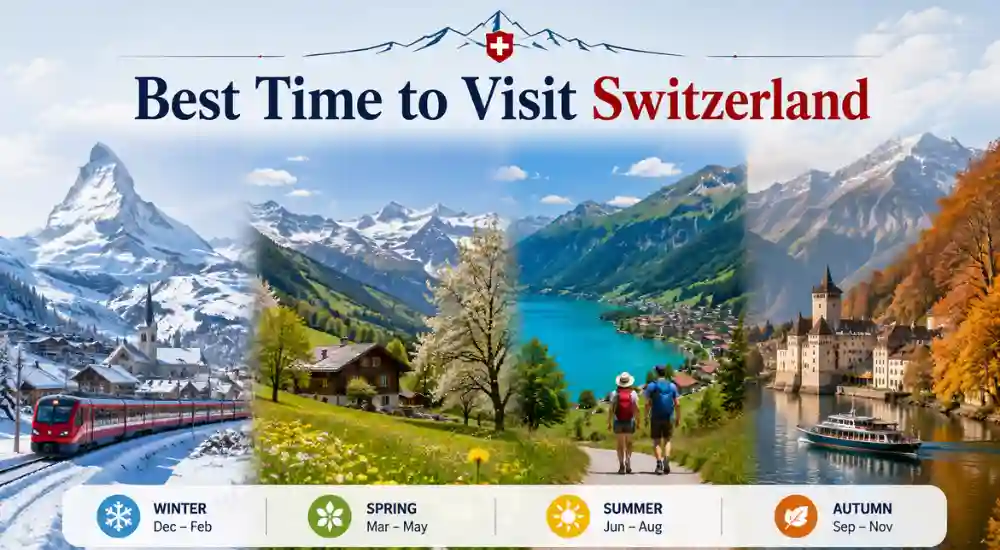
For hiking and high-mountain sightseeing, summer usually offers the broadest range of accessible routes. Winter shifts the focus toward skiing, snowshoeing, winter walks, and snow-covered scenic rail journeys. Autumn can bring excellent walking and vineyard scenery, but shorter days and early high-elevation snow become increasingly important.
Choose Your Season by Travel Style
June to September: Best suited to hiking, lakes, Alpine villages, and longer daylight.
December to March: Best suited to skiing, snow activities, winter resorts, and snowy rail journeys.
April to May: Useful for cities and lower-elevation sightseeing, but some mountain routes may remain between winter and summer operations.
October to November: Good for quieter city breaks and parts of the wine regions, but high-Alpine access becomes less predictable.
Always check the specific mountain railway, hiking trail, or cable-car operator shortly before travel.
Do You Need a Car in Switzerland?
For most visitors following this list, no.
Lucerne, Zurich, Bern, Geneva, Basel, Lausanne, Zermatt, the Jungfrau Region, and many lake destinations work extremely well by public transportation. Switzerland Tourism describes the country as having one of the world’s densest rail networks, while SBB offers visitor passes for trains, buses, boats, and local transportation.
A car becomes more useful when you’re building a rural route with many small villages or remote stops. Even then, remember that places such as Zermatt are car-free, while city parking may create more hassle than convenience. Zermatt requires private drivers to stop in Täsch and continue by train or approved local transport.
Swiss Travel Pass or Individual Tickets?
Don’t buy a pass automatically.
The Swiss Travel Pass currently comes in several durations and includes extensive train, bus, boat, and urban transportation, plus discounts on many mountain excursions. SBB also offers the Swiss Half Fare Card for international visitors. Which option saves money depends on your exact itinerary.
Build your route first. Then compare the actual journeys you expect to take.
How Expensive Is Switzerland?
Switzerland is rarely a cheap destination, but your route can change the final cost dramatically.
The largest expenses are often accommodation, mountain transportation, restaurant meals, and frequent hotel changes. A traveler staying three nights in one region may spend less than someone moving daily between famous resorts.
Practical Ways to Control Costs
- Stay longer in fewer bases
- Use grocery stores for some breakfasts or lunches
- Compare rail passes against individual tickets before buying
- Spend some days on free old-town walks, lakefronts, and viewpoints
- Avoid adding expensive mountain excursions merely because they’re famous
- Book accommodation earlier for high-demand Alpine areas
- Consider cities such as Bern or Basel between expensive resort stays
- Travel outside major holiday periods when your schedule allows
The goal isn’t to make Switzerland “cheap.” It is to spend more on the experiences you actually care about.
The Best Places to Visit in Switzerland
1. Lucerne — Best for a First Switzerland Trip
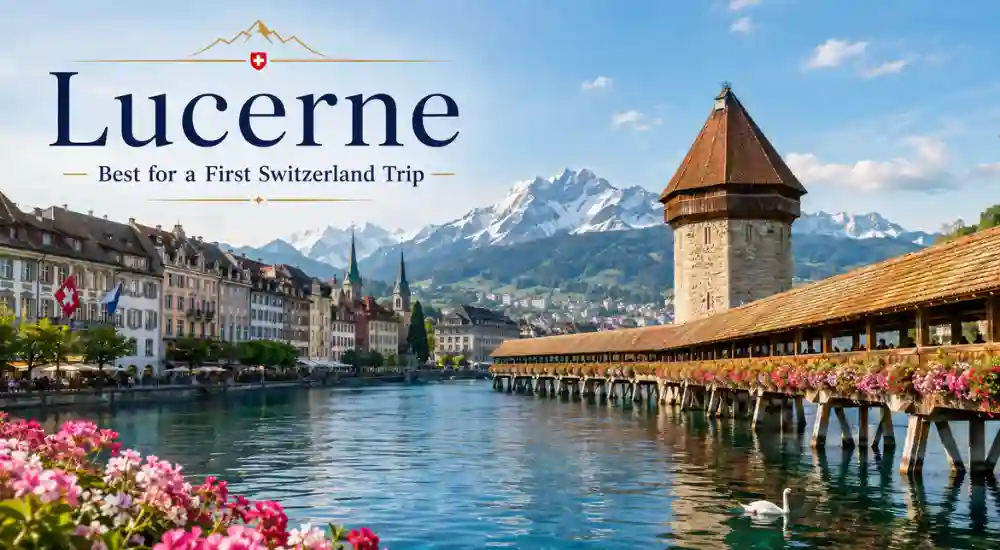
Lucerne is the easiest place to understand why Switzerland works so well for first-time visitors. You can walk across the historic Chapel Bridge in the morning, explore the Old Town, spend time beside Lake Lucerne, and still use the same hotel for mountain excursions.
The city itself doesn’t require several full sightseeing days. What makes a two- or three-night stay valuable is the surrounding region, including Lake Lucerne and nearby mountain trips. Switzerland Tourism highlights both Chapel Bridge and Mount Pilatus among the area’s major experiences.
Don’t miss:
- Chapel Bridge
- Old Town streets
- Lake Lucerne waterfront
- A boat trip if it fits your route
- One mountain excursion if weather cooperates
Choose Lucerne if: you want city, lake, and mountain scenery without changing hotels.
Consider skipping it if: your short itinerary already includes several lake cities and you want to spend almost all your time deep in the Alps.
Ideal stay: 2–3 nights
Best pairing: Jungfrau Region, Zurich, or Bern.
2. Jungfrau Region — Best for the Classic Swiss Alps
If your mental picture of Switzerland includes waterfalls, steep green valleys, snow-covered peaks, cog railways, and car-free villages, this is the region most likely to deliver it.
The key is choosing the right base. Interlaken is useful for transportation and a wider range of services. Wengen and Mürren put you directly in car-free mountain settings. Grindelwald gives easy access to major mountain excursions, while Lauterbrunnen places you inside the famous waterfall valley. Switzerland Tourism notes that Lauterbrunnen alone contains dozens of waterfalls, including Staubbach Falls.
Where Should You Stay in the Jungfrau Region?
Choose Interlaken if transportation flexibility matters most.
Choose Wengen if you want a traditional car-free village with easy rail access.
Choose Mürren if you prefer a quieter, more dramatic mountain setting.
Choose Grindelwald for major lifts, hikes, and easier access to the Eiger side of the region.
Don’t try to sleep in a different village each night. They’re close enough to explore through the regional transport system.
Important 2026 Jungfraujoch Rule
For journeys to Jungfraujoch – Top of Europe, seat reservations are mandatory from May 1 through October 31, 2026 on the specified Jungfrau Railway connections. Verify the rule again when booking because mountain transport policies can change.
Ideal stay: 3–4 nights
Choose this region if: mountains are the main reason you’re visiting Switzerland.
Skip Jungfraujoch itself if: cloud and visibility are poor. The wider region still offers plenty to do without paying for a high-altitude excursion with limited views.
3. Zermatt — Best for Matterhorn Views
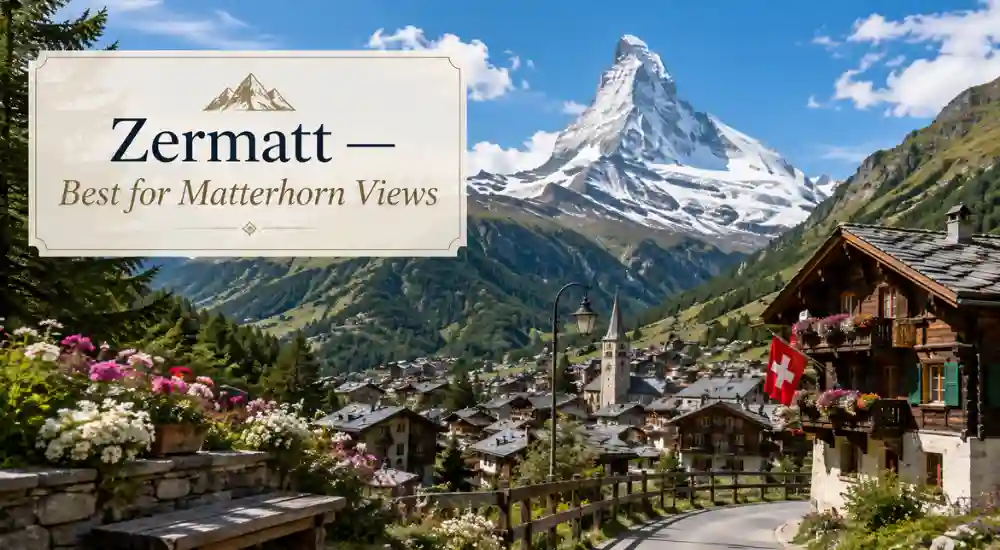
Some Swiss destinations offer variety. Zermatt offers one mountain so recognizable that it shapes the entire trip.
The Matterhorn appears from streets, hiking routes, railway viewpoints, and mountain terraces around the resort. The Gornergrat is one of the best-known high-elevation viewpoints, with the official destination highlighting extensive views across surrounding peaks and glaciers.
Zermatt is also car-free. Travelers driving through Switzerland must normally leave private vehicles in Täsch and continue to Zermatt by train or other authorized transport.
Best experiences include:
- Gornergrat
- Village walks with Matterhorn views
- Hiking during the snow-free season
- Winter skiing and snow activities
- Scenic rail connections through Valais
Choose Zermatt if: seeing the Matterhorn is one of your non-negotiable trip goals.
Skip it if: you’re watching your budget closely and don’t particularly care about the Matterhorn. The Jungfrau Region can offer a broader mix of villages and scenery.
Ideal stay: 2–3 nights, longer for serious hiking or skiing.
4. Bern — Best for History Without a Hectic City Feel
Bern doesn’t compete with the Alps for drama. That’s exactly why it works.
Its UNESCO-listed Old City, long arcades, fountains, sandstone buildings, Zytglogge clock tower, and bends of the Aare give travelers a change of pace between mountain stays. Bern’s tourism office notes that the Old City has held UNESCO status since 1983 and contains around six kilometers of arcades.
Rather than racing through a checklist, give yourself time to walk. Zytglogge, the Federal Palace area, Bern Cathedral, and viewpoints above the Aare can fill a relaxed day.
Choose Bern if: you want history, architecture, cafés, and an easy walking city.
Skip an overnight stay if: your route is already city-heavy. Bern can also work as a focused day stop.
Ideal stay: 1–2 nights
Safety note: Swimming in the Aare is a local summer tradition, but the river has strong moving water. Visitors shouldn’t treat it like an ordinary swimming pool.
5. Zurich — Best for Art, Lake Life, and an Easy Arrival
Many visitors see Zurich Airport and immediately leave for the mountains. That makes sense on a very short trip, but the city deserves time when art, dining, shopping, architecture, or urban lake life interest you.
Zurich is Switzerland’s largest city and combines Old Town, Lake Zurich, cultural venues, and a broad food scene. Kunsthaus Zürich is one of its major cultural anchors, while the Felsenegg area offers an easy elevated viewpoint over the city and lake.
Choose Zurich if: you want a polished urban stop at the beginning or end of your trip.
Skip it if: you have only five or six days and came primarily for mountain villages.
Ideal stay: 1–2 nights
A smart Zurich day mixes Old Town + lakefront + one museum or viewpoint rather than trying to squeeze in every district.
6. Montreux and Lavaux — Best for Lake Views, Vineyards, and Couples
Montreux feels gentler than Switzerland’s high-Alpine destinations.
Here, the focus shifts to Lake Geneva, vineyard terraces, lakeside promenades, Château de Chillon, and rail journeys toward the mountains. Switzerland Tourism highlights both Chillon and the GoldenPass connection from Montreux toward Interlaken.
The nearby Lavaux vineyard landscape adds another layer. Instead of spending the whole visit inside Montreux, use trains and local connections to explore vineyard villages and lake views.
Choose Montreux if: you want romance, slower sightseeing, vineyards, and lake scenery.
Skip it if: every available day needs to focus on high-mountain hiking.
Ideal stay: 2 nights, or 3 if exploring Lavaux slowly.
Best Route Combination
Montreux works especially well before or after the Jungfrau Region because the GoldenPass route creates a scenic connection between Lake Geneva and the Bernese Oberland.
7. Lugano and Ticino — Best for an Italian-Swiss Change of Pace
Lugano proves that Switzerland doesn’t have one visual identity.
The Ticino region blends lakes, green hills, Italian-language culture, old-town arcades, parks, and a noticeably southern atmosphere. Ticino’s official tourism site highlights Lugano’s lakeside setting, historic core, parks, and palm- and olive-lined landscapes.
From Lugano, a particularly satisfying outing links Monte Brè and Gandria. The official regional route allows travelers to combine a mountain viewpoint, walking, lakeside village, and boat or public transportation.
Choose Lugano if: you want food, lakes, mild-feeling landscapes, and a cultural contrast to German-speaking Switzerland.
Skip it if: you have only a week and your priorities are exclusively the headline Alpine regions.
Ideal stay: 2–3 nights
For a longer Ticino stay, look beyond Lugano toward Bellinzona, Locarno, or Lake Maggiore.
8. St. Moritz and Upper Engadin — Best for Scenic Rail and Alpine Luxury
St. Moritz has a luxury reputation, but focusing only on expensive hotels misses the wider Upper Engadin.
The real attraction is the combination of high mountain landscapes, Engadin lakes, outdoor sports, nearby villages, and famous rail routes. Official destination sources position St. Moritz around Engadin lakes, mountain excursions, sport, culture, and lifestyle.
Travelers who don’t care about luxury can base themselves elsewhere in the valley and still enjoy the same wider region.
Choose the Upper Engadin if: you want scenic rail travel, hiking, skiing, lakes, or an upscale mountain stay.
Skip central St. Moritz if: resort pricing and luxury shopping don’t interest you. Nearby Engadin communities may fit better.
Ideal stay: 2–4 nights
This area becomes especially attractive when your route includes the Bernina line or a longer scenic rail journey through Graubünden.
9. Geneva — Best for Museums and a Western Switzerland Gateway
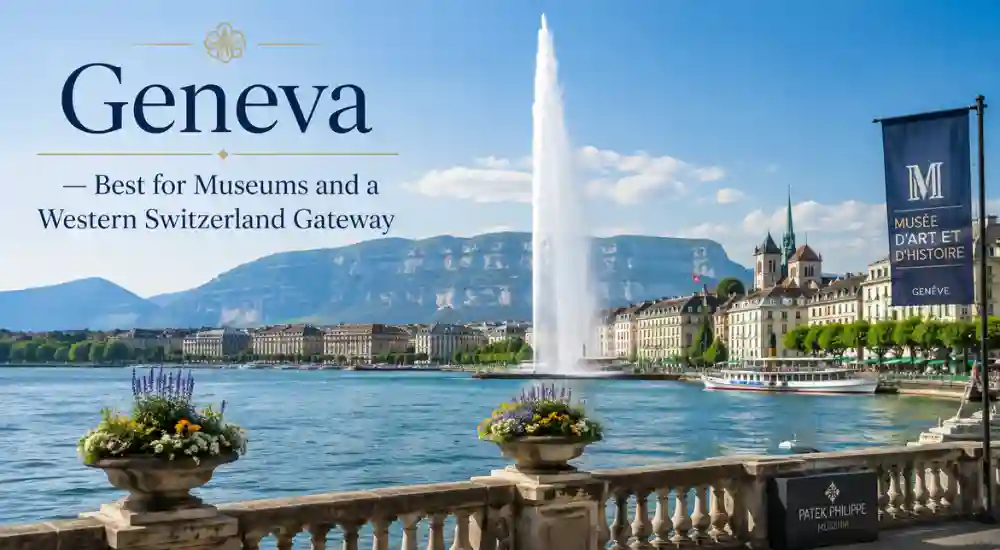
Geneva isn’t where you should go for the classic chalet-and-cowbell version of Switzerland.
Come for Lake Geneva, the Old Town, museums, international institutions, French-speaking culture, and the Jet d’Eau. Geneva Tourism identifies the 140-meter-high Jet d’Eau as one of the city’s defining landmarks.
The city works particularly well at the start or end of a route through Lausanne, Lavaux, and Montreux.
Choose Geneva if: you value museums, urban culture, lake walks, and easy access to western Switzerland.
Skip it if: you have only seven days and dramatic Alpine scenery is your overwhelming priority.
Ideal stay: 1–2 nights
Geneva becomes much more rewarding when you treat it as a city destination, not as a substitute for the Swiss Alps.
10. Basel — Best for Art Lovers and Rainy-Day Sightseeing
If you’ve already seen enough cable cars and mountain viewpoints, Basel is Switzerland’s strongest cultural change of pace.
Basel Tourism describes the city as an art-and-culture center on the Rhine, where historic architecture meets major museums and contemporary design.
Instead of squeezing Basel into a mountain day, build the visit around Old Town, the Rhine, Kunstmuseum Basel, modern architecture, or Fondation Beyeler depending on your interests.
Choose Basel if: art and architecture are major reasons you travel.
Skip it if: museums rarely hold your attention and this is your first short Alpine vacation.
Ideal stay: 1–2 nights
Why Basel Is Useful in a Switzerland Itinerary
Cloud and rain can ruin an expensive mountain-view day. They don’t ruin a museum day.
That makes Basel a useful weather-resistant destination during a longer Switzerland trip.
11. Lausanne — Best for Olympic Culture and Lavaux Day Trips
Lausanne rises steeply from Lake Geneva, so the city changes character as you move between the waterfront and historic upper districts.
The lakeside area around Ouchy, the Olympic Museum, Lausanne Cathedral, museums, parks, and nearby Lavaux vineyards give the city enough variety for a full day or short stay. Lausanne Tourism highlights the city as the Olympic Capital and promotes both lakefront and cultural experiences.
The city’s hills are real, not a minor detail. Public transportation can save energy when moving between the lake and upper city.
Choose Lausanne if: you want a younger-feeling cultural city with easy access to Lake Geneva and Lavaux.
Choose Montreux instead if: you mainly want a romantic waterfront base and Chillon.
Ideal stay: 1–2 nights
12. Appenzell and Alpstein — Best for Traditions and Quieter Mountains
Appenzell feels like a useful reset after Switzerland’s headline resorts.
The town is known for decorated houses, regional traditions, cheese culture, and access to the Alpstein massif. Nearby outdoor highlights include Säntis, Seealpsee, Ebenalp, and Äscher.
This region works especially well for travelers who want Swiss cultural traditions alongside hiking without spending every mountain day around Interlaken or Zermatt.
Choose Appenzell if: you prefer smaller towns, eastern Switzerland, hiking, and regional character.
Skip difficult Alpstein hikes if: conditions are poor or your experience doesn’t match the trail. Photographs can make exposed mountain routes look easier than they are.
Ideal stay: 2 nights, longer for hikers.
13. Kandersteg and Oeschinensee — Best for an Alpine Lake Escape
Oeschinensee is the kind of place that tempts travelers to add “just one more day trip” to an already crowded itinerary.
The lake sits above Kandersteg in the Bernese Oberland and works best when you give the day enough breathing room for the mountain journey, walking, lake scenery, and changing weather.
Important 2026 Oeschinensee Reservation Rule
From June 20 through September 20, 2026, the Kandersteg–Oeschinensee cable-car operator requires an ascent time-slot reservation under its current rules. A valid transport ticket from another seller may not automatically include that time slot.
Current Kandersteg Safety Update
As of the municipality’s August 17, 2026 update, precautions connected with Spitze Stei included an Oeschiwald closure and closure of the hiking route to Doldenhornhütte via Bärentritt. Conditions can change, so check the municipality’s latest update immediately before visiting.
Choose Kandersteg if: an Alpine lake and hiking day matters more than adding another city.
Ideal stay: 1–2 nights
This is one destination where current access information matters more than advice in an old travel article.
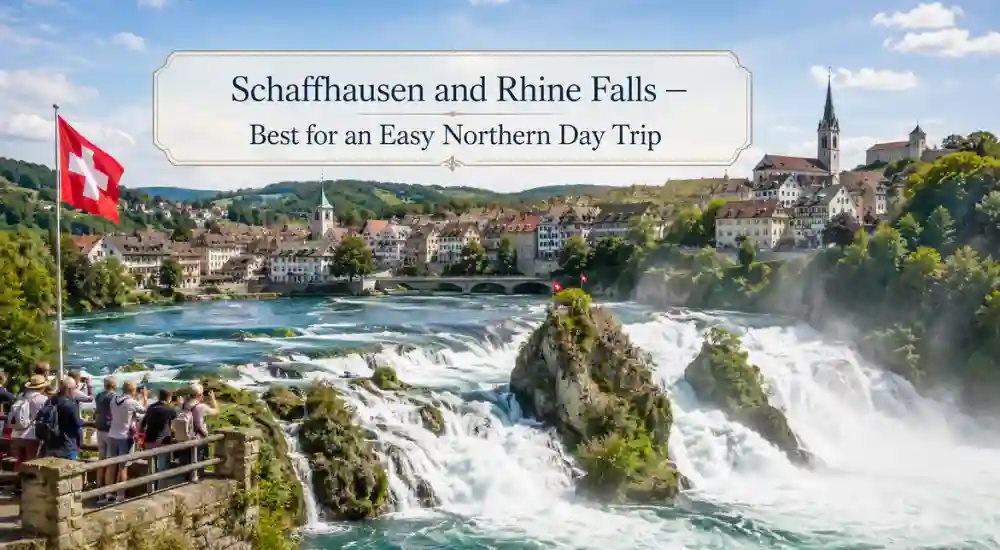
14. Schaffhausen and Rhine Falls — Best for an Easy Northern Day Trip
Rhine Falls gives you something missing from most Alpine itineraries: a major natural attraction at much lower elevation.
The falls sit near Schaffhausen and Neuhausen am Rheinfall, with viewing areas, walking routes, and seasonal boat experiences. Switzerland Tourism identifies Rhine Falls as Europe’s largest waterfall, and the official attraction site maintains current access and visitor information.
Combine the falls with time in Schaffhausen’s old town rather than rushing back immediately after taking photographs.
Choose Rhine Falls if: you’re staying around Zurich and want an easy nature-focused day trip.
Skip it if: your itinerary is already short and you would sacrifice a full day in the Jungfrau Region or Zermatt.
Time needed: Most of a day when combined with Schaffhausen.
Stay inside marked visitor areas around powerful moving water.
15. Gruyères — Best for Medieval History and Swiss Food Culture
Gruyères is small enough for a day trip but distinctive enough that it doesn’t feel like filler between larger destinations.
The car-free medieval town includes Gruyères Castle, Maison du Gruyère, museums, cobbled streets, and views toward the Fribourg Pre-Alps. Switzerland Tourism also highlights the unexpected H.R. Giger Museum, which gives the tiny town a striking contrast between medieval architecture and surreal modern art.
Choose Gruyères if: you want history, architecture, cheese culture, and a slower cultural day.
Skip the overnight stay if: your itinerary is tight. The main town works well as a day trip.
Ideal stay: day trip or 1 night
Gruyères is particularly useful when your schedule already contains enough mountain lifts and needs a different kind of Swiss experience.
16. Swiss National Park and Lower Engadin — Best for Wild Nature
The Swiss National Park is not another mountain resort.
It is a protected landscape where nature conservation shapes what visitors can do. The park has strict rules: visitors must stay on authorized routes, dogs aren’t permitted, camping and fires are prohibited, and winter entry is forbidden.
Use Zernez as a practical base or starting point. The National Park Centre provides route information, while the broader Lower Engadin adds places such as Scuol and mountain villages outside the park boundaries.
Current 2026 Trail Closure
The park currently states that the Route 10 Spöltal section between Punt Periv and Charbunera is closed until at least the end of 2026. Follow current signs and official route updates rather than older hiking maps.
Choose this region if: you want quiet hiking, protected landscapes, wildlife habitat, and fewer resort-style attractions.
Skip it if: you want cable cars, nightlife, or easy winter access.
Ideal stay: 2–3 nights
Which Switzerland Destination Should You Choose?
If you’re still unsure, use these head-to-head decisions.
Lucerne vs. Jungfrau Region
Choose Lucerne for:
- A historic city
- Lake activities
- Easy mountain day trips
- A gentler first introduction
Choose the Jungfrau Region for:
- More dramatic mountain scenery
- Alpine villages
- Serious hiking
- More time surrounded by the Alps
For a first 7–10 day trip, visit both rather than choosing one.
Jungfrau Region vs. Zermatt
Choose Jungfrau for greater variety.
You can move among Lauterbrunnen, Grindelwald, Wengen, Mürren, and Interlaken while choosing from different valleys and mountain excursions.
Choose Zermatt if the Matterhorn itself is one of your primary reasons for visiting Switzerland.
Montreux vs. Lugano
Choose Montreux for Lake Geneva, Lavaux, Chillon, and an easy route toward Interlaken.
Choose Lugano for Italian-speaking Switzerland, palm-lined lake scenery, Ticino food, and a stronger cultural contrast.
Geneva vs. Zurich
Choose Zurich when you’re continuing toward Lucerne or eastern Switzerland.
Choose Geneva when your itinerary focuses on Lausanne, Montreux, and western Switzerland.
Neither city needs to be included simply because your international flight lands there.
How to Combine These Places in 7 or 10 Days
A good Switzerland itinerary should minimize hotel changes and leave some flexibility for mountain weather.
7 Days: Best First-Time Route
Days 1–2: Lucerne
Explore the Old Town and lake. Use one day for a mountain or lake excursion.
Days 3–5: Jungfrau Region
Choose one base and explore nearby villages. Keep your clearest-weather day for the major high-elevation excursion.
Days 6–7: Bern or Zurich
Choose Bern for history or Zurich if it simplifies your departure.
This route gives you city, lake, mountains, villages, and culture without spending every afternoon checking into a hotel.
10 Days: Add the Matterhorn
Days 1–2: Lucerne
Days 3–5: Jungfrau Region
Days 6–8: Zermatt
Days 9–10: Bern, Zurich, or Montreux
Ten days is enough to add another major region without making every day a transfer day.
10 Days: Lakes and Culture Route
For travelers less interested in high-altitude hiking:
Zurich → Lucerne → Bern → Lausanne → Montreux
This route emphasizes cities, architecture, museums, lakefronts, and vineyards, with mountain excursions available rather than dominating the trip.
Common Switzerland Planning Mistakes
Trying to Visit Too Many Places
A two-hour rail journey isn’t only two hours.
Packing, hotel checkout, reaching the station, waiting, transferring, locating the next hotel, and checking in can consume much of a day.
Paying for Every Famous Mountain Excursion
Switzerland has countless free valley walks and viewpoints.
Spend on the mountain trips that genuinely matter to you rather than treating every expensive railway as mandatory.
Ignoring Mountain Weather
A clear morning and cloudy afternoon can create completely different experiences.
When possible, keep expensive high-elevation excursions flexible.
Staying Only in Interlaken
Interlaken is useful, but it isn’t automatically the best base for everyone.
Travelers wanting to wake up inside the mountains may prefer Wengen, Mürren, or Grindelwald.
Assuming Every Pass Covers Everything
Swiss transportation products are excellent, but coverage differs between standard public transport, mountain railways, cable cars, and reservation systems. Check each costly mountain trip rather than assuming your pass covers it fully.
FAQs About the Best Places to Visit in Switzerland
What is the best place to visit in Switzerland for first-time visitors?
Lucerne and the Jungfrau Region make the strongest first-time combination.
Lucerne gives you a historic city and lake, while the Jungfrau Region brings the Alpine villages and mountain scenery most visitors expect from Switzerland.
How many days do you need in Switzerland?
Seven days is enough for two or three well-chosen bases.
Ten to fourteen days gives you more freedom to add Zermatt, Ticino, Lake Geneva, or the Engadin while keeping time for weather changes and slower travel.
Is Lucerne or Interlaken better?
Choose Lucerne if you want a historic city, lakefront, and easy mountain day trips.
Choose the Interlaken/Jungfrau area if mountain scenery is the main purpose of your visit. Interlaken itself is primarily useful as a transport and activity base, while surrounding villages provide more Alpine atmosphere.
Is Zermatt or the Jungfrau Region better?
The Jungfrau Region gives first-time visitors more variety.
Choose Zermatt when the Matterhorn, skiing, or a specific Zermatt hiking experience is central to your trip.
Do you need a car in Switzerland?
Most travelers following a classic first-time route do not need a car.
Switzerland’s rail, bus, boat, and mountain transport systems reach most places in this guide, including several locations where cars provide little advantage.
Is the Swiss Travel Pass worth it?
It can be, especially when you’re taking frequent trains, boats, and local transportation.
However, don’t assume it is automatically the cheapest option. Compare your exact itinerary against the Swiss Travel Pass, Swiss Half Fare Card, and individual fares before buying.
What is the best month to visit Switzerland?
There isn’t one best month for every trip.
Choose summer for broad hiking access and lakes, winter for skiing and snow experiences, and shoulder seasons when cities, culture, or quieter travel matter more than guaranteed high-mountain access.
Is Switzerland good for families?
Yes, especially when you choose fewer bases, manageable walking days, and easy public transportation.
Lucerne, Zurich, the Jungfrau Region, Gruyères, and several lake areas can work particularly well, but always check trail difficulty, stroller access, cable-car rules, and altitude before planning mountain activities with young children.
Final Thoughts
The best places to visit in Switzerland aren’t simply the 16 places you can squeeze onto one map. They are the destinations that fit together into a trip you can actually enjoy.
For a first visit, Lucerne plus the Jungfrau Region is the safest starting combination. Add Zermatt for the Matterhorn, Montreux for Lake Geneva, Lugano for Italian-Swiss culture, or Appenzell and Lower Engadin when quieter landscapes matter more than famous names.
The most important planning decision is also the simplest: choose fewer bases and give each one enough time. Once you know which two or three regions matter most, compare train options, check current mountain access, and build the rest of your trip around them.