

Most Costa Rica trips go wrong for the same reason: someone tries to see the volcano, the cloud forest, and both coastlines in seven days — and spends three of those days staring at a rental car dashboard instead of a waterfall.
This Costa Rica travel guide is built to stop that from happening to you. It’s organized around the decisions that actually determine whether your trip feels relaxed or rushed: which season fits your priorities, which two or three regions to commit to, how to get between them, and what a realistic budget looks like at your travel style.
You’ll find region-by-region breakdowns, national park comparisons, real (not vague) cost ranges, food and culture context, a packing list, and two ready-to-adapt itineraries. Nothing here is padded just to hit a word count — every section exists because it answers a question real travelers ask before booking.
Quick Answer
If you only have one minute: visit during Costa Rica’s dry season (mid-December through April) for the most reliable weather, or the green season (May through November) for lower prices and fewer crowds. Pick two or three regions rather than trying to circle the whole country — a common first-timer pairing is a volcano or cloud-forest base (La Fortuna or Monteverde) with a Pacific beach town (Manuel Antonio or Tamarindo). Seven days covers two regions comfortably; ten to fourteen days allows a fuller loop. Most U.S. travelers don’t need a visa, but always confirm your exact permitted stay length with an official source before booking flights — see the Entry Requirements section below for why this number varies.
At a Glance: Costa Rica Travel Facts
| Category | Detail |
| Capital | San José |
| Official language | Spanish (English widely spoken in tourism) |
| Currency | Costa Rican colón (CRC); U.S. dollars widely accepted |
| Time zone | Central Standard Time (GMT-6), no daylight saving |
| Size comparison | Slightly smaller than West Virginia |
| Protected land | Roughly 25–26% of the country, managed by SINAC |
| Main international airports | Juan Santamaría (SJO, near San José); Daniel Oduber (LIR, Liberia/Guanacaste) |
| Emergency number | 911 |
| U.S. travel advisory (2026) | Level 2 — Exercise Increased Caution, per the U.S. State Department |
| Annual U.S. visitors | Over 1.6 million, per the U.S. Embassy in San José |
TL;DR — Key Takeaways
- Dry season (mid-Dec–April) means reliable sun, but also peak prices and crowds
- Green season (May–Nov) means lower costs and quieter parks, with rain mostly in the afternoons
- Most U.S. citizens don’t need a visa, but confirm your exact allowed stay before booking
- A 4×4 rental car gives the most flexibility once you leave the Central Valley
- Seven days = two regions done well; 10–14 days = a fuller loop
- Corcovado and Tortuguero both require a boat, guide, or small plane to reach — build in extra time
- Costa Rica sits at Level 2 on the U.S. travel advisory (same tier as many popular European destinations)
Best Time to Visit Costa Rica
Costa Rica runs on two seasons, not four, and this single decision shapes almost everything else about your trip — your budget, your crowd tolerance, and which activities are realistic.
The dry season runs from mid-December through April, with January and February delivering the clearest skies nationwide. This is peak tourist season, so expect higher hotel rates, busier trails, and the need to book national park entries and popular tours well in advance.

The green season (May through November) gets an unfair reputation. Mornings are usually sunny; the rain tends to arrive in the afternoon and clears within an hour or two. Locals call it “green” for a reason — the rainforest is genuinely more vivid, waterfalls run fuller, and hotel prices can drop by 20–40% compared to peak season.
Month-by-Month Breakdown
| Period | Conditions | Best For | Trade-Off |
| January–February | Driest, sunniest stretch of the year | Beaches, wildlife viewing, hiking | Highest prices, busiest parks |
| March–April | Still dry, hotter and drier inland | Volcano hikes, road trips | Easter week (Semana Santa) sees a domestic travel surge |
| May–June | Green season begins, mornings clear | Fewer crowds, lush scenery | Afternoon storms become routine |
| July–August | A short dry spell (the veranillo) hits the Pacific side | Rafting (rivers are full), Pacific hiking | Caribbean side stays wetter |
| September–October | Heaviest rainfall of the year, mostly Pacific side | Deep discounts, near-empty parks | Some rural roads and river crossings may be affected |
| November | Transitional month, mix of sun and rain | Shoulder-season value | Weather is genuinely unpredictable |
One detail most guides skip: the two coasts run on opposite rain patterns. When the Pacific side is at its wettest (September–October), the Caribbean coast is often experiencing its driest stretch of the year — a useful fact if your travel dates are fixed and you’re choosing a coast rather than a season.
Highland regions like Monteverde and the slopes around Arenal also run 10–15°F cooler than the coast year-round, regardless of season — pack a light layer even for a “tropical” trip.
Entry Requirements and Trip-Planning Basics
Here’s the one fact worth getting exactly right before you book flights: how long you’re allowed to stay without a visa. Sources genuinely disagree on this, and it’s worth understanding why.
Why the “90 days vs. 180 days” confusion exists
Older references (including archived government summaries) cite a 90-day visa-free limit for U.S., Canadian, UK, and EU citizens. More recent reporting, including current coverage from the U.S. State Department’s own country page, describes a stay of less than 180 days as visa-exempt. In practice, the number stamped in your passport is set by the immigration officer at the point of entry, and it has varied between these two figures depending on the source and the year.
What this means for you: don’t assume either number. Before booking any trip longer than a few weeks, check the current guidance directly at travel.state.gov’s Costa Rica page, which is the authoritative, regularly updated source for U.S. citizens.
Practical Entry Checklist
- Passport validity: Costa Rica technically only requires validity through your stay, but most airlines enforce a 6-month buffer — plan around that stricter standard
- Blank pages: Carry at least one blank page for the entry stamp
- Proof of onward travel: A return or connecting ticket is commonly requested at check-in and at the border
- Proof of funds: Immigration officers may ask for evidence you can support your stay
- Yellow fever vaccination: Only required if arriving from specific higher-risk countries in Africa or South America
- Currency: The colón is the official currency, but U.S. dollars and cards are accepted almost everywhere tourists go; carry some small colón bills for local markets, tips, and rural sodas where card machines are less reliable
- Language: Spanish is official; English is common in tourism-heavy towns but far less so in rural areas — a translation app or basic phrasebook genuinely helps
Always reverify entry rules on an official government source shortly before departure. Immigration policy is exactly the kind of detail that changes without much warning, and getting it wrong at the airport is a far worse outcome than double-checking at home.
Getting Around Costa Rica
The transportation decision matters more here than in most destinations, because Costa Rica’s terrain — steep, mountainous, and often unpaved outside the Central Valley — turns short map distances into long actual drive times.
Your Options, Compared
| Method | Typical Cost | Best For | Watch Out For |
| 4×4 rental car | $50–$100/day, including mandatory local insurance | Multi-region trips, flexibility, remote lodges | Mandatory insurance is often hidden until checkout on third-party booking sites |
| Public bus | $5–$15 per intercity route | Budget travelers, simple point-to-point routes | Slower, fixed schedules, limited luggage space |
| Shared shuttle | $40–$70 per leg | Comfort without driving | Costs add up fast on multi-stop trips |
| Domestic flight (Sansa/other carriers) | $80–$160 one-way | Turning a 4-hour drive into a 30-minute flight | Limited daily departures, especially off-peak |
| Private driver | $130–$300+ per trip | Families, groups, special occasions | Priciest option per person unless split across a group |
A rule of thumb worth remembering: if you’re visiting three or more regions, a rental car often works out cheaper and more flexible than stacking multiple shuttle legs — even after factoring in the mandatory insurance surcharge.
Regional Airport Strategy
If your trip is centered on Guanacaste (Tamarindo, Nosara, Santa Teresa), fly into Liberia (LIR) rather than San José. It’s closer to the beach towns, has noticeably less traffic, and can save four to five hours of driving compared to landing in San José and transferring.

A Note on Remote Parks
Corcovado and Tortuguero aren’t reachable by standard rental car. Corcovado requires a certified guide and typically a boat or short flight from Puerto Jiménez or Drake Bay; Tortuguero is accessible only by boat or small plane through a village with no road connection to the rest of the country. Build an extra travel day into your itinerary for either destination.
Best Regions and Places to Visit
Costa Rica looks compact on a map, and that’s exactly what trips people up. Mountain roads and single-lane bridges mean a 100-mile drive can easily take three hours. Choosing two or three regions — not six — is the single biggest factor in whether your trip feels relaxed.
Region Comparison Table
| Region | Best For | Signature Experience | Ideal Base Length |
| Arenal / La Fortuna | Volcanoes, hot springs, adventure sports | Soaking in a hot spring with a volcano view | 3 nights |
| Monteverde | Cloud forest, birdwatching | Walking a hanging bridge through the mist | 2–3 nights |
| Manuel Antonio / Quepos | Compact wildlife + beach combo | Spotting sloths minutes from the sand | 3 nights |
| Guanacaste (Tamarindo, Nosara, Santa Teresa) | Surf towns, driest climate | Learning to surf on a beginner-friendly break | 3–4 nights |
| Central Valley / San José | Culture, coffee, easy arrival/departure base | A coffee tour on a working highland farm | 1–2 nights |
| Osa Peninsula / Corcovado | Serious wildlife, remote rainforest | A guided hike through the most biodiverse rainforest in Central America | 3 nights |
| Caribbean coast (Puerto Viejo, Cahuita, Tortuguero) | Afro-Caribbean culture, turtle nesting | A canal boat safari past caimans and monkeys | 2–3 nights |
| Uvita / South Pacific | Quieter beaches, whale watching | Walking the whale-tail-shaped sandbar at low tide | 2 nights |
The most common first-timer mistake is trying to combine the Caribbean coast with Guanacaste in one trip — they sit on opposite sides of the country, and the drive between them can eat an entire day. Pick one coast per trip unless you have two full weeks.
Top National Parks and Nature Reserves
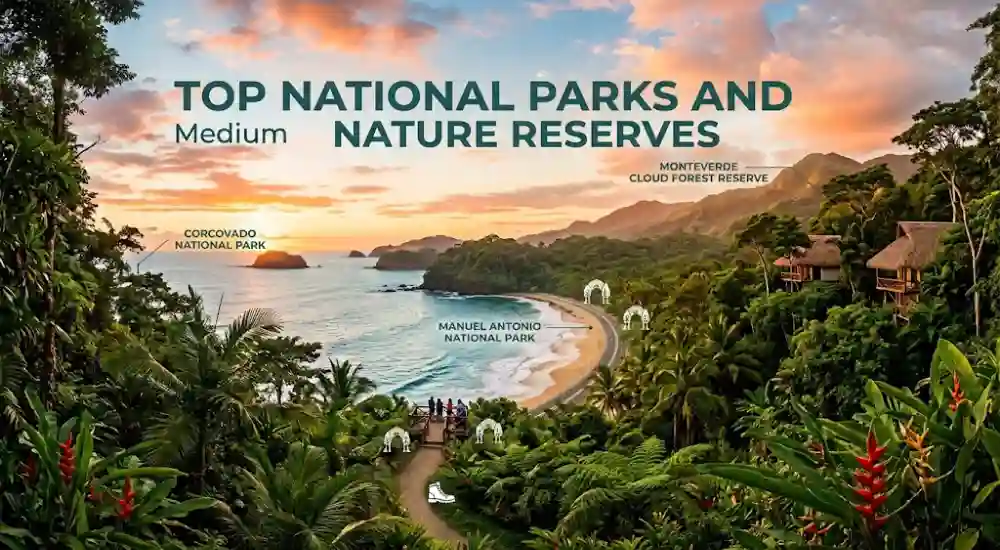
Costa Rica has staked its global identity on conservation — roughly a quarter of the country is protected land, managed through eleven regional conservation areas under SINAC, the national parks authority established in 1976. That’s an unusually high figure worldwide, and it’s the reason wildlife-viewing here feels almost guaranteed rather than lucky.
Each park has a specialty. Trying to visit all of them in one trip usually means rushing through each; picking two or three that match your interests is the better strategy.
National Park Quick-Reference
| Park | Known For | Access | Guide Required? |
| Arenal Volcano NP | Hiking trails, lava-flow terrain, nearby hot springs | Easy, by car from La Fortuna | No |
| Manuel Antonio NP | Compact trails, high wildlife density, beaches | Easy, by car | Recommended, not required |
| Monteverde Cloud Forest Reserve | Quetzals, orchids, canopy bridges (private reserve, not a national park) | Easy, by car | Recommended |
| Corcovado NP | All four Costa Rican monkey species, extreme biodiversity | Boat or flight from Puerto Jiménez/Drake Bay | Yes, mandatory |
| Tortuguero NP | Sea turtle nesting, canal wildlife tours | Boat or small plane only | Recommended for canal tours |
| Rincón de la Vieja NP | Geothermal mud pools, active volcano | Easy, by car from Guanacaste | No |
| Cahuita NP | Caribbean coral reef, easy coastal trail | Easy, by car | No |
| Tenorio Volcano NP | The vivid blue Río Celeste waterfall | Moderate drive, some unpaved road | No |
| Poás Volcano NP | Accessible crater viewpoint | Easy day trip from San José | No |
National park entrance fees for foreign visitors typically fall in the $10–$22 range per person, and several parks — Manuel Antonio and Corcovado among them — cap daily visitor numbers or require advance online booking, especially in dry season. Confirm current fees and reservation windows on SINAC’s official site before your visit date, since these details are adjusted periodically.
Best Beaches in Costa Rica
Two coastlines, two genuinely different vacations. The Pacific coast is drier overall and dominated by surf towns; the Caribbean coast is slower-paced, greener year-round, and culturally distinct, shaped by generations of Afro-Caribbean and Jamaican heritage.
Beach Comparison
| Beach | Coast | Known For | Swimming Conditions |
| Manuel Antonio Beach | Pacific | Calm coves next to the national park | Generally calm, family-friendly |
| Tamarindo | Pacific (Guanacaste) | Nightlife, beginner surf lessons | Moderate waves, watch for currents near the estuary |
| Santa Teresa / Santa Rosa | Pacific (Nicoya) | Surf and yoga culture | Stronger waves, better for intermediate surfers |
| Playa Conchal | Pacific (Guanacaste) | Shell-flecked sand, clear turquoise water | Calm, good for swimming |
| Marino Ballena (Uvita) | Pacific (South) | Whale-tail-shaped sandbar, whale watching season | Check tide times before walking the sandbar |
| Puerto Viejo / Playa Cocles | Caribbean | Surf, Afro-Caribbean culture | Can have strong currents; ask locally before swimming |
| Cahuita Beach | Caribbean | Reef-protected, good snorkeling | Calm near the reef |
| Nosara | Pacific (Nicoya) | Wellness retreats, quieter surf scene | Moderate, popular for longer surf lessons |
| Playa Sámara | Pacific | Sheltered bay | One of the calmer, more swimmer-friendly bays on this coast |
A safety note worth repeating: Costa Rica’s Pacific beaches see a meaningful number of rip current incidents every year. Look for posted flag warnings, ask lifeguards or hotel staff about conditions before swimming at an unfamiliar beach, and treat “calm-looking” water with the same caution as obviously rough water — many rip currents are visually deceptive.

Top Things to Do in Costa Rica
Costa Rica earned its adventure-travel reputation honestly, but the country offers more range than zip lines and volcano photos.
Adventure and Outdoor Activities
- Zip-lining through rainforest canopy near Monteverde or Arenal
- White-water rafting on the Pacuare or Sarapiquí rivers — the Pacuare in particular is regularly ranked among the best rafting rivers in Central America
- Canyoning and waterfall rappelling near La Fortuna
- Surf lessons in Tamarindo, Santa Teresa, or Nosara, all of which have reliable beginner-friendly schools
Wildlife and Nature Experiences
- Guided night walks to spot frogs, insects, and nocturnal wildlife most day-trippers never see
- Sloth-spotting walks in Manuel Antonio or Cahuita
- Boat safaris through Tortuguero’s canals, where sightings of caimans, monkeys, and dozens of bird species are common
- Whale and dolphin watching near Uvita, best from roughly July–October and December–March when humpback populations pass through
Culture and Local Life
- Coffee plantation tours in the Central Valley highlands, where Costa Rica’s high-altitude beans are grown
- A visit to a working farm for hands-on chocolate or sugarcane processing
- A soda meal — see the Food and Culture section below for why this matters more than most guides mention
Booking tip: popular activities like Pacuare rafting and Corcovado wildlife tours sell out during peak dry-season weeks. If your trip falls in January, February, or Easter week, book these specific experiences before you land, not after.

Food and Culture: What to Expect Beyond the Itinerary
Most Costa Rica guides skip this entirely, which is a mistake — food and everyday culture shape how a trip actually feels far more than any single attraction does.
What You’ll Actually Eat
The national dish is gallo pinto — rice and beans cooked together with onion, cilantro, and Salsa Lizano, a mildly sweet condiment Costa Ricans put on nearly everything (buy a bottle to bring home; it’s the closest thing the country has to a signature flavor). It’s served at breakfast alongside eggs and fried plantain, and it reappears at other meals as a side.
The everyday lunch or dinner plate is called a casado — rice, black beans, salad, fried plantain, and a protein of your choice. You’ll find it at sodas, the small, family-run restaurants that serve as Costa Rica’s real culinary backbone. A casado at a soda typically costs a fraction of a tourist-restaurant entrée and is usually fresher.
Other dishes worth trying: chifrijo (a layered bar snack of fried pork, beans, and pico de gallo), fresh ceviche on the coasts, and café chorreado, traditional drip coffee made through a cloth filter.
Tipping Norms
Tipping isn’t mandatory. Many restaurants already add a 10% service charge to the bill. Rounding up or leaving a small additional amount is appreciated but not expected, especially outside heavily touristed towns.
The “Pura Vida” Context
You’ll hear Pura Vida — literally “pure life” — used as a greeting, a farewell, an answer to “how are you,” and a general life philosophy. It’s not just a tourism slogan; Costa Rica abolished its military in 1948 and has since built national identity heavily around conservation, peace, and quality of life, which is part of why the country punches so far above its size in global recognition.
Free and Budget-Friendly Things to Do
Costa Rica has a reputation for being expensive by regional standards, but a surprising amount of the best experiences cost nothing.
- Public beach access is free almost everywhere, including the public entrance to Manuel Antonio’s beach area
- Wildlife spotting from a public trail or even a town sidewalk is often free — sloths and monkeys don’t require a paid tour to see
- Farmers markets (ferias) in towns like Santa Ana or Escazú offer cheap, fresh food and a real slice of local life
- Sunset viewing from any public beach or highland overlook costs nothing
- Self-guided walks through Cahuita or Puerto Viejo let you take in Caribbean culture without booking anything
- Some smaller waterfall trails near La Fortuna charge modest entrance fees far below the cost of a guided tour
- Green-season travel alone can cut accommodation and tour costs by 20–40%
- Sodas consistently serve full meals for a fraction of tourist-restaurant prices — this is the single easiest budget lever in the country
Costa Rica for Families
Short travel distances between activities and a high concentration of easy, high-payoff wildlife experiences make Costa Rica a genuinely strong family destination — Manuel Antonio and La Fortuna are the two most stroller- and kid-friendly bases.
- Manuel Antonio’s short, flat trails and calm beach coves suit younger kids well
- Tortuguero’s boat safaris let kids see wildlife without a demanding hike
- Many Guanacaste and Manuel Antonio hotels have pools, useful for filling unstructured afternoon time
- Zip-lining and canopy tours often carry minimum age or weight requirements — confirm before booking, not after arriving
- Hot springs near La Fortuna offer a low-effort way to unwind after a travel day
- Jaguar Rescue Center near Puerto Viejo is a well-regarded, kid-friendly wildlife rehabilitation stop
- Car seat availability with rental agencies varies — arrange this in advance rather than assuming it’s included
- Building a slow beach day between activity-heavy days prevents overtired kids and overtired parents alike
- Bathrooms and reliable food options are easiest to find in established tourist towns, not remote parks — plan accordingly for longer excursions
Romantic Getaways and Honeymoon Ideas

Jungle privacy paired with coastal scenery is why Costa Rica has become a genuine honeymoon competitor to more traditional destinations — without the crowds of somewhere like Cancún or the Amalfi Coast.
- Boutique rainforest lodges near Manuel Antonio or Monteverde often beat large resorts on privacy and setting
- Sunset catamaran cruises along the Guanacaste coast are a popular splurge for anniversaries and honeymoons
- Private hot spring resorts near La Fortuna, including properties like Tabacón Resort, offer a quieter, more curated experience than the public thermal rivers nearby
- Santa Teresa and Nosara suit couples who want a slower, less crowded beach scene than Tamarindo
- Private guided hikes can be arranged in Monteverde or Corcovado for a quieter, more intimate wildlife experience
- Pairing one adventure-region stay with one beach-region stay gives a honeymoon both energy and downtime — a structure that consistently works better than an all-adventure or all-beach trip
Solo Travel in Costa Rica
Costa Rica has one of the more established backpacker infrastructures in Central America, which makes it genuinely manageable for solo travelers — especially along the well-worn La Fortuna → Monteverde → Manuel Antonio corridor.
- Hostels in major hubs (La Fortuna, Monteverde, Manuel Antonio, Santa Teresa) have active social scenes built around shared shuttle schedules
- Shared shuttles are one of the easiest ways solo travelers naturally end up traveling with the same small group for days
- Group tours — rafting, zip-lining, wildlife walks — are a low-effort way to meet people without pre-planning
- Public buses are budget-friendly and reliable for solo point-to-point travel
- Avoid walking alone on isolated beaches or trails after dark — a standard precaution here as in most destinations
- Keep a digital and physical copy of your passport stored separately from the original
- If heading into a genuinely remote area like the Osa Peninsula, tell someone your general plan and expected return
Costa Rica’s current U.S. travel advisory sits at Level 2 — Exercise Increased Caution, the same tier as many popular destinations in Western Europe. It reflects petty crime concerns more than a systemic safety crisis, but normal precautions still apply, solo or otherwise.
Budget Travel Tips
Costa Rica costs more than most of its Central American neighbors, but a genuinely lean trip is realistic with the right choices.
- Public buses cost a fraction of shuttles or rental cars for intercity travel
- Green season travel (May–November) is the single biggest lever — both lodging and tours drop noticeably in price
- Sodas offer full, fresh meals well below tourist-restaurant prices
- Self-catering in a rental with kitchen access can cut food costs significantly, especially for breakfast and lunch
- Free beaches, viewpoints, and town walks fill itinerary time without extra spending
- Booking key tours in advance locks in lower rates before peak-season price increases hit
- A realistic budget-traveler daily spend, excluding international flights, typically runs $45–$80/day
- Splitting a rental car and fuel among a small group often beats paying for multiple individual shuttle legs
- Avoid booking domestic flights last-minute — fares climb sharply as departure approaches
Luxury Costa Rica Experiences
Costa Rica’s high end leans into privacy, sustainability, and personalized service rather than scale — think six-room jungle lodges, not sixty-story beachfront towers.
- Private domestic flights or transfers skip long, winding drives between regions entirely
- All-inclusive resorts along the Papagayo Peninsula pair beachfront access with full-service dining
- Private guided wildlife tours in Corcovado or Tortuguero offer a quieter, less crowded experience than group departures
- Wellness-focused retreats near Nosara combine yoga, spa treatments, and organic dining
- Remote eco-lodges on the Osa Peninsula offer genuine seclusion with minimal crowds
- Properties like Arenal Observatory Lodge — the only hotel located inside Arenal Volcano National Park itself, built on a former Smithsonian research station — offer a rare combination of proximity and exclusivity
- Private chef and in-villa dining are common at upscale rainforest properties
- A realistic luxury daily budget, excluding flights, commonly runs $250–$500+ per person, depending on lodging tier and private transport
Sample Costa Rica Itineraries
A realistic itinerary respects Costa Rica’s winding roads. Most successful trips commit to two or three regions and move between them slowly, rather than criss-crossing the country to check boxes.
7-Day Itinerary: Arenal + Manuel Antonio
| Day | Focus |
| 1–3 | Arrive (San José or Liberia), transfer to La Fortuna: volcano hikes, hot springs, waterfall visits |
| 4 | Travel day to Manuel Antonio (allow most of the day for the transfer) |
| 5–6 | Manuel Antonio National Park, beach time, a wildlife or boat tour |
| 7 | Depart via San José or a connecting transfer |
10-Day Itinerary: Monteverde + Arenal + South Pacific
| Day | Focus |
| 1–3 | Monteverde: cloud forest hikes, hanging bridges, birdwatching |
| 4–5 | La Fortuna: Arenal Volcano views, hot springs |
| 6–8 | Manuel Antonio or Uvita: beach time, wildlife, seasonal whale watching |
| 9–10 | Optional extension toward the Osa Peninsula for a guided Corcovado visit, or a relaxed final beach stretch |
Both itineraries assume region-to-region drives of three to five hours on winding roads — build that into your expectations rather than treating it as a quick hop. If traveling in green season, add a flexible buffer day, since heavy rain can occasionally affect road and river crossing conditions.
Where to Stay: Best Areas by Travel Style

Matching your base to your travel style saves real time and keeps your daily rhythm aligned with what’s actually nearby.
- La Fortuna — best for volcano views, hot springs, easy access to waterfalls and canopy tours
- Monteverde/Santa Elena — best for cloud forest hikes and a cooler, quieter highland pace
- Manuel Antonio/Quepos — best for families wanting beach and rainforest wildlife together
- Tamarindo — best for nightlife, surf lessons, and a livelier beach-town feel
- Nosara or Santa Teresa — best for a slower, wellness-focused surf and yoga scene
- Puerto Viejo — best for Caribbean culture, reggae-influenced nightlife, laid-back pace
- Central Valley (Escazú, Santa Ana) — best as a short arrival or departure base near San José
- Uvita — best for a quieter alternative to Manuel Antonio with whale-watching access
Packing List Essentials
Costa Rica’s climate punishes both overpacking and underpacking in specific ways — here’s what actually earns a spot in your bag.
- Lightweight rain jacket — even in dry season, sudden showers happen
- Quick-dry clothing — humidity means cotton stays damp for hours
- Sturdy hiking sandals or trail shoes — many trails are muddy even outside rainy season
- Reef-safe sunscreen — some parks and marine reserves require it
- A dry bag — for boat tours, waterfalls, and rafting days
- Light layer or fleece — highland areas like Monteverde and Arenal run noticeably cooler
- Bug spray with DEET or picaridin — especially for evening activities near water
- A universal power adapter — Costa Rica uses U.S.-style outlets (Type A/B), so U.S. travelers usually don’t need one, but non-U.S. travelers will
- Cash in small colón bills — for sodas, tips, and rural areas where cards aren’t reliable
- A basic Spanish phrase list — genuinely useful outside major tourist towns
Safety, Weather, and Practical Travel Tips
Costa Rica is generally considered one of the safer countries in Central America for tourists, but “generally safer” is not the same as risk-free, and it’s worth being specific about what the actual risks are.
As of April 2026, the U.S. State Department maintains Costa Rica at Level 2 — Exercise Increased Caution, citing petty crime as common and noting that violent crime, while less frequent, does affect tourists in some cases. That places Costa Rica in the same advisory tier as many popular Western European destinations — a real risk level, not a crisis, but not nothing either.
Practical Safety Guidance
- Don’t leave valuables visible in a parked rental car, especially overnight — vehicle break-ins are one of the most commonly reported issues affecting tourists
- Check local swimming conditions and rip current warnings before entering the ocean; the State Department specifically flags water safety as a recurring risk
- Stay on marked trails in rainforest areas to avoid both ecological damage and snake encounters
- Hire a certified guide for parks like Corcovado, where one is legally required
- Enroll in the State Department’s STEP program if you’re a U.S. citizen — it’s free and makes it easier for the embassy to reach you in an emergency
- Avoid displaying visible wealth (expensive jewelry, watches) — a specific recommendation in the current advisory
- Carry a light rain layer even in dry season
- Watch for slippery conditions on cloud forest trails and near waterfalls
- Be aware of hurricane season risk on the Caribbean side later in the year
- Dial 911 for any emergency, anywhere in the country
- Confirm reservation requirements and entrance fees for national parks shortly before your visit, since these shift periodically
Frequently Asked Questions
How many days do you need in Costa Rica?
Seven days comfortably covers two regions, such as a volcano area and a beach town. Ten to fourteen days allows a fuller loop across three or more regions with real downtime built in, rather than a packed sightseeing schedule.
Is Costa Rica safe for tourists?
Costa Rica sits at Level 2 (Exercise Increased Caution) on the current U.S. travel advisory — the same tier as several popular European destinations. Petty theft, including vehicle break-ins, is the most common issue affecting visitors; standard precautions like securing valuables and avoiding isolated areas after dark go a long way.
Do you need a car to get around Costa Rica?
Not strictly, but a 4×4 rental car adds real flexibility, especially for multi-region trips or reaching remote lodges. Travelers sticking to the main tourist corridor can rely comfortably on public buses or shared shuttles instead.
What is the best month to visit Costa Rica?
January and February offer the driest, sunniest conditions but also the highest prices. May, June, and November are strong shoulder-season picks, balancing decent weather with noticeably lower costs.
Is Costa Rica expensive to visit?
It’s pricier than most Central American neighbors, but budget travel is realistic. Expect roughly $45–$80/day for a budget trip, $90–$160/day mid-range, and $250+/day for a luxury experience — all figures excluding international flights.
Do U.S. citizens need a visa for Costa Rica?
Most U.S. citizens don’t need a tourist visa and receive an entry stamp on arrival. The exact permitted stay length has been reported as both 90 and 180 days depending on the source and year — confirm the current figure directly at travel.state.gov before booking a trip longer than a few weeks.
Is Costa Rica good for a honeymoon?
Yes — its combination of private rainforest lodges and two distinct coastlines makes it a strong honeymoon choice, particularly for couples who want a mix of adventure and relaxation rather than an all-resort trip.
What food should first-time visitors try?
Start with gallo pinto (rice and beans) at breakfast, a casado (full plate lunch) at a local soda, and Salsa Lizano on nearly everything — it’s the flavor most associated with Costa Rican home cooking.
Do I need travel insurance for Costa Rica?
It isn’t legally required, but the U.S. State Department specifically recommends it, including coverage for medical care and emergency evacuation, given Costa Rica’s active volcanic and earthquake zones and the cost of medical evacuation from remote areas like Corcovado or Tortuguero.
Conclusion
Costa Rica rewards travelers who plan around a realistic pace instead of trying to see everything in one trip. The country’s biggest planning trap isn’t picking the wrong destination — it’s picking too many of the right ones and running out of time to actually enjoy them.
Start with your season, based on whether reliable weather or lower costs matters more to you. Commit to two or three regions rather than six. Then build your route around realistic drive times, book your national park entries before your flights, and leave at least one unscheduled day for the trip to surprise you.
That’s the entire framework behind this guide — and it’s the difference between a Costa Rica trip that feels like a checklist and one that actually feels like a vacation.