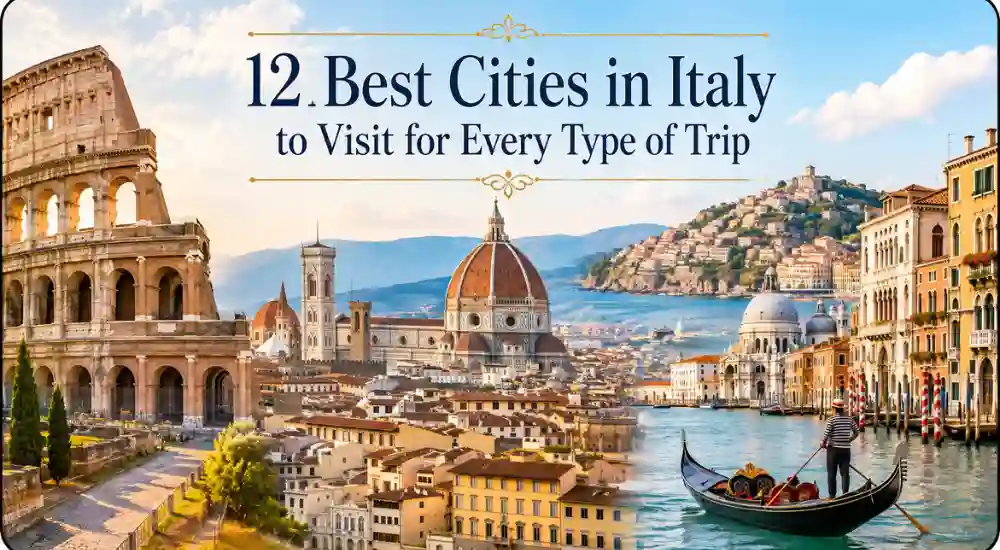
Planning an Italy trip gets difficult for one simple reason: too many cities deserve your time. Rome can fill several days with ancient sites, Florence packs world-famous art into a compact center, and Venice offers a city experience that works completely differently from anywhere else.
This guide compares 12 of the best cities in Italy to visit by travel style, ideal stay, standout experiences, transportation, regional pairings, and practical tradeoffs. The goal isn’t to squeeze every famous place into one vacation. It’s to help you choose cities that fit together and make your trip feel enjoyable rather than rushed.
Quick Answer: Which Cities in Italy Should You Visit?
For a first trip to Italy, the easiest starting trio is Rome, Florence, and Venice. Together, they cover ancient history, Renaissance art, famous architecture, and three very different urban experiences. Official Italian tourism guidance also highlights Rome, Venice, Milan, Florence, Naples, and other major art cities as key destinations across the country.
If you have more time, add Bologna for food, Naples for archaeology and street life, Milan for fashion and design, Palermo for Sicilian culture, or Matera and Lecce for a slower southern route.
Best Cities in Italy at a Glance
| City | Region | Best For | Suggested Stay | Car Needed? | Great Pairing |
|---|---|---|---|---|---|
| Rome | Lazio | Ancient history, first trips | 3–4 days | No | Florence |
| Florence | Tuscany | Renaissance art, walking | 2–3 days | No | Bologna |
| Venice | Veneto | Canals, couples, photography | 2–3 nights | No | Verona |
| Milan | Lombardy | Fashion, design, modern culture | 2 days | No | Turin |
| Naples | Campania | Food, archaeology, city energy | 2–3 days | No | Pompeii |
| Bologna | Emilia-Romagna | Food, markets, easy rail trips | 2 days | No | Florence |
| Verona | Veneto | Roman history, romantic breaks | 1–2 days | No | Lake Garda |
| Turin | Piedmont | Museums, palaces, cafés | 2 days | No | Milan |
| Genoa | Liguria | Maritime history, Ligurian food | 2 days | No | Camogli |
| Palermo | Sicily | Markets, architecture, street food | 2–3 days | Usually no | Monreale |
| Lecce | Puglia | Baroque architecture, Salento | 2 days | Helpful for coast | Southern Puglia |
| Matera | Basilicata | Cave districts, views, photography | 1–2 nights | Helpful regionally | Puglia |
Best overall first-trip combination: Rome + Florence + Venice
Best food combination: Bologna + Naples + Palermo
Best less-obvious combination: Turin + Genoa + Bologna
Best southern route: Naples + Matera + Lecce
How These Italian Cities Were Chosen
This isn’t meant to be a list of every attractive city in Italy. Italy’s official tourism portal alone features dozens of cities from north to south, ranging from Rome and Florence to Turin, Genoa, Palermo, Bari, Lecce, Matera, Trieste, and smaller regional centers.
The cities below earn their place because they provide a distinct travel experience and make sense in real itineraries. The selection considers:
- Cultural and historical value
- How different the city feels from other stops
- Quality of major attractions and neighborhoods
- Food and regional identity
- Ease of arriving and getting around
- Usefulness in a multi-city itinerary
- Value for first-time and repeat visitors
- Nearby destinations worth combining
- Whether the city deserves an overnight stay
The result is not a strict beauty ranking. A food traveler may enjoy Bologna more than Milan, while an art lover could happily give Florence more time than Venice.
Rome — Give the Eternal City More Time
Rome is the city most likely to expose an overpacked itinerary. Ancient ruins, monumental churches, museums, fountains, piazzas, archaeological areas, and entire neighborhoods compete for your time. Italy’s official tourism site describes the capital as a destination with an enormous artistic heritage and highlights both its classical sites and lesser-known attractions.
A rushed visit can turn Rome into a race between landmarks. A better plan is to give it three or four full sightseeing days and organize each day by area.
Why Choose Rome?
Choose Rome when you want ancient history on the largest scale.
The familiar names matter: the Colosseum, Roman Forum, Pantheon, Trevi Fountain, Piazza Navona, and the Vatican area. Yet some of Rome’s best moments come between them—walking into a quiet church, finding a small piazza, or staying out after the major tour groups disappear.
A Smarter Way to Plan Rome
Instead of crossing the city repeatedly, divide sightseeing geographically.
One day: Colosseum, Roman Forum, Capitoline area One day: Historic center, Pantheon, Piazza Navona, Trevi area One day: Vatican-area sightseeing and nearby neighborhoods Extra day: Trastevere, Monti, parks, museums, or less-famous sites
Italy’s official tourism portal even publishes a two-day Rome route, which shows that a short visit is possible. For a first trip, however, adding extra time creates much more breathing room.
Rome Is Best For
- First-time Italy visitors
- Ancient Roman history
- Major museums
- Architecture
- Food-focused neighborhood walks
- Travelers who enjoy full sightseeing days
Think Twice If
Rome is less suitable when you want a small, quiet city break with minimal transportation and short walking distances.
Florence — The Easiest Major Art City to Explore on Foot
If Rome feels enormous, Florence feels concentrated. Many of its best-known sights sit within a historic center that rewards walking, making it easier to combine serious museums with street-level sightseeing.
Want extra context on the style you’ll see across Florence? Read this concise overview of Renaissance architecture.
Florence is closely tied to the Renaissance and contains major museums, historic neighborhoods, architecture, artisan traditions, and surrounding Tuscan landscapes. Italy’s tourism authority specifically highlights its historic center, museums, crafts, neighborhoods, and art heritage.
Why Florence Works So Well on a First Trip
You can spend the morning around the Duomo, continue toward Piazza della Signoria, visit a major museum, walk across Ponte Vecchio, and finish in Oltrarno without building the day around long transportation.
That convenience makes Florence especially valuable on a multi-city trip.
Don’t Turn Florence Into a Museum Marathon
The Uffizi and Accademia are obvious priorities for many art lovers, but scheduling too many indoor attractions can make Florence surprisingly exhausting.
Mix major art with:
- Piazza della Signoria
- Ponte Vecchio
- Oltrarno
- Artisan streets
- Historic cafés
- Gardens and viewpoints
- An unscheduled evening walk
Official tourism guidance also promotes Florence beyond its headline museums, including crafts, neighborhoods, historic cafés, gardens, and alternative city experiences.
Florence Is Best For
- Renaissance art
- Architecture
- Couples
- Walkable sightseeing
- Photography
- First-time travelers
- Tuscany extensions
Ideal Stay
Two full days can cover the core experience. Three days are better if art is a major reason for your trip.
Venice — Stay After the Day-Trippers Leave
Venice isn’t simply another historic Italian city. Its canals function as waterways, while bridges and pedestrian lanes shape how you move through the historic center. Official Italian tourism information describes Venice as a city spread across islands joined by hundreds of bridges and separated by canals.
That makes practical planning important. Luggage, bridges, water transport, accommodation location, and crowd timing matter here more than they do in Bologna or Turin.
Why Venice Deserves an Overnight Stay
A day trip can show you St. Mark’s Square, Rialto, and the Grand Canal, but it also exposes you to Venice during its busiest hours.
Staying overnight gives you access to quieter early mornings and evenings. That’s when wandering through Cannaregio, Dorsoduro, or smaller lanes becomes much more rewarding.
Don’t Spend the Whole Trip Around San Marco
Include the famous center, then leave it.
Consider:
- Walking through Cannaregio
- Exploring Dorsoduro
- Riding a vaporetto along the Grand Canal
- Visiting Murano
- Visiting Burano
- Finding quieter canals away from the main route
- Leaving one hour completely unscheduled
Accessibility and Luggage Matter
Historic Venice includes many bridges and steps. Travelers with limited mobility should check accessible routes and transport information before choosing accommodation. Venice’s official visitor service maintains dedicated trip-planning and accessibility information.
Important Venice Update for 2026
The City of Venice confirms that its 2026 Access Fee trial ended on July 26, 2026. From July 27, 2026, the fee is no longer in effect and no payment or exemption request is required under that trial. Future years may be subject to new measures, so travelers should verify the official city information before visiting.
Venice Is Best For
- Couples
- Architecture
- Photography
- Art
- Slow wandering
- Travelers wanting an experience unlike Italy’s road-based cities
Ideal Stay
Plan two nights minimum if possible. Add a third night if you want lagoon islands or a slower pace.
Milan — Choose It for Fashion, Design, and a Faster Pace
Milan is the easiest city on this list to misunderstand.
Travelers expecting another Florence may be disappointed. Milan works better when you value fashion, design, modern culture, shopping, contemporary neighborhoods, museums, and urban energy.
Official tourism information describes Milan as an international fashion and design center that also preserves major cultural sites, museums, churches, and Renaissance heritage.
What Makes Milan Different?
The city’s appeal comes from contrast.
You can move from the Gothic Duomo to the elegant Galleria Vittorio Emanuele II, then visit Brera, explore design-focused spaces, and finish around the Navigli.
Leonardo’s Last Supper at Santa Maria delle Grazie also gives Milan one of Italy’s most famous individual artworks.
Should First-Time Visitors Choose Milan?
Choose it when fashion, design, shopping, modern Italy, or Leonardo rank high on your interests.
Consider saving Milan for a second trip if your first visit is short and you’re choosing between Milan and Rome, Florence, or Venice.
Milan Is Best For
- Fashion
- Design
- Shopping
- Contemporary culture
- Nightlife
- Leonardo fans
- Northern Italy itineraries
Ideal Stay
Two days are enough for a focused first visit. Stay longer if you’re adding museums, shopping, or nearby Lombardy destinations.
Naples — Come for the Food, Stay for the History
Naples doesn’t ask travelers to admire it from a distance. Its historic streets put churches, cafés, street food, markets, apartment balconies, scooters, monuments, and everyday life into a dense urban setting.
Official tourism information emphasizes Naples’ historic center, cultural layers, food traditions, waterfront setting, museums, and nearby attractions. It also provides a dedicated two-day city itinerary.
Why Naples Belongs on More Italy Trips
Naples provides something that Rome, Florence, and Venice cannot: a strong gateway into Campania’s archaeology and southern urban culture.
The National Archaeological Museum, historic center, churches, street-food traditions, castles, and views across the Bay of Naples can fill several days before you even consider excursions.
Naples and Pompeii Need Separate Time
A common mistake is treating Naples only as a hotel base for Pompeii.
If archaeology matters, dedicate a full outing to Pompeii and keep at least another day for Naples itself. The city’s museums and historic center add context rather than simply duplicating the archaeological site.
Eat Beyond One Pizza
Pizza is essential, but Naples’ food story goes further.
Look for:
- Pizza
- Fried pizza
- Sfogliatella
- Street snacks
- Espresso culture
- Traditional pastries
- Neighborhood markets
Italy’s tourism site specifically highlights Naples’ street-food culture as part of the city’s identity.
Naples Is Best For
- Food travelers
- Archaeology
- Street life
- Historic neighborhoods
- Travelers who like energetic cities
- Pompeii-based itineraries
Ideal Stay
Give Naples two or three days, plus separate time for major excursions.
Bologna — Come for the Food, Stay for the City
Bologna is often treated as a useful train station between Venice, Florence, Milan, and Rome.
That undersells it.
The capital of Emilia-Romagna combines Piazza Maggiore, medieval streets, historic markets, university life, porticoes, churches, and one of Italy’s strongest regional food traditions. Its famous porticoes are recognized by UNESCO, while official tourism material highlights fresh pasta, ragù, mortadella, markets, music, and historic architecture.
Why Bologna Works in a Busy Itinerary
Bologna provides contrast without creating difficult logistics.
You don’t need to spend three days moving between giant attractions. A focused stay can revolve around walking, markets, churches, food, and neighborhoods.
Italy’s official tourism portal even offers a one-day walking itinerary from the station through major central landmarks.
What to Prioritize
- Piazza Maggiore
- Basilica of San Petronio
- Santo Stefano
- Historic porticoes
- Quadrilatero area
- Traditional markets
- Fresh pasta
- A slow evening meal
Bologna Is Best For
- Food lovers
- Train-based itineraries
- Couples
- Short city breaks
- Travelers who enjoy walking
- Repeat Italy visitors
Ideal Stay
Two days give Bologna enough time to feel like a destination rather than a lunch stop.
Verona — More Than Romeo and Juliet
Verona is often sold through one story: Romeo and Juliet.
That is useful marketing, but it is not the main reason to stay.
Verona has more than two thousand years of history and combines its Roman heritage with squares, bridges, riverside views, medieval streets, and the famous Arena di Verona. Official Italian tourism guidance emphasizes both the city’s long history and its cultural attractions beyond the Shakespeare connection.
Why Choose Verona?
Choose Verona if Venice sounds appealing but you also want a compact historic city with conventional streets, easier movement, and fewer major sightseeing demands.
The center works particularly well for an overnight break.
What to See
- Arena di Verona
- Piazza delle Erbe
- Castelvecchio
- Adige riverfront
- Historic center
- Juliet’s House, if the literary connection interests you
Pair Verona With Lake Garda
Verona also works as part of a wider Veneto and Lake Garda trip. Official tourism content frequently connects the city with nearby Garda experiences.
Verona Is Best For
- Couples
- Roman history
- Short breaks
- Opera and culture
- Lake Garda combinations
- Travelers wanting a smaller alternative to major capitals
Ideal Stay
Plan one full day and one night, or two days at a slower pace.
Turin — One of the Best Alternatives to Italy’s Famous Trio
If you’ve already visited Italy’s headline cities, Turin is one of the strongest places to go next.
The Piedmont capital combines Baroque architecture, former royal residences, museums, arcades, café traditions, chocolate, and a more formal northern atmosphere. Italy’s official tourism authority highlights its Savoy heritage, Royal residences, National Cinema Museum, food culture, and architecture.
Why Turin Deserves More Attention
Turin has genuinely major museums without feeling like a city built around tourism.
Two standouts are:
- Egyptian Museum
- National Cinema Museum inside the Mole Antonelliana
Add the royal areas, historic cafés, covered arcades, aperitivo culture, and chocolate traditions, and Turin can comfortably fill a weekend.
Turin or Milan?
Choose Milan for fashion, design, shopping, and a faster modern-city feeling.
Choose Turin for palaces, museums, grand cafés, and a slower cultural break.
Turin Is Best For
- Museums
- Architecture
- Chocolate and café culture
- History
- Repeat visitors
- Quieter northern itineraries
Ideal Stay
Two days work well for a first visit.
Genoa — Choose It for Maritime History and Ligurian Character
Genoa is not polished in the same way as Florence, nor does it try to be.
Its appeal lies in the relationship between old alleyways, grand palaces, hills, waterfront areas, maritime history, and Ligurian food.
Official tourism information highlights Genoa’s historic center, Palazzi dei Rolli, Old Port, Aquarium, hills, coastal position, and strong maritime identity.
Why Genoa Feels Different
The city is squeezed between mountains and sea, so streets rise, drop, narrow, and open unexpectedly.
That physical layout creates character, but it also means travelers with limited mobility should plan carefully.
What to Prioritize
- Old Port
- Historic center
- Palazzi dei Rolli
- Strade Nuove
- Genoa Aquarium
- Ligurian food
- Pesto and focaccia
- Waterfront walks
Use Genoa as a Ligurian Base
Genoa also places travelers within reach of Camogli, Portofino, and other Ligurian coastal destinations. Official tourism guidance presents the city as a gateway to the surrounding Riviera.
Genoa Is Best For
- Maritime history
- Families
- Architecture
- Seafood and Ligurian food
- Repeat Italy trips
- Coastal extensions
Ideal Stay
Allow two days for Genoa itself before moving toward the coast.
Palermo — Sicily in One Intense City Break
Palermo makes a strong case for travelers who want history to feel layered rather than neatly separated.
Churches, aristocratic buildings, working neighborhoods, markets, street food, and architectural influences from different eras overlap throughout the Sicilian capital. Official tourism guidance describes Palermo as a crossroads of cultures and highlights its markets, Arab-Norman heritage, churches, architecture, and culinary traditions.
Why Palermo Is Worth the Flight or Ferry
Palermo isn’t simply a southern alternative to Rome.
It delivers a distinctly Sicilian experience through:
- Palermo Cathedral
- Palazzo dei Normanni
- Palatine Chapel
- Quattro Canti
- Historic markets
- Arab-Norman architecture
- Street food
The Arab-Norman monuments of Palermo, together with sites in nearby Cefalù and Monreale, form an important recognized heritage group.
Markets Are Part of the Sightseeing
Don’t separate food from culture here.
Markets such as Ballarò help explain Palermo through ingredients, noise, movement, street cooking, and neighborhood life.
Add Monreale
When you have extra time, Monreale is one of the most logical additions because it expands the architectural story beyond central Palermo.
Palermo Is Best For
- Street food
- Markets
- Architecture
- Southern history
- Photography
- Repeat Italy travelers
- Sicily-focused trips
Ideal Stay
Allow two or three full days before adding longer Sicilian excursions.
Lecce — The Best City Base for a Slower Salento Trip
Lecce earns its place through detail rather than scale.
The historic center uses warm local stone for elaborate Baroque façades, churches, balconies, and small architectural details. Roman remains add another layer beneath the later city.
Official tourism guidance calls Lecce the heart of Salento and highlights its Baroque center, Roman heritage, local stone, food, and access to nearby coastal areas.
Why Lecce Works Better Slowly
You don’t need a rigid sightseeing schedule here.
A better visit mixes:
- Piazza del Duomo
- Basilica di Santa Croce
- Piazza Sant’Oronzo
- Roman remains
- Cafés
- Evening walks
- Regional food
- Day trips into Salento
Do You Need a Car?
Not for exploring central Lecce.
A car becomes more useful if the trip expands into smaller towns, beaches, or rural areas of southern Puglia. Rail and bus options exist, but flexibility varies by destination.
Lecce Is Best For
- Baroque architecture
- Couples
- Slow travel
- Puglia itineraries
- Regional food
- Travelers wanting fewer headline attractions
Ideal Stay
Plan two days for the city, then add more nights if using Lecce as a regional base.
Matera — Stay Overnight, Not Just for a Photograph
Matera has one of the most unusual urban landscapes in Italy.
The Sassi districts, rock-cut spaces, stone homes, churches, terraces, steps, and surrounding ravine create a setting that feels completely separate from Rome, Milan, or Florence. Official tourism information identifies the Sassi as a World Heritage Site and highlights the nearby Murgia Materana Park and rock churches.
Why an Overnight Stay Matters
Matera changes through the day.
Morning gives you clearer walking conditions before the hottest hours in warmer months. Late afternoon reshapes the stone with lower light. Evening reveals the Sassi through hundreds of lights.
A quick stop captures the view.
An overnight stay lets you experience the city.
Walking Can Be Demanding
Expect:
- Steps
- Uneven stone
- Steep slopes
- Long walking periods
- Limited direct vehicle access in some historic areas
Travelers with mobility concerns should research accommodation location and accessible routes carefully.
Add Murgia Materana
The nearby landscape provides a different perspective across the ravine toward the Sassi and includes archaeological and rock-church heritage.
Matera Is Best For
- Photography
- Architecture
- History
- Couples
- Slower travel
- Distinctive overnight stays
Ideal Stay
Choose one or two nights rather than treating Matera as a quick roadside stop.
Best Cities in Italy by Travel Style
Choosing cities by fame alone is the fastest way to build a repetitive trip.
A better itinerary combines different experiences.
| Travel Style | Best Choices |
|---|---|
| First trip to Italy | Rome, Florence, Venice |
| Ancient history | Rome, Naples, Verona |
| Renaissance art | Florence, Milan |
| Food | Bologna, Naples, Palermo |
| Couples | Venice, Florence, Verona, Matera |
| Fashion and shopping | Milan |
| Museums | Rome, Florence, Turin, Milan |
| Street life and markets | Naples, Palermo |
| Photography | Venice, Florence, Matera, Palermo |
| Smaller-city pace | Verona, Lecce, Matera |
| Maritime character | Genoa, Naples, Palermo |
| Repeat Italy trip | Turin, Bologna, Genoa, Lecce, Palermo |
| Train-focused trip | Rome, Florence, Bologna, Milan, Venice, Naples, Verona, Turin |
Best Cities for First-Time Visitors vs Repeat Visitors
First-Time Italy Trip
For most first-time visitors, build the journey around:
Rome → Florence → Venice
Why this route works:
- The cities feel very different.
- Each contains nationally important cultural sights.
- Major rail connections make the route practical.
- You move logically through central and northern Italy.
Both Trenitalia and Italo currently operate high-speed networks connecting major cities including Rome, Florence, Bologna, Milan, Venice, Naples, Verona, and Turin. Travelers should check their exact dates because schedules can change.
Second or Third Italy Trip
Consider:
Turin → Genoa → Bologna
or
Naples → Matera → Lecce
or
Palermo + a wider Sicily itinerary
These routes shift attention away from Italy’s most heavily repeated first-trip pattern.
Which Italian Cities Are Easiest Without a Car?
For a city-focused trip, you generally do not need a rental car in Rome, Florence, Venice, Milan, Naples, Bologna, Verona, Turin, Genoa, or Palermo.
Italy has extensive rail infrastructure, and official tourism information recommends trains among the main ways to move around the country.
Best Car-Free Choices
Florence: Compact historic center Bologna: Central sights work well on foot Venice: Historic center has no normal road-based transport Milan: Strong public transportation Rome: Public transit plus walking Turin: Urban transit and walkable central areas Naples: Rail and metro useful for major areas
When a Car Becomes More Helpful
A car makes more sense when your trip shifts from cities toward:
- Tuscan countryside
- Small Puglia towns
- Rural Basilicata
- Remote coastal areas
- Mountain regions
- Small villages with limited transit
Don’t rent a car simply because you’re visiting Italy. Rent one when the route requires it.
How to Travel Between Cities in Italy by Train
Italy is particularly well suited to a rail-first city itinerary.
Trenitalia’s current Frecciarossa network includes corridors linking cities such as Turin, Milan, Bologna, Florence, Rome, Naples, Venice, and Verona, while Italo also serves many of the same major urban destinations.
Use High-Speed Trains For
- Rome ↔︎ Florence
- Florence ↔︎ Bologna
- Bologna ↔︎ Milan
- Bologna ↔︎ Venice
- Milan ↔︎ Turin
- Milan ↔︎ Verona
- Florence ↔︎ Naples
- Rome ↔︎ Naples
Use Regional or Other Services For
Smaller cities, secondary routes, and local day trips may require regional trains, buses, ferries, or transfers.
Smart Train Planning Tips
- Check both major high-speed operators.
- Compare the actual station, not just the city name.
- Leave reasonable transfer time.
- Travel with luggage you can carry yourself.
- Stay near a useful station when making frequent moves.
- Check schedules again shortly before departure.
- Avoid booking every leg so tightly that one delay ruins the day.
Best Time to Visit Cities in Italy
There is no single month that works equally well for every Italian city.
The north, center, south, islands, and coastal regions experience different conditions. Instead of asking only, “What is the best month for Italy?” ask what kind of sightseeing you plan to do.
Spring
March through May often suits travelers who expect long walking days.
Spring can be especially appealing in:
- Rome
- Florence
- Bologna
- Verona
- Turin
Weather varies, so packing layers remains useful.
Summer
June through August brings long daylight hours, but summer heat can make afternoon sightseeing demanding.
For Rome, Florence, Naples, Palermo, Lecce, and Matera, consider:
- Earlier starts
- Indoor attractions during hotter periods
- Longer lunch breaks
- More water
- Less aggressive daily schedules
Fall
September and October are strong choices for travelers who want city sightseeing combined with food, culture, or regional extensions.
Winter
Winter can make sense for:
- Museums
- Art-focused trips
- Food trips
- Major cities
- Travelers less interested in beaches
Cities such as Rome, Florence, Milan, Turin, Bologna, and Naples still offer plenty of indoor cultural value.
Always check a short-range forecast before departure rather than assuming seasonal averages predict the exact conditions of your trip.
How Many Cities Should You Visit in Italy?
More cities do not automatically create a better trip.
Every hotel change involves:
- Packing
- Checking out
- Reaching the station
- Waiting
- Traveling
- Reaching the next hotel
- Checking in
- Reorienting yourself
That means even a short train ride can consume a meaningful part of the day.
For 7 Days
Choose two main cities, or three only when the route is very simple.
Good options:
Rome + Florence
Florence + Venice
Bologna + Florence + Rome
For 10 Days
Choose three main bases.
Classic:
Rome → Florence → Venice
Food and culture:
Bologna → Florence → Rome
Northern:
Turin → Milan → Venice
For 14 Days
Four main bases become much more comfortable.
Example:
Venice → Bologna → Florence → Rome
Or:
Rome → Naples → Matera → Lecce
The strongest itineraries usually move in one logical direction instead of repeatedly backtracking.
Three Practical Italy City Itineraries
Classic 10-Day First Trip
Days 1–4: Rome Ancient sites, historic center, Vatican-area sightseeing, neighborhoods.
Days 5–7: Florence Renaissance highlights, Oltrarno, museums, one slower evening.
Days 8–10: Venice San Marco, Grand Canal, quieter districts, optional lagoon island.
Food-Focused 10-Day Route
Days 1–3: Bologna Markets, pasta, porticoes, historic center.
Days 4–6: Florence Art, Tuscany flavors, Oltrarno.
Days 7–10: Rome Roman food, major landmarks, neighborhood dining.
Southern Italy Route
Days 1–4: Naples Historic center, food, museums, Pompeii excursion.
Days 5–7: Matera Sassi, viewpoints, Murgia landscape.
Days 8–10: Lecce Baroque center, Salento food, optional coastal outing.
Italian Cities Worth Considering Beyond These 12
The main list is intentionally selective. Several other cities deserve attention when they fit the route.
Bari
A useful Puglia gateway with a waterfront, old town, food traditions, and transport links toward other southern destinations. Italy’s official city collection includes Bari among its highlighted southern urban destinations.
Trieste
One of Italy’s most distinctive border cities, shaped by Latin, Slavic, and German cultural influences.
Siena
A strong Tuscany alternative when medieval character matters more than large museum collections.
Ravenna
An excellent choice for travelers interested in early Christian and Byzantine mosaics. Official Italian tourism guidance highlights its UNESCO monuments and layered historic role.
Cagliari
A compelling city base when you want to combine Sardinian history with sea access.
Parma
A strong food-and-culture stop in Emilia-Romagna and a useful alternative for repeat visitors.
Perugia
A hill city in Umbria that offers a different central-Italy experience from Florence and Rome.
Catania
A major eastern Sicilian city for travelers building a wider Sicily itinerary.
Common Mistakes When Planning an Italy City Trip
Trying to Visit Too Many Cities
Five cities in ten days may look exciting on paper.
In practice, it often means five check-ins, five departures, constant luggage, and less time enjoying each place.
Using Every City as a Day Trip
Some destinations become much better once you stay overnight.
Venice and Matera are strong examples because their atmosphere changes when day visitors leave.
Renting a Car for a Rail-Friendly Route
Driving from Rome to Florence to Bologna to Venice often creates more work than value.
Save a rental car for regions where rail becomes limiting.
Booking Attractions Without a Neighborhood Plan
A morning reservation on one side of Rome and an afternoon booking across town can create unnecessary stress.
Map each day’s sights before buying timed tickets.
Treating All Italian Cities as Similar
A route of Rome, Florence, Venice, Bologna, and Milan works because each serves a different purpose.
Think in experiences:
Ancient history + art + canals + food + design
not simply:
five famous cities
Accessibility and Mobility Considerations
Historic Italian cities were not built around modern accessibility standards, so individual routes can vary sharply.
Cities Requiring Extra Planning
Venice: Bridges and stairs can interrupt otherwise short routes. Matera: Stone paths, slopes, and steps are common. Genoa: Hills can make walking more demanding. Rome: Distances between major attractions can be significant. Florence: Central sightseeing is compact, but historic surfaces may still be uneven.
Check official accessibility information for specific museums, stations, accommodation, and transportation before travel.
FAQs About the Best Cities in Italy
What are the three best cities in Italy for a first-time visitor?
For most first trips, choose Rome, Florence, and Venice. Rome gives you ancient history, Florence delivers Renaissance art in a compact center, and Venice provides a completely different canal-based urban experience.
The three are also practical to combine through Italy’s major rail network.
How many cities should I visit during 10 days in Italy?
Three main bases are a comfortable target for most travelers. You can technically fit four, but additional hotel changes reduce your usable sightseeing time.
For a first trip, Rome, Florence, and Venice provide an easy structure.
What is the most beautiful city in Italy?
There is no objective winner.
Choose Venice for an extraordinary waterside cityscape, Florence for Renaissance architecture, Rome for monumental history, or Matera for stone-built landscapes. Italy’s official tourism portal itself presents beauty across many different cities rather than identifying one universal choice.
Which Italian city is best for food?
For a food-centered city trip, Bologna, Naples, and Palermo stand out for different reasons.
Bologna is tied closely to Emilia-Romagna pasta and cured-meat traditions; Naples has deeply rooted pizza and street-food culture; Palermo combines markets with distinctive Sicilian street foods. Official tourism resources specifically emphasize the culinary identities of all three cities.
Which cities in Italy are easiest to visit without a car?
Rome, Florence, Venice, Milan, Bologna, Naples, Verona, and Turin are particularly suitable for rail-based trips. Major high-speed services connect many of these cities, while urban public transportation and walking cover much of the sightseeing once you arrive.
Is Milan worth visiting on a first trip to Italy?
Yes, if fashion, design, shopping, modern culture, or Leonardo da Vinci are major interests.
If you have only one week and have never visited Italy, Rome, Florence, and Venice will usually provide a broader introduction. Milan becomes easier to justify when the trip is longer or centered on northern Italy.
Is Bologna worth visiting if I’m already going to Florence?
Yes, because the two cities provide different experiences.
Florence is driven by Renaissance art and monumental architecture. Bologna adds porticoes, markets, university culture, and Emilia-Romagna food, while also fitting naturally into many train routes.
Is Rome or Florence better for a first trip?
Choose Rome if ancient history and world-famous monuments matter most.
Choose Florence if you prefer a compact, highly walkable city centered on art and architecture. If your schedule allows, combining both creates a much stronger first Italy itinerary than choosing between them.
Final Thoughts
The best cities in Italy aren’t interchangeable, and that’s exactly why planning by traveler type works better than planning by fame. Rome gives you ancient scale, Florence puts Renaissance art close together, Venice changes the way you move through a city, while Bologna, Naples, Palermo, Turin, Genoa, Lecce, Verona, Milan, and Matera reveal very different regional identities.
For most travelers, the best next step is simple: choose two to four cities that feel different and connect logically. Give major cities enough nights, use trains where they make sense, verify current attraction rules, and resist filling every hour. Italy becomes more enjoyable when there is still time for an unexpected piazza, a long meal, or a neighborhood you hadn’t planned to see.
Best first route: Rome → Florence → Venice
Best advice: Visit fewer cities, experience them better.