
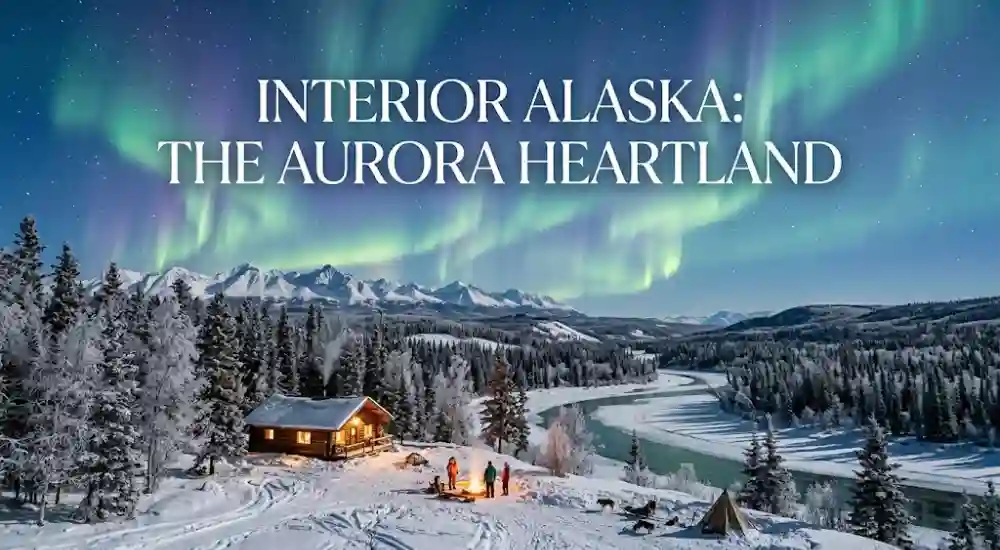
Alaska sits almost entirely inside the auroral oval, the ring-shaped zone around the North Pole where the northern lights appear most often. That’s why the state consistently ranks alongside Norway, Iceland, and northern Canada as one of the best places on Earth to see them. But “Alaska” is a big answer to a specific question. Fairbanks, Denali, the Arctic Circle, and Anchorage all sit under that same oval, and each one delivers a genuinely different night.
This guide breaks Alaska’s best aurora destinations down by region, tells you honestly what each one is and isn’t good for, and answers the practical questions — timing, cost, driving conditions, kids, cameras — that most guides skip past. If you’re trying to decide where to actually book a flight, this is built to get you there.
Quick answer:
For most first-time visitors, Fairbanks is the strongest overall pick — it sits directly under the auroral oval, has a dry interior climate with fewer cloudy nights than coastal Alaska, and offers the widest range of guided tours for people without a car. From there, Chena Hot Springs, Denali, and the Arctic Circle towns of Coldfoot and Wiseman round out the top tier, while Anchorage and the Mat-Su Valley work well as closer, lower-effort backups.
At a Glance
- Best overall base: Fairbanks — most consistent viewing conditions in the state
- Best for comfort: Chena Hot Springs — watch the sky from a hot spring
- Best for serious chasers: Coldfoot and Wiseman — above the Arctic Circle, almost no light pollution
- Best for scenery: Denali National Park in winter
- Best season: Late August through mid-April, with March and September as standout months
- Best viewing window: Roughly 10 p.m. to 2 a.m. on a clear night
- Biggest mistake first-timers make: Booking only one or two nights and hoping for clear skies on demand
How the Aurora Actually Works (in Plain English) {#how-it-works}
You don’t need a physics degree to chase the northern lights, but knowing roughly how they work will make your trip planning make a lot more sense.
The aurora borealis happens when charged particles from the sun collide with gases in Earth’s upper atmosphere. Oxygen produces the classic green glow; nitrogen adds the rarer purples and reds you’ll see in stronger displays. This activity concentrates in a band around the North Pole called the auroral oval — and Alaska’s Interior region sits almost squarely inside it.
Three things determine whether you’ll actually see anything on a given night:
- Solar activity — measured on the KP index, a 0–9 scale of geomagnetic disturbance. A KP of 3–4 is usually enough for a good show in Fairbanks; you’d need a KP of 6 or higher to see the lights as far south as Anchorage.
- Darkness — you need real nighttime darkness, which is why the season runs roughly late August through mid-April and goes dark from May to July (the “midnight sun” months).
- Cloud cover — the single biggest wildcard. A strong aurora behind thick clouds is invisible; a weak aurora under a perfectly clear sky can still be a memorable night.
2026 is a useful year to know about specifically. The sun is currently near a period of solar maximum, meaning geomagnetic activity — and aurora displays — tend to run stronger and more frequent than during quieter years of the 11-year solar cycle. That’s good news for anyone planning a trip through 2026 and into 2027, though it doesn’t change the basic rule: dark skies and clear weather still matter more than any single forecast number.
Interior Alaska: The Aurora Heartland {#interior}
If you only have time to research one region, make it this one. Interior Alaska — anchored by Fairbanks — offers the most reliable combination of darkness, clear skies, and easy access anywhere in the state.
Fairbanks: The Aurora Capital of Alaska
Fairbanks isn’t just a good place to see the northern lights — locals will tell you it’s the reason the town’s winter tourism economy exists at all. The city sits almost directly beneath the auroral oval, and its dry interior climate means noticeably fewer cloudy nights than you’d get on the Alaska coast.
Local tourism estimates put visible aurora on roughly four out of five clear nights here during peak season — a figure that holds up well against nearly anywhere else in North America.
Why it works for almost everyone: Fairbanks has city comforts (hotels, restaurants, an international airport) plus a genuinely deep bench of tour operators who specialize only in aurora chasing. You don’t need to rent a car or know the backroads — guided chase tours will pick you up from your hotel and drive to known dark-sky pull-offs.
Key facts:
- Aurora season runs from roughly August 21 through mid-April
- Downtown light pollution is real — most serious viewing happens a short drive outside town
- The University of Alaska Fairbanks Geophysical Institute runs one of the most trusted aurora forecast tools available anywhere, updated in near real-time
- Winter temperatures regularly drop well below zero (°F), so cold-weather gear isn’t optional
- Fairbanks pairs naturally with day trips to Chena Hot Springs or Denali
Plan on at least three nights in Fairbanks if this is your primary destination. Weather is the one variable no amount of planning controls, and extra nights are the single best insurance policy against a cloudy sky ruining your trip.
Murphy Dome and Cleary Summit: Where Locals Actually Go
Ask a longtime Fairbanks resident where they watch the aurora, and one of these two hills comes up almost every time.
Both climb just high enough above town to leave the streetlights behind, with wide, unobstructed views toward the north — exactly where the aurora tends to appear first.
| Spot | Distance from Fairbanks | Notes |
| Murphy Dome | ~25 miles | Highest point near Fairbanks; open tundra views; road often icy Oct–April |
| Cleary Summit | ~20 miles | Along the Steese Highway; more accessible, busier than Murphy Dome |
A few things worth knowing before you drive out:
- Neither spot has public restrooms — plan accordingly
- Rental car drivers should be especially cautious on the Murphy Dome road; tow trucks are called out to this stretch regularly in winter, often for out-of-state drivers unfamiliar with the ice
- An all-wheel or four-wheel-drive vehicle makes a real difference on both roads
- Watch for moose, especially at dusk — they’re common along both access roads
Chena Hot Springs Resort: Watch the Sky From a Hot Spring
This is the one destination on this list where you can genuinely combine relaxation with aurora watching — and it’s exactly why Chena has such a loyal following among couples and photographers.
Set about 60 miles from Fairbanks, beneath the same auroral oval, Chena Hot Springs Resort offers a dedicated outdoor viewing area and heated yurts for colder nights, plus geothermal pools you can soak in between checks on the sky.
Season and timing: Aurora season at Chena runs roughly September through March, and both September and March tend to bring equinox-related activity spikes — a pattern tied to how Earth’s magnetic field aligns with the solar wind twice a year, in spring and fall.
Practical notes:
- Reaching Chena at night without a car is genuinely difficult; most visitors book a guided tour that includes transportation
- The resort’s Ice Museum tour and hot spring access give you something to do while waiting for the sky to clear
- Book aurora-focused tours well in advance during peak winter months — demand is high and availability is limited
- Confirm current tour schedules and pricing directly with the resort before finalizing dates, since these change seasonally
Denali National Park in Winter: Scenery Over Substance
Most people know Denali as a summer destination for wildlife and mountain views. In winter, it becomes something else entirely: a nearly empty, snow-covered wilderness with some of the darkest skies in the region — and that emptiness is exactly what makes it work so well for aurora viewing.
What changes in winter: Most visitor services close, including the hotels near the park entrance, and the majority of the Park Road closes to vehicle traffic. The Winter Visitor Center stays open, though, along with frontcountry trails for short walks or snowshoeing.
Who this is for: Travelers who want the aurora layered over dramatic mountain silhouettes, not just an open field. It takes more planning than Fairbanks because winter services are limited — but it rewards that planning with a setting almost nothing else on this list can match.
- Denali pairs well with a Fairbanks base since it’s a manageable drive or train ride away
- Check current park winter operating details before you go — access and services change seasonally and shouldn’t be assumed from last year’s information
- Dress for extreme cold; shelter is limited along open viewing areas
Southcentral Alaska: Convenient and Underrated {#southcentral}
Southcentral Alaska — anchored by Anchorage — doesn’t have Fairbanks’ odds, but it has something Fairbanks doesn’t: a major international airport, a bigger city, and several genuinely good viewpoints within an hour or two of downtown.
Anchorage and the Glen Alps Overlook
Anchorage isn’t the state’s top aurora destination, and it shouldn’t be marketed as one. But its size and airport access make it a practical starting point, especially for shorter trips.
The Glen Alps trailhead overlook, inside Chugach State Park, sits at about 2,200 feet with sweeping views across the Anchorage Bowl and several mountain ranges — arguably the best in-city vantage point available.
Other in-town and near-town options:
- Point Woronzof — another open-sky viewpoint inside city limits
- Eklutna Lake — its calm surface can mirror the aurora on still nights
- Flattop Mountain — panoramic views over the city and surrounding wilderness
One honest caveat: a full or near-full moon can wash out fainter aurora displays entirely, so it’s worth checking the lunar calendar alongside the forecast. And winter road conditions can turn icy fast at elevation — drive cautiously after dark, especially on unfamiliar routes.
Bottom line: If Fairbanks isn’t in your budget or your itinerary, Anchorage still gives you a real shot — just treat it as a bonus you might catch, not the reason you booked the flight.
Hatcher Pass and the Mat-Su Valley
About 70–90 minutes from Anchorage, Hatcher Pass sits in the Talkeetna Mountains — far enough from Anchorage, Wasilla, and Palmer that light pollution drops off noticeably, with mountain vantage points well above 3,000 feet.
Part of the pass road closes for winter, so most visitors park at the accessible winter lot below Independence Mine State Historical Park. Nearby, the Knik River Valley and Eklutna Tailrace offer additional open-sky pull-offs, and Palmer Hay Flats State Game Refuge has a wildlife viewing tower near Reflection Lake that doubles as a solid aurora spot.
- Guided ATV and snowmobile tours run out to dark-sky vantage points for travelers without four-wheel drive
- Scout unfamiliar pull-off spots in daylight first — winter ice is much harder to judge at night
- This is a natural midpoint stop for anyone road-tripping between Anchorage and Denali or Fairbanks

Girdwood and the Seward Highway
The drive south from Anchorage to Girdwood runs along Turnagain Arm, one of the most scenic stretches of road near the city — and it’s dotted with easy pull-offs at Beluga Point and Bird Point along the way.
Girdwood itself sits surrounded by mountains and tall trees, which can actually work against you here, since they block the northern sky where the aurora most often appears. Moose Meadows, just outside town, offers a more open sightline and 360-degree views.
Pair the drive with a daytime stop at the Alyeska Resort tram for valley views, and watch for icy patches on the highway shoulders once the sun goes down.
Talkeetna: A Quieter Base With Mountain Views
Talkeetna sits a little over two hours (about 114 miles) from downtown Anchorage, with a small-town feel that Fairbanks and Anchorage both lack — and it’s within easy reach of Denali State Park’s mountain views.
Driving just a short distance outside downtown clears most of the in-town light pollution. Christensen Lake is a locally recommended spot, and both Riverfront Park and Denali State Park offer additional open viewing areas nearby.
Talkeetna’s small size means fewer lodging options than bigger towns, so book ahead during peak winter months. It’s a strong pick for couples and photographers who want mountain silhouettes under the lights without the crowds of a bigger base — and it pairs naturally with a Denali day trip if your schedule allows.
The Arctic: For Committed Aurora Chasers {#arctic}
Everything in this section requires more effort, more budget, and more flexibility than Interior or Southcentral Alaska. In exchange, you get some of the darkest, least light-polluted skies on the continent.
Coldfoot and Wiseman: Arctic Circle Base Camps
Coldfoot sits along the Dalton Highway, north of the Arctic Circle, with virtually no light pollution — and a well-earned reputation among aurora chasers for consistent displays. Nearby Wiseman adds a small, historic community feel to the same dark-sky advantage, including off-grid lodging built specifically around aurora watching.
Getting there: Distances from Fairbanks run roughly 250 miles, which is why most visitors fly rather than drive — regional operators run daily bush flights from Fairbanks to Coldfoot. Self-driving the Dalton Highway is possible but demands real preparation; it’s a rugged, remote road with limited services and little to no cell coverage.
This pairing suits committed chasers willing to trade convenience for darkness. Skip it if your schedule is tight — Coldfoot rewards flexibility, not a rigid two-night itinerary, since weather delays are common this far north.
- Winter temperatures regularly fall far below zero, so serious cold-weather gear is essential
- Build in extra buffer days in case flights or weather cause delays
Utqiagvik: Aurora at the Top of the World
Utqiagvik (formerly known as Barrow) is the northernmost city in the United States, sitting north of the Arctic Circle on the shores of the Chukchi Sea. Winter here brings the polar night — a stretch of roughly 65 days without sunrise — which makes for exceptionally reliable dark-sky viewing when conditions cooperate.
This isn’t a starter destination. It’s the trip people add after they’ve already seen the aurora once and want the extreme version of the story: more remote, colder, and pricier, with far fewer amenities than Fairbanks or Anchorage.
- Most visitors reach Utqiagvik by flying through Fairbanks, since driving conditions this far north are unpredictable
- Visitors can also learn about Iñupiat culture and history at the local heritage center — a genuine highlight beyond the aurora itself
- Extreme cold is a serious safety concern; limit continuous outdoor exposure time and dress in true Arctic-grade layers
- Guided tours are the more practical option given the remoteness and weather risk
Comparison Table: All Destinations at a Glance {#comparison}
| Destination | Best For | Distance | How to Get There | Season Window |
| Fairbanks | First-timers, no-car travelers | — | Direct flights | Aug 21–mid April |
| Chena Hot Springs | Comfort, couples, photographers | ~60 mi from Fairbanks | Car or guided tour | Sep–Mar |
| Murphy Dome / Cleary Summit | Budget self-drivers | 20–25 mi from Fairbanks | Rental car (4WD recommended) | Sep–Apr |
| Denali National Park | Scenery + dark sky | ~120 mi from Fairbanks | Drive or Alaska Railroad | Sep–Mar |
| Anchorage / Glen Alps | Short trips, airport convenience | — | Direct flights | Sep–Apr |
| Hatcher Pass | Road-trippers, Anchorage day-trippers | 70–90 min from Anchorage | Car or guided ATV tour | Sep–Apr |
| Girdwood | Scenic drive + aurora combo | ~40 mi south of Anchorage | Car | Sep–Apr |
| Talkeetna | Quiet, less touristy base | ~114 mi from Anchorage | Car | Sep–Apr |
| Coldfoot / Wiseman | Serious chasers, flexible schedules | ~250 mi from Fairbanks | Bush flight or Dalton Highway drive | Aug–Apr |
| Utqiagvik | Bucket-list, extreme Arctic experience | Flight via Fairbanks | Flight only | Nov–Jan (polar night) |
Best Time of Year to Go {#best-time-year}
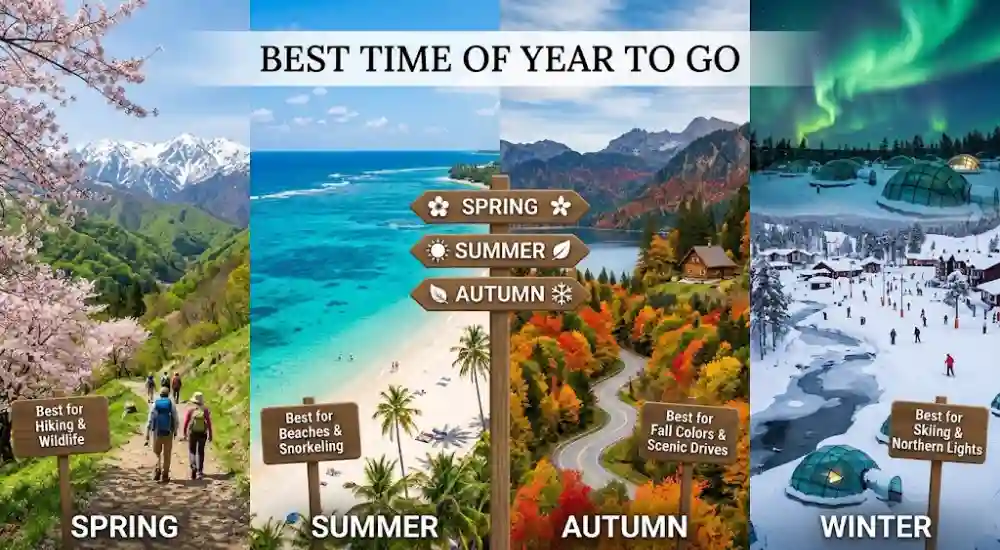
The overall Alaska aurora season runs from late August through mid-April, but not every month inside that window offers the same odds.
September, October, February, and March are consistently the strongest months, with March often standing out as the single best all-around choice — it combines clearer skies, long dark nights, and a genuine increase in geomagnetic activity around the spring equinox.
December offers the longest stretches of darkness — Fairbanks can see 20+ hours of night — but it comes at a cost: temperatures routinely drop to -20°F to -40°F, and ice fog can settle over town and obscure the sky. Getting outside the city center (Murphy Dome, Cleary Summit) helps avoid this.
Here’s a quick month-by-month breakdown:
- August 21–September: Season begins; equinox activity spike; still-mild temperatures
- October–November: Reliable darkness, moderate cold, generally good odds
- December–January: Longest dark windows, harshest cold, watch for ice fog in Fairbanks proper
- February: Similar odds to fall, with slightly milder conditions
- March: The sweet spot — clear skies, spring equinox activity spike, manageable cold
- April: Season winds down as daylight hours lengthen
A note on 2026 specifically: the sun is near solar maximum, meaning geomagnetic activity — and aurora frequency — has been running above the long-term average through this stretch of the 11-year solar cycle. That’s a genuine tailwind for anyone planning a trip this year, though it’s not a guarantee against cloud cover, which remains the single biggest wildcard on any given night.
Best Time of Night to Watch {#best-time-night}
Timing your evening matters almost as much as choosing a location. Most reliable viewing hours fall in the late evening through early morning — roughly 10 p.m. to 2 a.m. local time — once true darkness has fully set in.
Patience is the real skill here. Displays often start as a faint, pale smear low on the horizon before building into the ribbons of green (and sometimes purple or red) that photos capture so well. Give your eyes 15 to 20 minutes to adjust to full darkness before deciding whether the sky is “active” or not.
A few practical notes:
- A clear sky with visible stars is a good early sign conditions are right
- Bright moonlight can mute fainter displays, so check the lunar calendar alongside the aurora forecast
- Bring a chair or blanket — good viewing often means standing or sitting still for an hour or more
- Step away from parked-car headlights and phone screens, both of which hurt your night vision
A Sample 5-Day Interior Alaska Aurora Itinerary {#itinerary}
If you’re not sure how to string these destinations together, here’s a realistic starting framework built around Fairbanks as a base:
Day 1 — Arrive in Fairbanks. Settle in, adjust to the cold, and check the aurora forecast for the week ahead.
Day 2 — Chena Hot Springs day trip. Soak in the geothermal pools, visit the Ice Museum, and stay through the evening for aurora viewing from the resort’s dedicated station.
Day 3 — Fairbanks self-drive night. Head out to Cleary Summit or Murphy Dome with a rental car, or book a local chase tour if you’d rather not drive icy backroads yourself.
Day 4 — Denali day trip. Take the train or drive down for daytime winter recreation at the Winter Visitor Center, then return to Fairbanks (or overnight near the park) for another viewing window.
Day 5 — Flex day. Keep this open. If clouds ruined one of your earlier nights, this is your buffer to try again — and if you’ve already had a strong showing, use it for the Museum of the North or another daytime activity before flying home.
Why build in a flex day? Because weather, not aurora activity, is usually the deciding factor on any given trip — and one extra night dramatically improves your overall odds of a real sighting.
Aurora Viewing by Traveler Type {#traveler-type}
Family-Friendly Aurora Viewing
Long, cold waits aren’t realistic for younger kids, so choosing a base with warm indoor backup options matters more than picking the single “best” viewpoint.
- Chena Hot Springs lets kids warm up in the pools between checks on the sky
- Many Fairbanks hotels offer aurora wake-up calls, so families can sleep until the sky is actually active
- Favor shorter, closer viewpoints over long drives with tired kids
- Pack extra layers sized specifically for children — cold tolerance is lower than adults assume
- The Museum of the North in Fairbanks makes a strong daytime pairing activity
- Set honest expectations with kids in advance: some nights simply won’t deliver a strong show
Budget-Friendly Aurora Viewing
Seeing the aurora doesn’t require an expensive tour package. Many of the best viewpoints are free, public pull-offs — as long as you have transportation and comfort with winter driving.
- Cleary Summit and Murphy Dome are free with a rental car
- Glen Alps and Point Woronzof in Anchorage require no tour or entrance fee
- Traveling in shoulder months like September or April often means lower lodging rates
- Group chase tours typically cost less per person than private tours
- Bringing your own cold-weather gear avoids rental fees
- Public campgrounds near Denali and Fairbanks offer lower-cost lodging alternatives
- Prices vary by season and operator — always confirm current rates directly before booking
Luxury Aurora Lodges and Experiences
For travelers who want comfort layered onto the experience, several Alaska properties are purpose-built around aurora viewing — including glass-roofed cabins near Fairbanks designed so guests can watch the sky without leaving bed.
- Some lodges pair aurora viewing with dog sledding or ice-carving experiences
- Private chase tours offer more flexibility than group departures
- Remote basecamps often include full board, since nearby dining options are limited
- Book well ahead for peak winter dates — these properties have limited rooms
- Rates and included activities change seasonally, so confirm current details before booking
Aurora Photography Tips
If you’re bringing a camera, a few basics will save you a frustrating night:
- Use a tripod — even a small travel one — since long exposures are essential
- Shoot in manual mode with a wide aperture (f/2.8 or wider if possible), a high ISO (start around 1600–3200), and a shutter speed of 3–10 seconds
- Bring spare batteries — cold drains them fast, sometimes within an hour
- A wide-angle lens captures more of the sky and surrounding landscape
- Many modern smartphones now have dedicated night modes capable of capturing a decent aurora shot — worth testing before you rely on it
What to Pack and Know Before You Go {#packing}
Alaska’s winter cold isn’t like cold anywhere else most travelers have experienced, and dressing for it is the single biggest factor in whether you actually enjoy the wait for the lights.
- Layer system: base layer (synthetic or wool, not cotton), insulating mid-layer, windproof/waterproof outer shell
- Insulated, waterproof boots rated for sub-zero temperatures
- Hand and foot warmers for long outdoor waits
- A hat that covers your ears, plus a scarf or neck gaiter
- Check current road conditions before driving to remote viewpoints at night
- Scout unfamiliar pull-off spots in daylight before returning after dark
- Watch for wildlife, especially moose, on rural roads at dusk and after dark
- Avoid trespassing on private property when looking for a clearer sightline
- Have a backup plan for cloudy nights — a daytime activity the next day keeps morale up

What If You Don’t See Anything? {#no-show}
This is the question most guides skip, and it’s the one that matters most emotionally. Cloud cover, not aurora activity, is the most common reason travelers miss a sighting — even during a strong solar cycle like the one Alaska is in through 2026.
If your first night doesn’t deliver:
- Don’t panic — build flexibility into your schedule from the start. A 3+ night trip dramatically improves your odds compared to a single-night gamble.
- Check the forecast for a better night, not a different location. Moving 20 miles rarely fixes a cloudy sky; waiting for a clearer night usually does.
- Talk to your tour operator or hotel — many track conditions closely and can suggest the best night of your stay to prioritize.
- Treat any daytime activities as the trip, not the backup. Denali, Chena’s hot springs, dog sledding, and local museums are worth doing on their own merits, aurora or not.
It’s a real disappointment if it happens — but it’s also common enough that experienced Alaska guides plan around it rather than treating it as a failure.
Frequently Asked Questions {#faq}
How many days should I plan for an Alaska aurora trip?
Three nights or more gives you a realistic shot at clear skies, since Alaska weather can shift quickly. Shorter trips are possible, but they carry a meaningfully higher risk of missing a display entirely due to cloud cover alone.
Do I need a car to see the aurora in Alaska?
Not necessarily. Fairbanks has an especially deep bench of guided chase tours that pick up directly from hotels, and several lodges offer aurora wake-up calls so you don’t have to stay up watching yourself. A car adds flexibility but isn’t required, especially for a Fairbanks-based trip.
What is the best month to see the northern lights in Alaska?
March is generally considered the strongest all-around month, combining clear skies, long dark nights, and a real increase in geomagnetic activity tied to the spring equinox. September offers similar advantages with milder temperatures.
How much does it cost to see the northern lights in Alaska?
Costs vary widely. Budget self-drive trips using free viewpoints like Murphy Dome or Glen Alps can keep costs to flights, lodging, and a rental car. Guided chase tours typically run in the moderate range per person, while multi-night packages at properties like Chena Hot Springs or dedicated aurora lodges cost more. Always confirm current pricing directly with operators, since rates change seasonally.
Is Anchorage a good place to see the northern lights?
Anchorage can work on strong nights, especially from elevated spots like Glen Alps. It’s meaningfully less reliable than Fairbanks, though, so treat it as a convenient backup rather than a primary destination if seeing the aurora is your main goal.
Is Denali worth visiting just for aurora viewing?
Yes, particularly paired with a Fairbanks stay. Denali’s dark, open skies and dramatic mountain scenery make it a strong pick — just confirm current winter access and services before you go, since much of the park closes seasonally and this changes year to year.
What should first-time visitors know before chasing the aurora?
Cloud cover matters more than almost anything else. Flexibility beats a rigid schedule every time. Dress warmer than you think you need to, build in extra nights, and treat the daytime activities as worthwhile on their own — not just filler while you wait for dark.
Can you see the northern lights without a tour, on your own?
Yes. Locations like Murphy Dome, Cleary Summit, Glen Alps, and Point Woronzof are all free, public pull-offs accessible by rental car. Self-driving requires comfort with winter road conditions, so scout unfamiliar spots in daylight first and check current road conditions before heading out at night.
Conclusion
The best places to see the aurora in Alaska aren’t one single spot — they’re a range of options that trade convenience for darkness in different ways. Fairbanks remains the strongest all-around choice for most travelers, especially first-timers who want the highest odds without a rigid, high-effort itinerary. From there, Chena Hot Springs adds comfort, Denali adds scenery, and the Arctic Circle towns of Coldfoot, Wiseman, and Utqiagvik offer the darkest skies in the state for travelers willing to go further and spend more.
Whichever spot you choose, the single biggest factor in your success isn’t the location — it’s how much flexibility you build into your schedule. Book more nights than you think you need, keep a daytime backup plan ready, and let the forecast — not the calendar — decide your best night to watch.
That patience, more than any single viewpoint on this list, is what separates a good aurora trip from an unforgettable one.