Most “best dive destinations” round-ups hand you the same seven famous names in a different order, whether or not they actually fit where you are as a diver. That’s a problem, because the Maldives is a frustrating first trip for a brand-new Open Water diver, and Bonaire quietly undersells someone with 200 logged dives looking for current and big animals.
This guide works differently. It’s organized by skill level, budget, marine life, and season, so you can jump straight to the section that matches your actual trip — not just a generic list. You’ll also find what certification really costs, how to pick a dive operator you can trust, and a sample multi-day itinerary you can adapt.
Quick Answer
The best places to scuba dive in 2026 depend on your certification level: new divers do best in Bonaire, Cozumel, or the Florida Keys, while experienced divers get more from the Maldives, Raja Ampat, or the Galapagos. If you’re diving domestically, Key Largo, Hawaii’s Big Island, and California’s Channel Islands cover warm-water, wreck, and cold-water diving without a passport.
TL;DR
- Match skill level first — the “best” destination changes completely between a first certification trip and dive #150
- Florida Keys and Hawaii offer the easiest warm-water US diving, no passport required
- Raja Ampat and the Red Sea lead for sheer reef biodiversity and coral cover
- Galapagos and the Maldives deliver the strongest big-animal encounters (sharks, mantas, whale sharks)
- Open Water certification typically runs $350–$700 in the US, and it never expires
- Hurricane season (June–November) affects Caribbean and Gulf Coast trip planning, not Pacific or Indian Ocean destinations
Destinations at a Glance
Before diving into details, here’s how the most-searched destinations stack up side by side. Use this table to shortlist two or three, then read the full sections below for the specifics that actually affect your booking.
| Destination | Best For | Skill Level | Best Season | Typical Cost Tier |
| Key Largo, Florida | Wrecks + easy reef | Beginner–Intermediate | Apr–Oct | $ |
| Bonaire | Shore diving, self-paced | Beginner | Year-round | $$ |
| Cozumel, Mexico | Drift diving | Beginner–Intermediate | Year-round | $$ |
| Hawaii (Big Island/Oahu) | Manta night dives, wrecks | Beginner–Intermediate | Year-round | $$$ |
| Maldives | Manta/shark channels | Intermediate–Advanced | Dec–Apr | $$$$ |
| Raja Ampat, Indonesia | Coral biodiversity | Advanced | Oct–Apr | $$$$ |
| Red Sea, Egypt | Reef + wrecks, affordable training | Beginner–Advanced | May–Sep | $$ |
| Galapagos Islands | Big animals, hammerheads | Advanced | Jun–Nov | $$$$ |
| Channel Islands, California | Kelp forests, cold water | Intermediate | Jun–Oct | $$$ |
Best Overall Scuba Diving Destinations in the World
Ask ten experienced divers for their top destination and you’ll get ten different answers, because “best” really means “best for what you want to see.” Below are the handful of places that consistently earn a spot on serious dive-trip bucket lists, along with what actually sets each one apart.
Raja Ampat, Indonesia
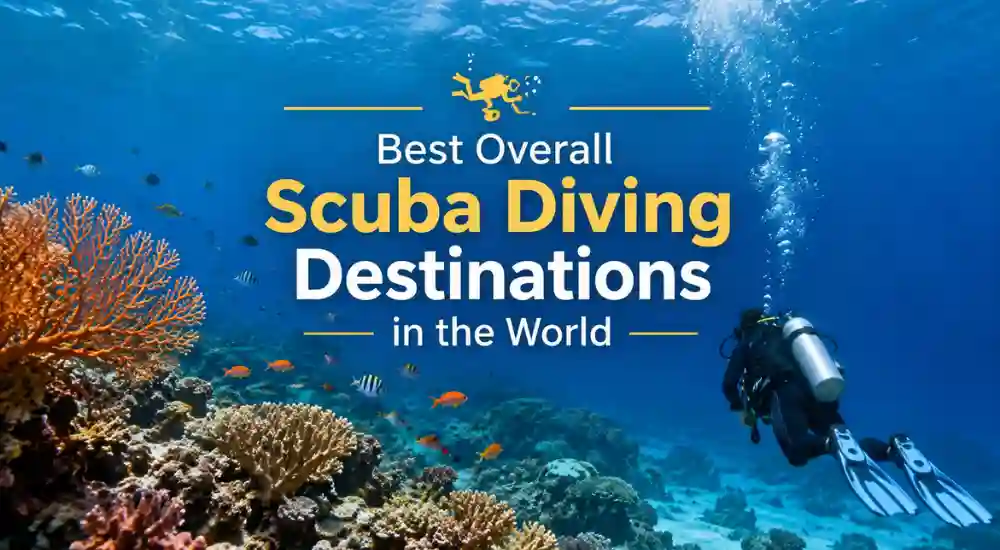
Raja Ampat sits at the heart of the Coral Triangle, and the numbers back up its reputation: roughly 75% of all known coral species live in this one region. What that means underwater is density — reef sharks, pygmy seahorses, and schooling fish stacked into a single frame that a photographer could spend a whole trip on. It’s a demanding destination logistically (remote, liveaboard-heavy), which is exactly why it rewards divers with some open-water hours behind them rather than a first trip.
Red Sea, Egypt
The Red Sea earns its spot for a different reason: consistency. Visibility regularly tops 100 feet, the water stays warm through summer, and the training infrastructure is some of the best-value in the world. It’s rare to find a destination this strong for wrecks (the Thistlegorm), reef (Ras Mohammed), and beginner training all in one place.
Galapagos Islands, Ecuador
This is not a relaxing drift dive. Currents run strong and the water runs cooler than most tropical destinations, but that’s the trade-off for hammerhead shark schools, whale sharks, and sea lions that treat divers like curious neighbors rather than threats. Go here once you’re comfortable managing current on your own.
Maldives
The Maldives built its dive reputation on channel diving — narrow passages between atolls where nutrient-rich water funnels manta rays, gray reef sharks, and eagle rays past a fixed viewing point. December through April tends to bring the calmest conditions for most channel sites; May through November shifts the action toward Baa Atoll’s manta aggregations (snorkel-only inside Hanifaru Bay itself).
Other destinations worth the trip
- Great Barrier Reef, Australia — the largest living reef system on Earth, with sheltered inner-reef sites that suit newer divers
- Palau — Blue Corner and German Channel deliver reliable shark and eagle ray action on the current
- Fiji — soft coral density in the Somosomo Strait, plus bull shark dives near Beqa Lagoon
- Cozumel, Mexico — relaxed drift diving over Palancar Reef, detailed further below
A practical note: water temperature, current strength, and visibility all shift by season at every site above. A “best” destination can turn mediocre if you book the wrong month — cross-check the Best Time of Year table before locking in dates.
Best Places to Scuba Dive in the United States
You don’t need a passport to find serious diving. The US covers roughly 95,500 miles of coastline plus the Great Lakes, spanning coral reefs, kelp forests, volcanic rock, and thousands of wrecks. It’s also the most practical way to rack up dives between big international trips, since flights are shorter and there’s no customs paperwork for dive gear.
Florida: the country’s easiest reef and wreck diving
Key Largo is often called the diving capital of the US, and the title holds up. John Pennekamp Coral Reef State Park protects the only living coral barrier reef in the continental US, with depths from 6 to 60 feet — shallow enough for newer divers, interesting enough that experienced ones keep coming back. The USS Spiegel Grove, one of the largest artificial reefs anywhere, sits nearby for divers with advanced certification. Further south, Dry Tortugas National Park is reachable only by boat or seaplane, which keeps it uncrowded, and pairs reef diving with a walk through 19th-century Fort Jefferson.
Hawaii: warm water and volcanic terrain
Hawaii’s signature dive is the Kailua-Kona manta ray night dive on the Big Island, where lights attract plankton and mantas glide within arm’s reach — one of the more reliably spectacular dives in US waters, viewable most nights of the year. Molokini Crater off Maui offers unusually clear volcanic-wall diving, and Oahu has earned the nickname “wreck capital of Hawaii” with roughly ten sunken ships and submarines to explore.
California: cold water, big rewards
Southern California’s Channel Islands National Park protects kelp forests, sea caves, and giant sea bass in water that runs 55–65°F even in summer — a 7mm wetsuit or drysuit is standard gear here, not optional. Further north, Monterey Bay pairs kelp forest diving with sea otters and dense invertebrate life.
More US diving worth knowing about
- Flower Garden Banks National Marine Sanctuary — a coral reef roughly 100 miles off Texas and Louisiana in the Gulf of Mexico
- Florida’s freshwater springs (Ginnie Springs, Devil’s Den) — clear inland cavern diving distinct from the state’s ocean sites
- Great Lakes shipwrecks — thousands of wrecks preserved in cold, freshwater conditions across Michigan and Wisconsin
- Bonne Terre Mine, Missouri — a flooded former lead mine turned inland dive site with unusually high visibility
Best Beginner-Friendly Dive Destinations
New divers succeed fastest in warm, calm, shallow water with forgiving currents — conditions that let you focus on buoyancy and breathing instead of fighting the ocean. A destination’s fame for rare wildlife matters far less on your first ten dives than how sheltered and well-run the local dive school is.
- Bonaire — shallow shore reefs you can enter at your own pace, with minimal current and no boat required
- Cozumel, Mexico — warm, easy drift dives with strong visibility and a huge, experienced instructor base
- Koh Tao, Thailand — one of the busiest, most affordable places worldwide to earn a first certification
- Key Largo, Florida — shallow sections of Molasses Reef run just 6 to 60 feet
- Red Sea, Egypt — warm, calm, inexpensive training paired with genuinely world-class conditions
- Grand Cayman — flat, shallow reef and wreck sites close to shore with dependable visibility
- Great Barrier Reef inner sites, Australia — sheltered from open-ocean swell and current
Before you book your first open-water dives, ask the shop directly about current strength, typical group size, and maximum depth planned — a good shop will answer specifically, not with a vague “it’s beginner-friendly.”
Best Caribbean Dive Destinations
For US-based travelers, the Caribbean is still the most accessible warm-water diving region — often a 3–4 hour flight, with warm water nearly year-round and pricing that spans every budget.
| Island | Signature Site | Known For |
| Bonaire | House reefs | 80+ shore-accessible dive sites |
| Little Cayman | Bloody Bay Wall | Drop from 20 ft to 1,000+ ft offshore |
| Cozumel | Palancar Reef | Drift diving, warm current |
| Turks and Caicos | Northwest Point | Dramatic wall diving |
| Bahamas | Tiger Beach | Shark encounters |
| Roatan, Honduras | West Bay | Affordable barrier reef access |
Puerto Rico and the US Virgin Islands round out the list for East Coast travelers wanting a shorter flight, with Vieques, Culebra, and reef-plus-wreck sites drawing fewer crowds than the bigger-name islands.
Timing matters here more than in most regions: hurricane season runs June through November, and it can affect visibility, boat schedules, and whether travel insurance will even cover a last-minute cancellation.
Best Wreck Diving Destinations
There’s a specific kind of quiet that settles over a wreck dive — hovering next to a hull that’s been underwater for decades feels different from any reef. Most wreck sites sit deeper than standard recreational limits, so an Advanced Open Water certification is the realistic minimum, and swimming inside a wreck’s structure (“penetration”) requires dedicated wreck-diving training on top of that.
- Chuuk Lagoon, Micronesia — around ten sunken Japanese Imperial Navy ships from 1944, several over 300 feet long
- USS Spiegel Grove, Key Largo, Florida — one of the largest artificial reefs in the world
- Thistlegorm, Red Sea, Egypt — a WWII British cargo ship still loaded with motorcycles and supplies
- Windjammer Wreck, US Virgin Islands — a 19th-century wreck now functioning as an artificial reef
- Great Lakes wrecks, Michigan and Wisconsin — remarkably preserved thanks to cold, low-salinity freshwater
- Oahu wrecks, Hawaii — Sea Tiger and the YO-257/San Pedro, both near Waikiki
- Coron, Philippines — a cluster of WWII-era wrecks in warm, clear water
- Vandenberg, Key West, Florida — a sunken missile-tracking ship turned dive attraction
Staying outside a wreck’s structure is safer and still gives you a full sense of its scale — don’t treat penetration training as optional just because a shop offers to guide you through.
Best Places to Dive with Sharks
Shark dives pull in experienced divers chasing a genuinely different kind of adrenaline than a reef dive offers. Species, behavior patterns, and safety protocols vary enormously by location, which is why the operator you choose matters more here than almost anywhere else on this list.
- Beqa Lagoon, Fiji — bull shark dives run by operators with decades of local experience
- Tiger Beach, Bahamas — tiger shark encounters in shallow, unusually clear water
- Galapagos Islands — hammerhead schools near Wolf and Darwin Islands
- Florida Keys — reef and nurse shark sightings on standard, no-specialty-needed reef dives
- Guadalupe Island, Mexico — seasonal cage diving with great white sharks
- French Polynesia — lemon and blacktip reef shark encounters around Moorea and Bora Bora
- Red Sea, Egypt — oceanic whitetip sightings near the Brothers Islands
A well-run operator briefs you thoroughly and keeps a deliberate distance during encounters. If a briefing feels rushed or the operator seems more focused on getting close for photos than on diver safety, sit that dive out.
Best Places to Dive with Manta Rays and Whale Sharks
Big pelagic encounters are almost entirely about timing, since both species migrate on predictable — but not identical — annual patterns. Booking the right week matters more here than picking the “best” destination in the abstract.
- Kailua-Kona, Hawaii — the manta night dive, viewable most of the year
- Baa Atoll, Maldives — seasonal manta aggregations, roughly May through November
- Ari Atoll, Maldives — regular whale shark sightings alongside manta activity
- Isla Mujeres, Mexico — whale shark season runs roughly May through September
- Utila, Honduras — one of the more consistent whale shark zones in the Caribbean
- Ningaloo Reef, Australia — whale shark migration typically runs March through July
Note that some of these encounters are snorkel-only by local regulation — Hanifaru Bay’s manta aggregation in the Maldives, for instance, protects the animals by limiting entry to snorkelers rather than scuba divers. Confirm this before you build an entire trip around one site.
Best Coral Reef Diving Destinations
Healthy coral is what most people picture when they imagine a dive trip — color, structure, and the small stuff (nudibranchs, shrimp, juvenile fish) that rewards a slower pace. Reef health is also the most season- and climate-sensitive category on this list, since warming water can trigger bleaching events with little warning.
- Raja Ampat, Indonesia — roughly 75% of all known coral species, described above
- Red Sea, Egypt — dense coral growth, visibility regularly over 100 feet in summer
- Great Barrier Reef, Australia — the largest living reef system on the planet
- Cozumel, Mexico — Palancar Reef’s coral formations and swim-throughs
- John Pennekamp Coral Reef State Park, Florida — the only living coral barrier reef in the continental US
- Fiji’s Somosomo Strait — locally nicknamed the “soft coral capital of the world”
- Bonaire — protected shore reefs with consistently strong coral cover
Before booking a reef-focused trip, a quick search for recent bleaching reports at your destination takes five minutes and can save a disappointing trip.
Best Liveaboard Diving Destinations
A liveaboard puts you on a boat for several days straight, reaching remote reef systems that day-boats simply can’t cover. Expect two to four dives a day, shared cabins, and a fixed route — it’s the most efficient way to maximize dive count on a single trip, but it suits certified divers with some open-water hours more than absolute beginners.
- Galapagos Islands — multi-day routes to Darwin and Wolf Islands for big-animal encounters
- Maldives atolls — one boat covers several atolls that land-based diving can’t reach
- Raja Ampat, Indonesia — remote reef systems realistically only accessible by boat
- Red Sea, Egypt — routes covering the Brothers Islands and southern reef systems
- Cocos Island, Costa Rica — hammerhead and whale shark diving, liveaboard-only access
- Socorro Islands, Mexico — giant manta encounters in open Pacific water
- Palau — multi-day routes across Blue Corner, German Channel, and the outer reefs
Popular liveaboard routes sell out months in advance during peak season, particularly Galapagos and Raja Ampat departures — book earlier than you think you need to.
Best Freshwater and Cave Diving Spots
Freshwater diving offers something ocean diving can’t: in the right spring, visibility that borders on surreal, along with cooler, mineral-clear water and unusual geology. Cave and cavern diving specifically requires certification beyond Open Water — this is one category where cutting corners has serious consequences.
- Ginnie Springs, Florida — clear spring water with cavern and full cave zones for trained divers
- Devil’s Den, Florida — a spring-fed sinkhole with striking underwater visibility
- Bonne Terre Mine, Missouri — a flooded former mine offering unusually clear inland diving
- Cenotes, Yucatan Peninsula, Mexico — limestone sinkholes with dramatic shafts of light, some requiring full cave certification
- Blue Hole, Santa Rosa, New Mexico — a spring-fed, high-visibility inland site
- Great Lakes freshwater wrecks — cold-water wreck diving across Michigan, Wisconsin, and Ontario
An overhead environment — anywhere you can’t swim straight up to the surface — is not a place to “wing it” with open-water training alone. Treat the certification requirement here as absolute, not a suggestion.
Best Cold-Water and Kelp Forest Diving Destinations
Cold water trades tropical warmth for scenery and species you won’t find anywhere near the equator: towering kelp canopies, sea caves, and octopus encounters most tropical divers never get. A thicker wetsuit or drysuit is standard here even in July, and visibility can genuinely rival the tropics on a clear day.
- Monterey Bay, California — kelp forest diving with sea otters and dense invertebrate life
- Channel Islands, California — sea caves and kelp canopies with resident sea lions
- Puget Sound, Washington — giant Pacific octopus sightings in cold, clear water
- Alaska’s coastal waters — remote, rarely-dived sites with dramatic marine life
- British Columbia, Canada — some of the most productive cold-water reefs anywhere
- Oregon coast — accessible shore diving with kelp and rockfish
If you plan to dive cold water more than once, a drysuit specialty course pays for itself quickly in comfort — trying to “tough it out” in a wetsuit past 15–20 minutes in 50°F water isn’t something most divers enjoy twice.
Best Budget-Friendly Dive Destinations
Diving has a luxury-travel reputation it doesn’t fully deserve. Local shore diving and lower-cost training regions can keep a trip genuinely affordable without cutting corners on safety or quality.
- Koh Tao, Thailand — among the least expensive places worldwide to get certified
- Red Sea, Egypt — affordable training combined with world-class conditions
- Washington and Oregon shore diving — free or low-cost entry points, no boat fees
- Roatan, Honduras — lower-cost lodging and diving than most nearby Caribbean islands
- Florida springs diving — no boat fees, short drives from major cities
- Moalboal and Coron, Philippines — budget-friendly diving with strong reef and wreck variety
Three moves cut costs fastest: rent gear instead of buying it while you’re new, dive locally between big trips instead of only diving on vacation, and travel during shoulder season when both flights and dive packages drop.
Best Luxury Dive Destinations
For travelers who want top-tier accommodations alongside serious diving, a handful of destinations combine private resorts with genuinely well-run dive programs — not just a nice pool next to an average reef.
- Maldives private island resorts — direct house-reef access paired with overwater villas
- Palau’s boutique resorts — small-group diving with premium liveaboard add-ons
- French Polynesia (Bora Bora, Moorea) — high-end lagoon resorts paired with shark and ray dives
- Fiji private island resorts — soft coral diving with deliberately low guest density, meaning you’ll often have a wall to yourself
- Seychelles — remote granite reef diving paired with upscale lodging
- Cocos Island liveaboards, Costa Rica — premium small-boat trips for serious divers
A five-star resort and a five-star dive program aren’t automatically the same thing. Check the dive shop’s own reviews separately from the hotel’s — a stunning property can still run a mediocre boat operation.
Best Family-Friendly Snorkel and Dive Destinations
Families mixing certified divers with snorkelers do best where both groups can access the same shallow reef at the same time, rather than splitting into separate excursions. Junior Open Water certification starts around age 10, with depth limits that lift once the diver turns 15.
- Key Largo, Florida — shallow reef sections work for both snorkelers and new divers together
- Hanauma Bay, Oahu, Hawaii — a protected bay built for beginner snorkeling, though it does require an advance reservation and has a visitor cap
- Bonaire — shallow shore access suits mixed-experience groups without a boat
- Cozumel, Mexico — calm, shallow reef zones close to the main pier areas
- Grand Cayman’s Stingray City — kids stand waist-deep in a sandbar surrounded by wild southern stingrays, with guides handling all animal contact
- Channel Islands, California — a solid day-trip option for families comfortable in cooler water
Always confirm minimum age, swim-test requirements, and any site-specific reservation systems (like Hanauma Bay’s) directly with your chosen operator before booking a family trip.
Best Time of Year to Scuba Dive by Region
Timing shapes visibility, water temperature, and which animals you’re likely to see — arguably more than the destination’s overall reputation does. A world-famous site during its off-season can underperform a lesser-known one that’s peaking.
| Region | Best Months | What to Expect |
| Maldives | December–April | Calm channels, strong manta and shark activity |
| Red Sea, Egypt | May–September | Warm water, exceptional visibility |
| Florida Keys | April–October | Warm water, lower storm risk in spring |
| Hawaii | Year-round | Consistent warm water, manta night dives |
| Caribbean | December–April | Drier weather, lower hurricane risk |
| California coast | Summer–fall | Clearer kelp forest visibility |
| Galapagos | June–November | Cooler water, peak hammerhead activity |
Treat these as planning averages, not guarantees — weather patterns shift year to year, so check a short-range forecast once your travel dates are close.
What a Dive Trip Actually Costs
Most guides stop at certification pricing and leave the rest of the trip a mystery. Here’s a fuller picture, broken into the pieces that actually add up.
| Expense | Typical Range (USD) | Notes |
| Open Water certification | $350–$700 | One-time, no expiration |
| Gear rental (per dive) | $30–$60 | BCD, regulator, wetsuit combined |
| Single boat dive | $50–$100 | Varies heavily by region |
| 2-tank dive trip | $90–$180 | Most common day-boat format |
| 7-night liveaboard | $2,000–$5,000+ | Includes most/all meals and dives |
| Dive-specific travel insurance | $50–$150 | Confirm it covers your planned depth/activity |
Domestic US trips (Florida, Hawaii, California) generally run cheaper overall than international liveaboards once flights are factored in, mainly because there’s no long-haul airfare or visa cost to absorb.
Certification 101: PADI vs. SSI vs. NAUI
Nearly every dive shop in the world recognizes all three major agencies, so the “right” one usually comes down to which shop is nearby and which schedule fits your life, not which agency is objectively better.
| Agency | Known For | Typical Course Length |
| PADI | Largest global network, most widely recognized | 3–4 days |
| SSI | Strong online/self-paced learning options | 3–4 days |
| NAUI | Nonprofit structure, often favored by technical divers | 3–5 days |
Whichever agency you choose, expect the same basic structure: classroom or e-learning, confined-water (pool) practice, and open-water checkout dives. You’ll also need to pass a swim test — roughly 200 yards/meters with no aids, plus 10 minutes of treading water or floating. It’s a comfort-in-water test, not a speed test.
Once you’re certified, it doesn’t expire. If you haven’t dived in a year or more, though, most shops will ask you to complete a short refresher (sometimes called a “scuba review”) before joining an open-water trip — a reasonable safety step, not a sales tactic.
How to Choose a Dive Operator
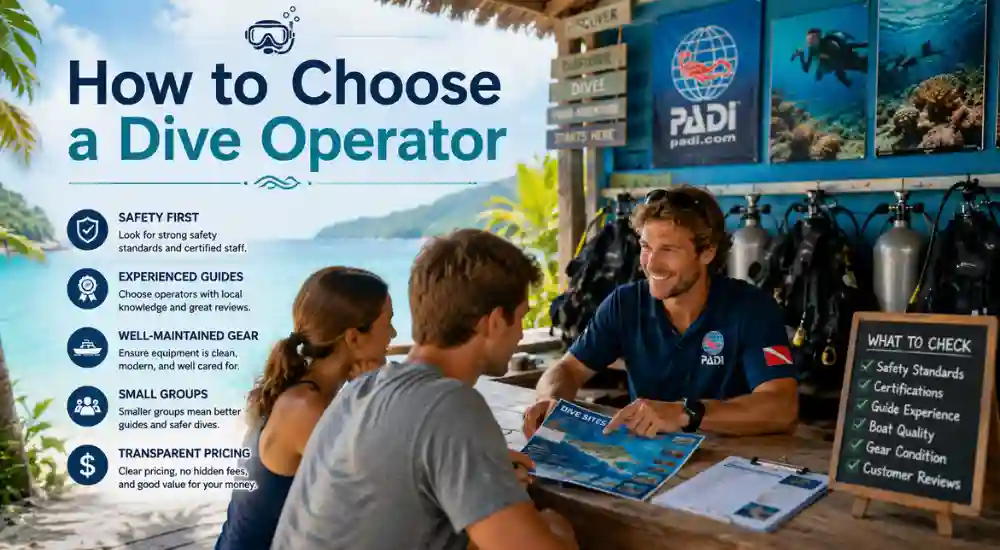
The operator matters as much as the destination, especially for wreck, cave, or shark dives. A few direct questions before booking will tell you more than any star rating:
- How many years has the shop operated at this specific site? Local experience matters more than a flashy website.
- What’s the maximum group size per dive? Smaller groups mean more attention if something goes wrong.
- Is the divemaster or instructor certified for this specific activity (wreck, cave, nitrox)?
- What’s their emergency protocol, and how far is the nearest chamber or medical facility?
- Do they inspect and service rental gear regularly? Ask when tanks were last hydro-tested.
A shop that answers these specifically, without hesitation, is usually a safe bet. Vague or defensive answers are a signal to keep looking.
Gear: What to Buy vs. What to Rent
New divers don’t need a full gear closet on day one. A reasonable order of priorities:
- Buy first: mask, snorkel, and fins — these need to actually fit your face and feet, and rentals rarely fit well
- Rent while you’re new: BCD, regulator, wetsuit, and tank — expensive to own before you know your preferences
- Consider owning once you’re diving regularly (10+ dives a year): a dive computer, then your own BCD and regulator
- Buy last: a drysuit — only worth it if you’re diving cold water regularly
A basic mask/snorkel/fins set runs roughly $150–$300; a full personal gear setup (BCD, regulator, wetsuit, computer) typically lands between $1,500 and $3,000 depending on brand and features.
Sample 5-Day Itinerary: Florida Keys for New and Early-Certified Divers
For a concrete example of how a trip actually comes together, here’s a realistic five-day plan combining beginner-friendly reef diving with one wreck dive for divers who’ve earned Advanced Open Water.
- Day 1 — Arrival, Key Largo: Check in, gear check with a local shop, easy afternoon reef dive on Molasses Reef
- Day 2 — John Pennekamp Coral Reef State Park: Two-tank morning dive, afternoon free to explore the park’s visitor center and glass-bottom boat tour
- Day 3 — USS Spiegel Grove: A deeper wreck dive (Advanced Open Water needed), followed by a relaxed afternoon reef dive
- Day 4 — Drive south to Islamorada or Marathon: Shallow reef dive plus optional snorkel stop, lighter day to avoid fatigue
- Day 5 — Dry Tortugas day trip (optional) or departure: A longer boat ride but a genuinely different, less-crowded reef experience if your schedule allows it
Build in at least an 18-hour surface interval before flying after your last dive, a standard recreational diving guideline that avoids decompression sickness risk at altitude.
Frequently Asked Questions
What is the best place in the world to scuba dive?
There’s no single answer — it depends on what you want to see. Raja Ampat and the Red Sea lead for reef diversity, while the Galapagos and Maldives lead for big-animal encounters like sharks and mantas.
Where is the best scuba diving in the USA?
The Florida Keys are the most popular US dive destination, known for shallow reefs and accessible wrecks like the USS Spiegel Grove. Hawaii and California’s Channel Islands are strong alternatives for warm-water and cold-water diving respectively.
Do I need certification to scuba dive?
Yes — most operators worldwide require at least an Open Water certification before allowing independent diving. Uncertified visitors can typically join a supervised introductory dive (often called a Discover Scuba experience), but it comes with depth limits and a higher per-dive cost than certified diving.
How much does it cost to get scuba certified?
An Open Water certification in the US typically costs $350 to $700, covering instruction, materials, and open-water checkout dives. Prices vary by shop, region, and whether gear rental is bundled in.
Is scuba diving expensive overall?
It can be, but it doesn’t have to be. Certification is a one-time cost, and after that, local shore diving and rental gear keep per-dive costs low — a liveaboard trip is the expensive end of the spectrum, not the norm.
What is the best time of year to scuba dive?
It depends entirely on the destination. The Maldives favors December through April, the Red Sea favors May through September, and Florida and Hawaii offer solid conditions most of the year.
Is scuba diving safe for beginners?
Diving carries real risk, but proper certification, a qualified instructor, and following dive briefings make it manageable for most healthy adults. Choose calm, shallow, warm-water destinations for your first certified dives, and always dive with a buddy.
What is the easiest place to learn to scuba dive?
The Red Sea, Koh Tao in Thailand, Bonaire, and Cozumel are commonly recommended for first-time certification thanks to warm, calm, clear water and well-established dive schools.
Do I need to know how to swim to scuba dive?
Yes, at a basic comfort level. Certification courses require a swim test — typically around 200 yards/meters without aids, plus 10 minutes of treading water or floating — but you don’t need to be a strong or fast swimmer, just comfortable in the water.
Conclusion
The best places to scuba dive in 2026 aren’t a fixed top-10 list — they shift based on your certification level, budget, and what you actually want to see underwater, whether that’s a shallow Florida reef, a Hawaiian manta night dive, or a current-swept channel in the Maldives. Start with your skill level and budget, cross-reference the season, and let those three factors point you to the right destination, not the other way around.
Once you’ve picked a region, confirm current certification requirements, entry fees, and seasonal conditions directly with a local operator before booking anything. That single step is what turns a good destination choice into a trip that actually goes the way you planned.