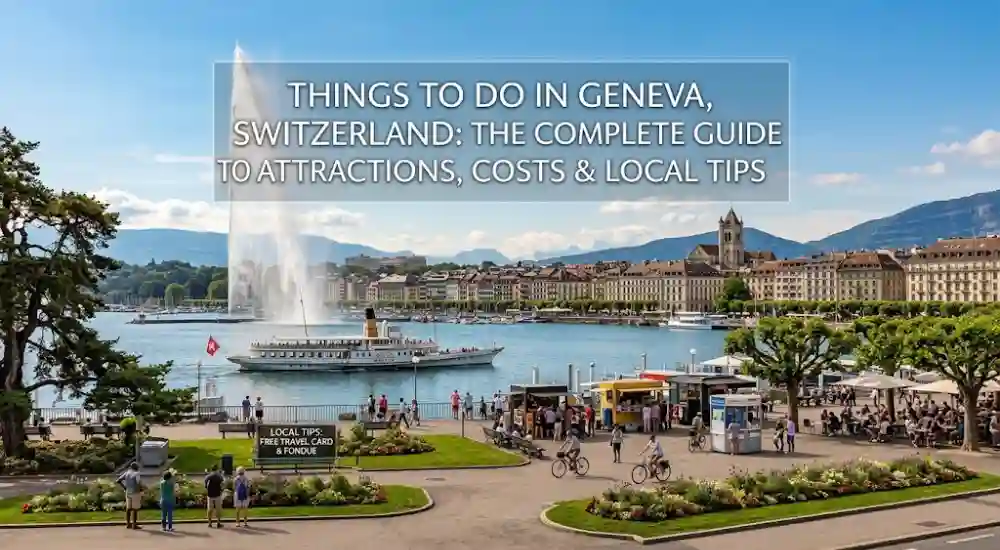
Most people picture Geneva as a stopover, not a destination — a lake, some banks, maybe a UN meeting in the background. Then they see the Jet d’Eau blasting water 140 meters into the sky over a lake that straddles the French border, and that impression shifts fast.
This is a city where a working particle physics laboratory sits a tram ride from a 500-year-old watchmaking industry, and where you can walk from a medieval cathedral to a lakeside beach in under 15 minutes. It’s compact, it’s walkable, and it rewards visitors who give it more than a rushed afternoon.
📝 Quick answer:
The best things to do in Geneva include walking through the Old Town (Vieille Ville), seeing the Jet d’Eau, visiting CERN Science Gateway, touring the Patek Philippe Museum, and taking a boat trip on Lake Geneva (Lac Léman). Most of these sights sit within a 20-minute walk of each other, so a first-time visitor can cover the highlights on foot in a single day.
Below, you’ll find a full breakdown of what to see, what it costs, how to get around, and answers to the questions most first-time visitors actually ask.
How Many Days Do You Need in Geneva?
⭐ One full day covers Geneva’s essentials: the Old Town, the cathedral, the Jet d’Eau, and the lakefront. Add a second day if you want to include CERN or a museum without rushing. A third day gives you room for Carouge, a chocolate tour, and a half-day trip to a nearby lakeside town.
Here’s how that breaks down in practice:
| Trip length | What you can realistically fit in |
| 1 day | Old Town, Cathédrale St-Pierre, Jet d’Eau, lakefront walk |
| 2 days | Everything above, plus CERN Science Gateway and one museum |
| 3+ days | Everything above, plus Carouge, a chocolate tour, Bains des Pâquis, and a day trip to Montreux or Lausanne |
Getting to Geneva and Getting Around
Geneva is unusually easy to reach and navigate, which matters more than people expect when planning a short trip.
From Geneva Airport to the City Center
Geneva Airport (GVA) sits just 5 km from downtown, and getting into the city takes minutes rather than hours.
| Option | Travel time | Cost |
| Train | 6–7 minutes | Free with a boarding pass (pick up a free ticket from the machine in baggage claim, valid 80 minutes) |
| Bus (lines 5, 10, 23, 28) | 15–20 minutes | Free with the same airport ticket |
| Taxi | 10–15 minutes | Approximately 35–45 CHF |
Important: Every arriving passenger can grab a free public transport ticket from a machine in the baggage claim area — this alone covers the train or bus into town, so there’s rarely a reason to pay for a taxi unless you’re arriving very late at night or traveling with heavy luggage.
Getting Around Once You’re There
If you’re staying overnight anywhere in the canton — a hotel, hostel, or campsite — you’ll automatically receive a Geneva Transport Card at check-in. It gives you free, unlimited use of buses, trams, and the small lake shuttle boats (the yellow mouettes) for your entire stay. Ask for it at reception if it isn’t offered.
Without the card, a single ticket costs around 3 CHF and covers 60 minutes of travel. Given how walkable the center is, you may not need public transport at all for a one-day visit.
Where to Stay in Geneva
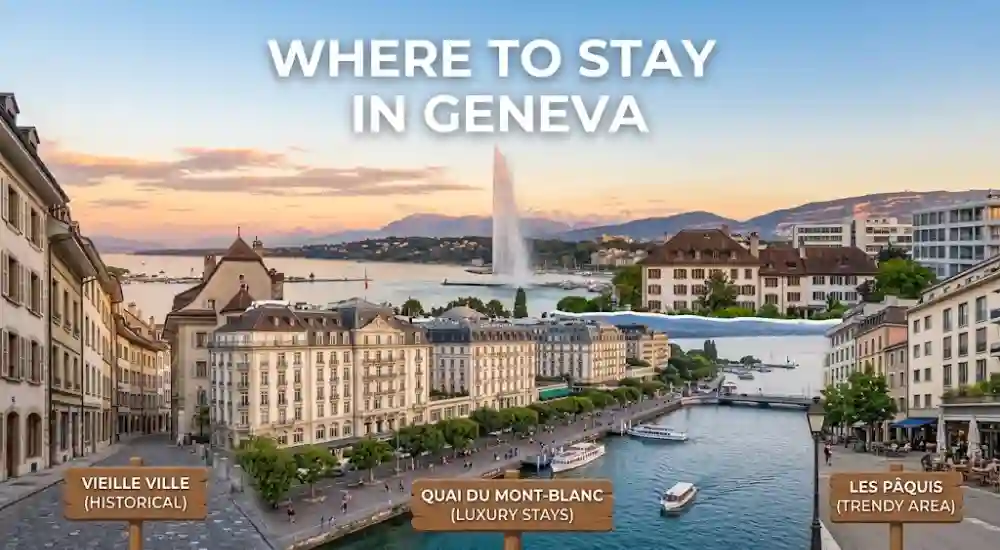
Where you base yourself changes how your trip feels, and Geneva’s neighborhoods each have a distinct character.
- Old Town (Vieille Ville): Best for first-time visitors who want to walk to nearly everything. Expect cobblestones, higher prices, and a quieter evening scene.
- Pâquis: A livelier, more affordable district near the lake and Bains des Pâquis, popular with younger travelers and known for its multicultural food scene.
- Lakefront (Quai du Mont Blanc area): The splurge option — grand hotels with lake and mountain views, right by the Jet d’Eau and Jardin Anglais.
Explore Geneva’s Old Town (Vieille Ville)
Geneva’s Old Town sits on a hill above the lake, and it’s the natural starting point for any visit. Its narrow, cobbled streets are lined with cafés, independent shops, and buildings that have stood for centuries. At its heart is Place du Bourg-de-Four, a lively square built on the site of a former Roman market and, later, a medieval fairground.
Grab a coffee at one of the terrace cafés here, and you’ll likely hear four or five languages within ten minutes — a small reminder of just how international this city is. From the square, wander in almost any direction and you’ll find something worth stopping for: the Maison Tavel, Geneva’s oldest surviving residential building; the Arsenal, with its old cannons and mosaics; or the Treille Promenade, home to a bench recognized as one of the longest wooden benches in the world.
Cathédrale St-Pierre and Its Underground Archaeology
At the highest point of the Old Town stands Cathédrale St-Pierre, a cathedral with foundations dating back to the 12th century. Inside, Gothic and neoclassical elements sit side by side, including the chair once used by Protestant reformer John Calvin, who preached here during the 16th-century Reformation.
Climbing the 157 steps to one of the towers rewards you with sweeping views across the Old Town rooftops and the lake beyond. Beneath the cathedral, though, is the real surprise: an archaeological site with ruins dating to the 4th century, recognized as one of the largest of its kind in northern Europe. It’s a paid add-on to the cathedral visit, and it’s genuinely worth the extra half-hour if you enjoy history.
See the Iconic Jet d’Eau and Lakefront
The Jet d’Eau is Geneva’s most photographed landmark: a fountain that shoots water 140 meters into the air at roughly 200 km/h, visible from almost anywhere along the lakefront. The closest, most dramatic views are from the pier right beside it — bring a light jacket if the wind is blowing your way.
Just west of the fountain, the Jardin Anglais (English Garden) holds the famous Flower Clock, planted with thousands of flowers that change with the seasons. Continue along Quai du Mont Blanc and you’ll pass grand belle-époque hotels and, on clear days, a distant view of Mont Blanc, Western Europe’s highest peak, rising above the water.
Enjoy Lake Geneva (Lac Léman)

Locally known as Lac Léman, Lake Geneva is the largest lake in Western Europe, and it shapes daily life in the city far more than most visitors expect. A short lake cruise is one of the easiest ways to see Geneva from the water, with options ranging from a 50-minute loop to longer routes toward Lausanne or Montreux.
If you’d rather stay active, you can rent a paddleboard or kayak, or simply hop on one of the yellow mouettes — small shuttle boats that double as public transport across the lake. As mentioned earlier, these are typically free for anyone holding a Geneva Transport Card.
Bains des Pâquis
Bains des Pâquis is a public bathing pier that’s been part of Genevan life since the late 1800s. In summer, locals swim off small artificial beaches and sunbathe on the pier. In winter, it stays open for cold-water swimming, followed by a sauna, hammam, or a bowl of hot fondue at the on-site café. Entry costs only a few francs, making it one of the best low-cost ways to experience the city the way residents actually do.
Visit CERN Science Gateway
CERN doesn’t look like a typical tourist stop from the outside — mostly glass, concrete, and security gates. But step into the Science Gateway, and within minutes you’re watching a simulation of two protons colliding at close to the speed of light.
This is also the site where British scientist Tim Berners-Lee invented the World Wide Web in 1989, largely as a side project to help physicists share research. The Science Gateway, CERN’s public visitor center, opened in 2023 and is free to enter, with interactive exhibits covering particle collisions, the origins of the universe, and quantum physics.
Guided tours that go deeper into the actual research areas, including underground detector facilities, are extremely popular. Spots are usually released and booked through CERN’s official visitor platform, often just one to two hours before a tour starts, so checking availability first thing in the morning gives you the best odds. Even without a tour slot, the exhibitions alone are worth two to three hours if you’re at all curious about science.
Discover Geneva’s Watchmaking Heritage at the Patek Philippe Museum
Switzerland’s reputation for watches took shape largely in Geneva, where the Reformation pushed goldsmiths and jewelers into the watchmaking trade during the 1500s and 1600s. By 1760, the city was already home to hundreds of watchmaking workshops.
The Patek Philippe Museum tells this story across several floors, from antique tools and restoration workbenches to the brand’s own collection dating back to its founding in 1839. You don’t need to know anything about watches to appreciate it — the sheer detail on display, some pieces representing years of handwork, makes it worthwhile on craftsmanship alone. On select days, you can also watch real watchmakers at work in the museum’s restoration workshop.
Go on a Swiss Chocolate Tour
Chocolate in Geneva isn’t a tourist gimmick; it’s a genuine local industry with over a dozen chocolatiers still operating across the city. Long-established names like Favarger and Auer sit alongside smaller shops tucked into Old Town side streets, many selling Genevan specialties such as pavés genevois — square chocolates shaped to echo the city’s cobblestones.
💡 Practical tip: A chocolate pass is a simple way to sample several shops without committing to a full box at each one. These passes typically include a small sample bag from multiple partner chocolatiers, plus a discount voucher, making it easy to figure out your favorites before buying chocolate to take home. Ask at the tourism office or check geneve.com for current partner shops and pricing, since these details change from year to year.
Explore the International District (UN & Broken Chair)
Beyond banking and chocolate, Geneva’s global reputation rests heavily on diplomacy. The International District is home to the Palais des Nations, the European headquarters of the United Nations, along with more than 200 other international organizations — a scale of diplomatic presence matched by very few cities worldwide.
Right outside the gates sits the Broken Chair, a striking 12-meter wooden sculpture built as a statement against landmines and cluster bombs. Most visitors photograph it from outside, but guided interior tours of the Palais des Nations are available with advance booking. Nearby, you’ll also find Geneva’s botanical gardens and a cluster of specialist museums covering the history of science and the Red Cross.
Wander Carouge, Geneva’s Italian Quarter
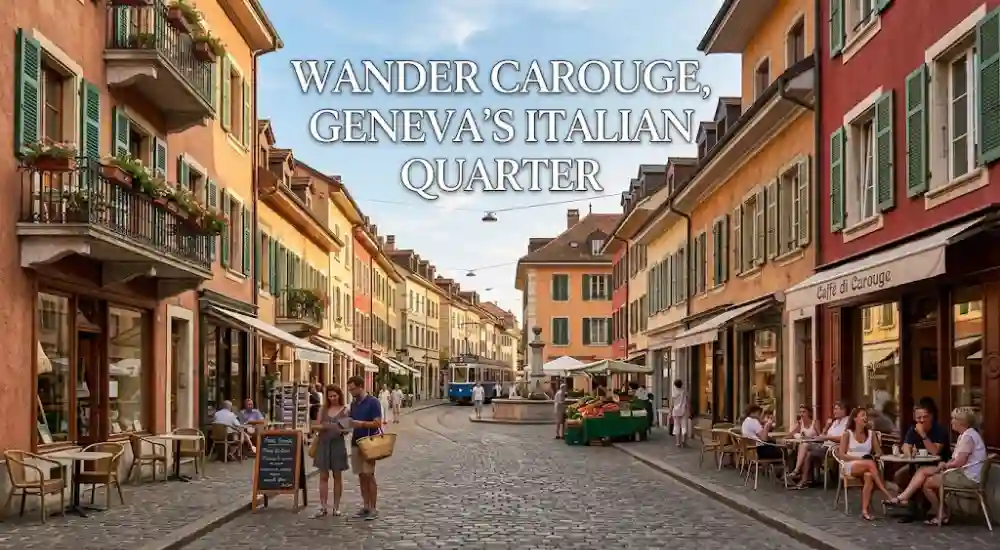
A short tram ride from the center, Carouge feels like a different city entirely. Founded by Sardinian settlers in the 18th century, it has a distinctly Mediterranean character: pastel-colored buildings, hidden courtyard gardens, and a concentration of small art studios and independent boutiques.
Carouge is at its liveliest on market mornings (Wednesday and Saturday), when local vendors set up stalls selling fresh produce, flowers, and handmade goods. It’s a relaxed, unhurried contrast to the polish of central Geneva, and a good half-day addition if you have more than 24 hours in the city.
Where to Eat in Geneva
Geneva’s food scene reflects its international population as much as its Swiss roots, and it’s worth planning at least one meal around it rather than grabbing whatever’s closest.
- Cheese and chocolate fondue: A near-mandatory Geneva experience, widely available across Old Town restaurants and at Bains des Pâquis’ café.
- Marché de Rive: A Saturday and Wednesday morning market where you can sample local produce, cheese, and even fresh lake fish sold directly by local fishermen.
- Casual cafés: Spots like Birdie are popular for coffee and brunch among both locals and visitors.
- Fine dining: Geneva holds several Michelin-starred restaurants for those looking to splurge on a special meal.
Free and Budget-Friendly Things to Do in Geneva
Geneva has a reputation for being expensive — and it largely deserves it — but several of its best experiences don’t cost a franc.
| Activity | Cost |
| Walking the Old Town | Free |
| Viewing the Jet d’Eau | Free |
| CERN Science Gateway exhibitions | Free |
| Broken Chair & International District (exterior) | Free |
| Treille Promenade & lakefront parks | Free |
| Museum of Art and History | Pay-as-you-wish |
| Cathédrale St-Pierre towers | Small paid entry |
| Bains des Pâquis | Low-cost entry fee (a few CHF) |
⭐ Takeaway: You can genuinely spend a full day in Geneva seeing major sights without paying for anything beyond a coffee and a transport ticket.
Take a Day Trip from Geneva
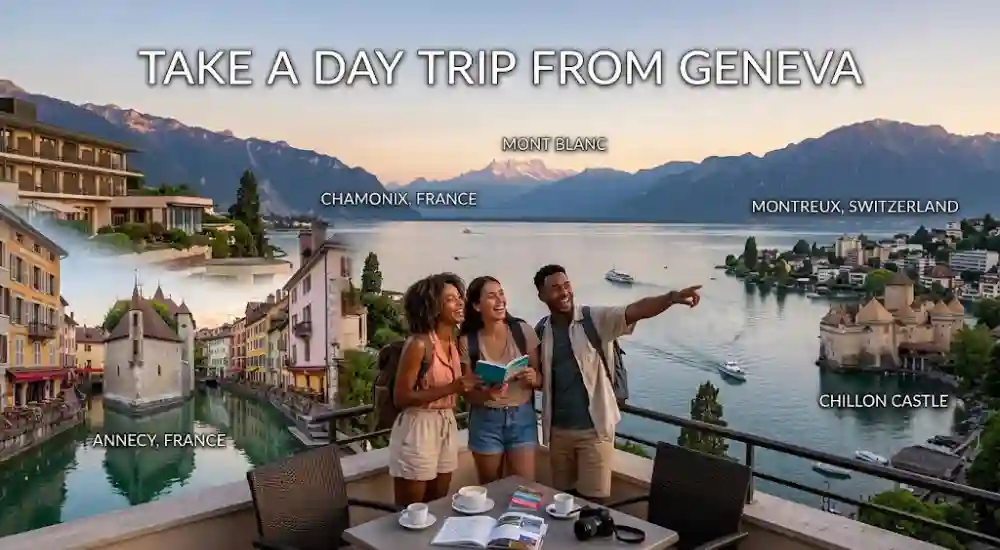
Geneva’s location near both the Alps and the French border makes it an excellent base for day trips. Within one to two hours, you can reach lakeside towns, mountain viewpoints, and a different country entirely.
| Destination | Distance/time from Geneva | Best for |
| Montreux | ~1 hour by train | Lakeside promenade, nearby Chillon Castle |
| Lausanne | ~35–45 minutes by train | Olympic Museum, lakeside old town |
| Annecy, France | ~1 hour by car or bus | Canals, alpine lake views |
| Chamonix, France | ~1.5–2 hours by car or bus | Mont Blanc views, cable cars |
| Mont Salève | 20–30 minutes plus cable car | Paragliding, hiking, panoramic views over Geneva |
Practical Information for Visiting Geneva
A few practical details make a real difference to how smoothly your trip runs.
Language: French is Geneva’s official language, but English is widely spoken in hotels, restaurants, and tourist sites, thanks to the city’s large international population.
Currency: Switzerland uses the Swiss Franc (CHF), not the euro, though some central shops near the French border will accept euros at a less favorable rate. Cards are widely accepted almost everywhere.
Safety: Geneva is generally considered a safe city for tourists, with low crime rates and a visible police presence. Standard precautions apply — keep an eye on bags in crowded tourist areas and around the main train station at night.
Best time to visit: Late spring through early autumn is peak season, when the Bains des Pâquis, lake cruises, and outdoor cafés are all in full swing. December has its own distinct appeal thanks to the L’Escalade festival — commemorating a failed 1602 invasion attempt — and the Christmas market along the lakefront.
Frequently Asked Questions
Is Geneva worth visiting?
Yes. Geneva combines a walkable historic center, a major lake, and globally significant institutions like CERN and the UN, making it a well-rounded stop even on a short trip.
Is Geneva expensive?
Geneva is one of the more expensive cities in Switzerland, particularly for food and accommodation. That said, many of its best attractions — the Old Town, the Jet d’Eau, and CERN’s exhibitions — are free.
Is one day enough in Geneva?
One day is enough to cover the highlights: the Old Town, cathedral, and lakefront. A second day lets you add CERN, a museum, or Carouge without feeling rushed.
Is CERN free to visit?
Yes. The CERN Science Gateway and its exhibitions are free to enter. Guided tours of the research areas are also free, but require advance booking through CERN’s official visitor platform, as spots fill quickly.
How do I get from Geneva Airport to the city center?
The fastest option is the train, which takes 6–7 minutes to Cornavin station and is free with the transport ticket handed out at baggage claim. Buses take 15–20 minutes and are also free with the same ticket.
Is Geneva safe for tourists?
Generally, yes. Geneva has low crime rates and a strong police presence, though standard city precautions — watching your belongings in crowded areas — still apply.
What language do people speak in Geneva?
French is the official language, but English is widely understood in hotels, restaurants, and at major attractions.
What is Geneva famous for?
Geneva is best known for hosting the United Nations and dozens of other international organizations, its centuries-old watchmaking industry, Swiss chocolate, and Lake Geneva itself.
Can you see Mont Blanc from Geneva?
On clear days, yes. Mont Blanc is visible from several points along the lakefront, including Quai du Mont Blanc.
What currency should I bring to Geneva?
Switzerland uses the Swiss Franc (CHF). Cards are accepted almost everywhere, so carrying large amounts of cash isn’t necessary.
Final Thoughts
Geneva isn’t a city you rush through, and most visitors underestimate it before they arrive — a fountain and some banks, they assume. Give it a proper morning in the Old Town and an afternoon by the water, and a different side starts to show: a serious science hub, a walkable food scene, and a neighborhood in Carouge that feels like southern Italy fifteen minutes from the lake.
Whether you have one day or three, the combination of history, nature, and world-shaping institutions packed into such a small, walkable footprint is what makes Geneva worth far more time than its reputation as a “stopover city” suggests.