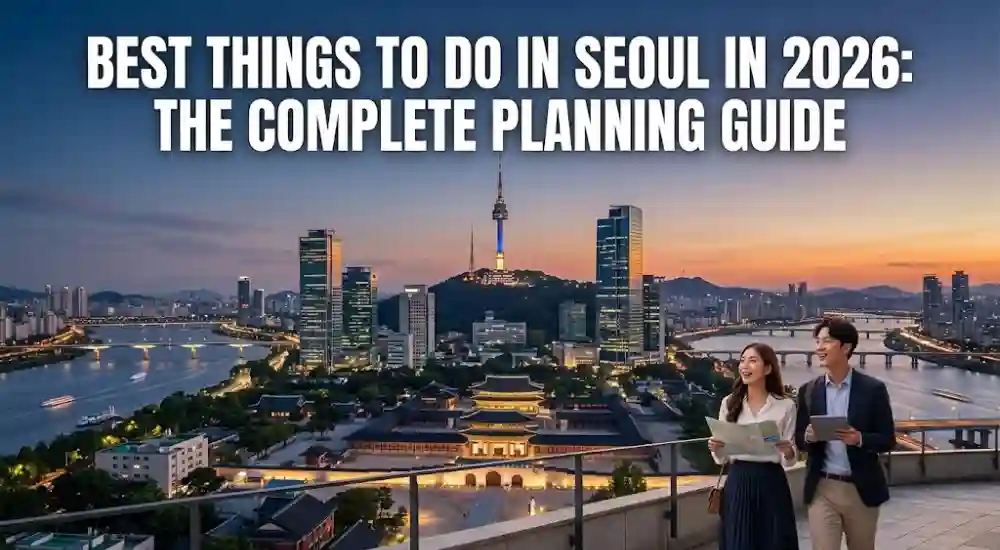
The first time you climb the steps out of Anguk Station and see Gyeongbokgung Palace‘s stone walls against a backdrop of apartment towers, Seoul makes its argument in about four seconds: this is a city that never chose between old and new — it just built them on top of each other.
That’s the pattern that repeats everywhere here. A 600-year-old palace sits two subway stops from a 500-foot shopping mall. A quiet hanok alley in Bukchon opens onto a street of neon-lit convenience stores. Understanding things to do in Seoul means understanding that contrast, not picking a side of it.
This guide is built around that idea. Instead of a flat, 50-item bucket list, it groups Seoul’s best experiences by what kind of day they create — palace mornings, market lunches, river sunsets, and the theme-park or DMZ day trips that round out a longer stay. You’ll find real cost ranges, realistic timing, current transit details, and the practical trade-offs that most listicles skip.
Quick Answer
The best things to do in Seoul mix royal palaces, hanok neighborhoods, street food markets, and a Han River sunset, with a theme park and a DMZ day trip rounding out a longer stay. Three full days covers the highlights without rushing; five to seven days lets you add hiking, hidden neighborhoods, and a slower pace.
TL;DR — Key Takeaways
- Palaces and hanok villages anchor almost every first-time itinerary, and wearing a hanbok gets you free entry to all four major palaces.
- Spring (April–May) and fall (October) bring the mildest weather and the biggest crowds — book accommodations 2–3 months out if you’re traveling then.
- A T-money transit card is the single most useful purchase you’ll make in Korea; new 2026 kiosks now accept international cards directly.
- Families choosing a theme park should weigh Lotte World’s convenience against Everland’s scale — see the comparison table below.
- The DMZ day trip requires a physical passport and, for JSA add-ons, advance registration — plan this early in your trip.
- Budget travelers can spend several days seeing palaces, museums, and parks for close to nothing by planning around Culture Day and the hanbok rule.
A Sample 3-Day Seoul Itinerary
If you only take one thing from this guide, take this: don’t try to see everything. Group attractions by neighborhood, not by “importance,” or you’ll spend half your trip riding the subway back and forth across the river.
| Day | Morning | Afternoon | Evening |
| Day 1 — Palace & Hanok | Gyeongbokgung Palace (arrive by 9:30 a.m. to beat tour groups) | Bukchon Hanok Village, then Insadong for lunch and tea houses | N Seoul Tower at sunset via cable car |
| Day 2 — Market & River | Gwangjang Market for a street-food breakfast | Dongdaemun or Myeongdong for shopping | Han River picnic at Banpo Bridge (rainbow fountain show) |
| Day 3 — Modern Seoul | COEX Mall and Starfield Library, Gangnam | Bongeunsa Temple, then Seongsu-dong cafés | Hongdae or Itaewon for dinner and live music |
Extending to 5–7 days? Add a full day for Everland or Lotte World, a full day for the DMZ, and a half-day hike up Namsan or into Bukhansan National Park. Save the DMZ for early in your trip in case a tour gets rescheduled — see the DMZ section for why that matters.
Seoul’s Five Palaces, Compared
Seoul has five surviving Joseon-dynasty palaces, and no first-timer needs to visit all five. Gyeongbokgung is the one everyone photographs, but it’s often the second-best choice if you actually want a quiet, unhurried walk through royal architecture — for that, seasoned visitors tend to prefer Changdeokgung’s Secret Garden.
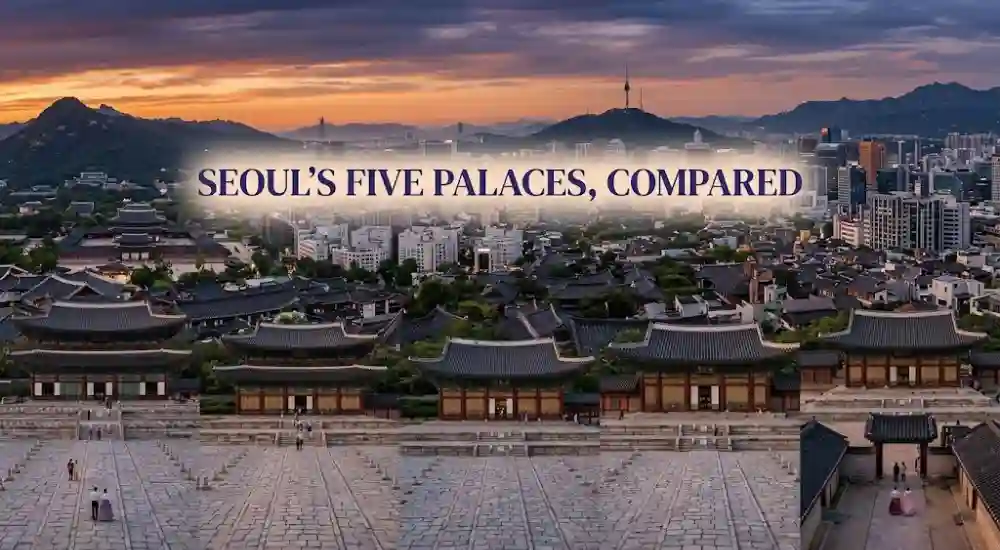
Here’s how they actually compare:
| Palace | Best For | Standout Feature | Crowd Level | Free With Hanbok? |
| Gyeongbokgung | First-time visitors | Lotus-pond pavilion, twice-daily Royal Guard Ceremony (10 a.m. & 2 p.m.) | High | Yes |
| Changdeokgung | Slower, deeper visits | Secret Garden (Huwon) — separate timed ticket required | Medium | Yes (Secret Garden ticket extra) |
| Deoksugung | A quick, central stop | Mix of hanok and Western neoclassical buildings | Low-Medium | Yes |
| Changgyeonggung | Avoiding crowds | Botanical greenhouse and quieter grounds | Low | Yes |
| Gyeonghuigung | Architecture without lines | Smallest of the five, often nearly empty | Very Low | Yes |
The hanbok rule, explained properly: wearing a complete hanbok outfit — top and bottom together — gets you free entry to all four major palaces, any day they’re open. Half a hanbok (just the jacket, for instance) doesn’t count; this trips up more visitors than you’d expect. Rental shops cluster around Gyeongbokgung’s Heungnyemun Gate, typically running ₩15,000–20,000 for a two-hour rental, though prices shift by shop and season.
Most palaces close one day a week — commonly Monday or Tuesday, and it varies by site — so check the specific palace’s schedule before you build your day around it. Budget 1.5–2 hours per palace, closer to 3 hours at Gyeongbokgung if you’re also visiting the National Folk Museum on its grounds.
A practical note most guides skip: the stone courtyards and gravel paths are genuinely uneven. Wedge sandals and hanbok don’t mix well underfoot — pick supportive shoes if you’re renting traditional dress, or plan to change before a long walk.
Hanok Villages: Where Photos Meet Real Neighborhoods
Bukchon Hanok Village sits in the hills between Gyeongbokgung and Changdeokgung, and its narrow alleys of traditional houses are exactly as photogenic as Instagram suggests. What photos don’t show: this is a lived-in residential neighborhood, not a museum, and the quiet-please signs on some doors are there because actual families live behind them.
Ikseon-dong solves this differently — it’s the same architectural style, but the hanoks here have been converted into cafés, cocktail bars, and small boutiques, so wandering in doesn’t mean wandering through someone’s front yard. It’s also considerably livelier after dark than Bukchon, which mostly quiets down by early evening.
For a genuinely different experience, Eunpyeong Hanok Village offers wider streets and a fraction of the tourist traffic — worth the extra transit time if Bukchon’s crowds sound exhausting.
Timing tip: visit Bukchon before 10 a.m. Not for the photos — though the early light helps — but because the alleys are narrow enough that a single tour group can make them feel genuinely crowded by midday.
N Seoul Tower and Namsan Park
You’ll spot N Seoul Tower from half the city before you ever get close to it — perched on Namsan Mountain, it’s one of the few Seoul landmarks visible from almost every direction. Getting to the top is where opinions split.
Three ways up:
- Cable car — departs near Myeongdong Station, a short and scenic ride, and the easiest option if you’re short on time or energy.
- New hiking trail (added 2025) — an easier, well-marked route that reaches the summit in roughly 40 minutes, a good middle ground between effort and reward.
- Full hike — longer, steeper approach trails through Namsan Park for anyone wanting a proper walk before the view.
Whichever way you go up, sunset is both the busiest and most rewarding time to be there — arrive at least an hour early to get a decent spot on the observation deck. The love-lock fences near the tower base are a genuine local tradition, not just a tourist gimmick, and attaching one costs little more than the lock itself.
Because both share a subway corridor, pairing this with a Myeongdong afternoon (below) makes for an efficient half-day loop.
Myeongdong: Shopping and Street Food in One Grid
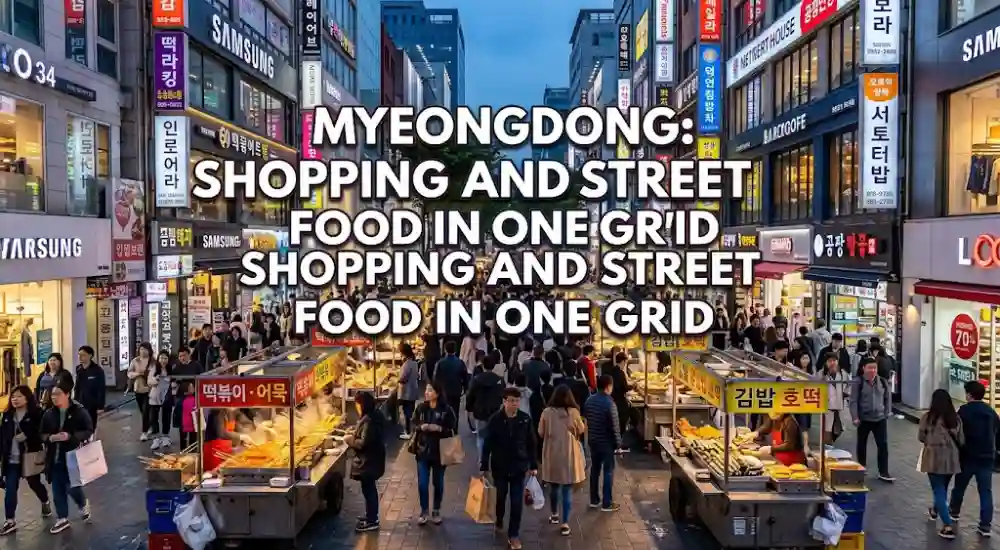
Myeongdong is Seoul’s most concentrated shopping-and-snacking district — a compact grid where skincare shops, fashion chains, and food stalls sit within a few blocks of each other. It’s touristy, and it knows it, but it earns the reputation.
Go for the street food as much as the shopping: tteokbokki (spicy rice cakes), hotteok (sweet filled pancakes), and skewered meats line the main strip from late morning onward. For a sit-down meal, step one block off the main street, where prices drop and the food gets noticeably better — a pattern that holds true in most of Seoul’s touristy districts.
Crowd pattern to know: Myeongdong gets genuinely packed after 5 p.m., especially on weekends. If browsing matters more to you than atmosphere, go before lunch.
Traditional Markets: Where Locals Actually Eat
Gwangjang Market is Seoul’s oldest traditional market, and its food alley is the reason most visitors come — legendary bindaetteok (crispy mung bean pancakes) and mayak gimbap (“addictive” mini rice rolls) draw lines of locals and tourists alike. A filling meal here typically runs under ₩20,000, though menu prices vary by stall and season.
Namdaemun Market, Korea’s largest traditional market, is less about eating and more about bargain shopping — clothing, kitchenware, dried seafood, and ginseng spread across a genuinely labyrinthine layout.
For something quieter and more residential, Mangwon Market near Hongdae is where locals actually shop, with fresher produce and a fraction of the visitor traffic of Gwangjang.
Practical tip that matters: not every stall takes cards or T-money. Carry some cash — Korea has moved fast toward cashless payment, but street-food stalls are often the last holdout.
Lotte World vs. Everland: Which One Fits Your Trip
Seoul’s two major theme parks solve genuinely different problems, and picking the wrong one for your itinerary can cost you half a travel day.
| Lotte World | Everland | |
| Location | Jamsil, inside Seoul city limits | Yongin, roughly 40–60 minutes outside the city |
| Access | Direct subway (Jamsil Station) | Bus or car; longer transit commitment |
| Setting | Mostly indoor, plus an outdoor “Magic Island” section | Large outdoor park with a zoo and drive-through safari |
| Best For | Short visits, bad-weather days, younger children | Full-day trips, thrill rides, animal encounters |
| Standout Feature | Central location, easy half-day option | Lost Valley drive-through safari, Panda World |
| Booking Tip | Online tickets are consistently cheaper than gate prices | Arrive early — the park is large enough to eat a full day |
If you only have time for one: choose Lotte World for convenience and shorter visits, or Everland if a full day trip with bigger rides and open-air space matters more than saving transit time. Families with very young children often lean toward Lotte World simply because it’s easier to leave early if a meltdown happens.
Both parks get considerably busier on weekends and Korean public holidays — a weekday visit can mean dramatically shorter wait times for the same rides. Check current opening hours and any seasonal event schedules before you go, since both parks run limited-time festivals that shift the calendar.
Free Things to Do in Seoul
Seoul rewards budget planning more than most capital cities. Two systems, used together, can make several days of sightseeing nearly free.
Culture Day waives or discounts admission at many palaces and museums on designated days — the schedule has expanded in recent years, so confirm the current calendar before building a day around it.
The hanbok rule (explained in full above) gets you into all four major palaces free, any day, no Culture Day required — just a complete hanbok outfit.
Beyond that, several of Seoul’s best experiences cost nothing at all:
- National Museum of Korea — one of Asia’s largest museums, with free entry to its permanent collection (special exhibits may carry a separate fee).
- Han River parks — miles of riverside space for cycling, picnicking, or simply sitting.
- Cheonggyecheon Stream — a landscaped walkway cutting through downtown, especially pleasant in the evening.
- Free walking tours — neighborhood-focused routes through areas like Bukchon and local markets.
- The Royal Guard Changing Ceremony at Gyeongbokgung’s main gate, performed daily at no cost.
Gangnam: Seoul’s Glossy, Modern Counterpoint
If the palace circuit is Seoul’s past, Gangnam is unapologetically its present. Skyscrapers, luxury retail, and a late-night restaurant and karaoke scene define the district by evening — by day, it centers more on shopping and a surprisingly calm temple complex.
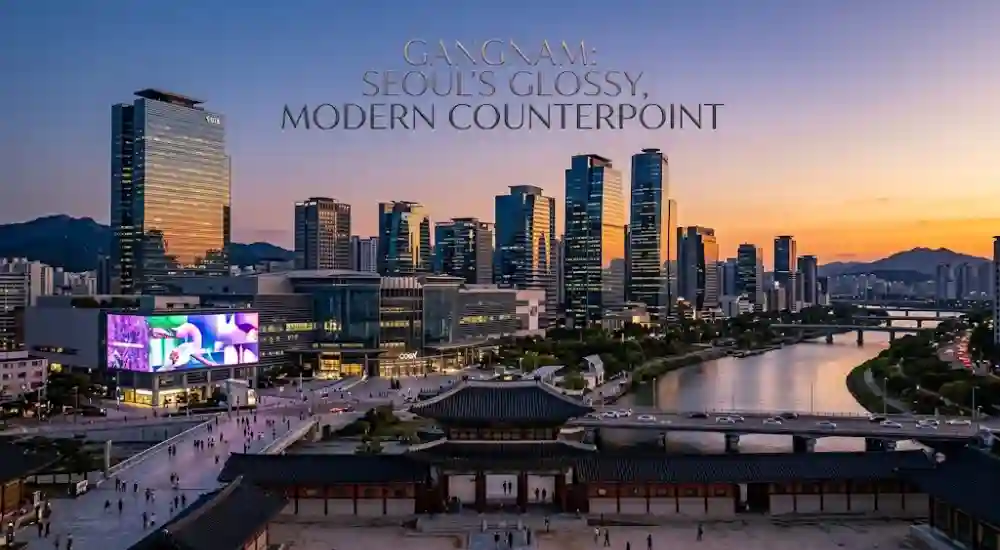
COEX Mall anchors the daytime side of things, with the Starfield Library — a genuinely striking, two-story wall of books — as one of Seoul’s most photographed modern interiors. A short walk away, Bongeunsa Temple is a working Buddhist temple that feels remarkably calm given it sits directly beside Gangnam’s skyline.
Gangnam spans three districts — Gangnam-gu, Seocho-gu, and Songpa-gu — and is best reached by subway. Expect noticeably higher prices for dining and shopping here compared with markets north of the river; it’s a useful modern contrast after a day of historic sites, not necessarily a budget stop.
Local Neighborhoods: Seongsu, Yeonnam-dong, and Beyond
Beyond the landmark circuit, a handful of neighborhoods show how Seoulites actually spend their weekends — and they draw far more locals than tour groups.
Seongsu-dong, once an industrial printing and shoemaking district, is now packed with converted-warehouse cafés, craft breweries, and design studios — something like a Korean answer to Brooklyn’s DUMBO. Yeonnam-dong, just next to the busier Hongdae district, offers a quieter, café-heavy version of the same energy. Ihwa Mural Village, on a hillside above Naksan Park, pairs colorful street art with genuinely good sunset views over the city.
These neighborhoods reward slower exploration far more than a checklist approach — put the map away for an hour and follow whichever side street looks interesting.
Hiking: Bukhansan National Park and Namsan
Bukhansan National Park, just outside central Seoul, offers real mountain hiking within easy subway reach — a genuine surprise for a capital city this dense. The Bukhansanseong Course to Baegundae Peak is the most popular summit route, and it’s more demanding than it looks from the trailhead: expect rope-assisted rock scrambling on the final approach, which means proper hiking shoes aren’t optional.
Namsan, by contrast, is a much gentler outing — paved paths inside the city, with N Seoul Tower as a natural turnaround point.
Weather on exposed ridgelines can shift quickly, so check current trail conditions before setting out, especially after rain or snow. Starting early avoids both summer heat and the afternoon crowds that build on clear-weather weekends.
Unwinding Along the Han River
Ask a Seoul local for their favorite unplanned evening spot, and the Han River comes up more than almost anywhere else on this list. Riverside parks run for miles on both banks, and the pace here is noticeably different from the rest of the city — picnic mats, portable grills, and river breezes replace the usual bustle.
A distinctly local tradition worth trying: pick up instant noodles and a foil bowl at a riverside convenience store, use the automated cooking machines, and eat “Han River ramen” on a mat by the water — it sounds unremarkable and somehow isn’t.
Banpo Bridge’s rainbow fountain show runs on select evenings and pairs well with sunset. Seokchon Lake, near Lotte World, is especially scenic during cherry blossom season. Weekend evenings draw the biggest crowds, so arrive early if a quiet spot matters to you.
Taking a Day Trip to the DMZ
The Demilitarized Zone (DMZ) is one of the most distinctive day trips available from any capital city in the world — a sobering, close-up look at the border between North and South Korea, about an hour outside Seoul.
This is not a destination you can visit independently. Access past the civilian control line requires a licensed tour operator with military coordination, and the specifics matter more here than almost anywhere else on this list.
What to know before booking
- A physical passport is mandatory. Photocopies and phone photos are not accepted at military checkpoints — bring the original document, every time.
- Standard half-day tours typically cover Imjingak Park, the Third Infiltration Tunnel, and Dora Observatory.
- Full-day tours may add the Joint Security Area (JSA), though public JSA access has been limited since 2023. Confirm current availability directly with the operator before booking — this changes without much notice.
- Book a few days ahead at minimum, earlier during spring blossom season or around Korean holidays.
- DMZ sites are generally closed on Mondays.
- Dress modestly — many operators enforce rules against shorts, sandals, and sleeveless tops, particularly for JSA-inclusive tours.
- Tours can be cancelled on short notice due to security conditions. Booking this early in your trip, rather than on your last available day, gives you room to reschedule if needed.
Seoul With Kids
Seoul is a genuinely manageable city to visit with children, thanks to clean public transportation and a strong mix of hands-on museums and parks. The real skill is pacing — alternating high-energy stops with deliberate downtime.
Lotte World works well for younger children or rainy days, thanks to its mostly indoor layout and direct subway access. Everland rewards families with more time and older kids who’ll appreciate bigger rides and the zoo section. For a lower-cost, lower-stakes outing, Children’s Grand Park offers a small zoo and gentler pace, well suited to toddlers who tire quickly.
Interactive museums — the hands-on kind, not glass-case artifact collections — tend to hold young attention spans far longer. Palace visits work best in shorter blocks, paired with a nearby park or snack break rather than stretched into a full-day outing.
One detail most guides skip: Seoul’s subway is stroller-manageable at most central stations, but elevators aren’t universal system-wide — check station maps in advance if you’re navigating with a stroller at less central stops.
Getting to Know Seoul After Dark
Seoul’s nightlife spreads across a handful of distinct districts, each with a different crowd. Hongdae leans toward students, street performers, and live music near Hongik University. Itaewon draws a more international, mixed crowd with a broader dining and bar scene. Gangnam, by contrast, skews upscale and slightly older after dark.
The subway generally stops running around midnight; Seoul’s Owl Bus network covers overnight routes for anyone out past that. Solo travelers commonly report feeling comfortable navigating the well-lit main streets of these districts after dark, though — as anywhere — sticking to busier routes and knowing your way home in advance is sensible practice, not a sign the city is unusually risky.
Karaoke rooms (noraebang) — private, rentable spaces rather than public stage performances — are a common, low-pressure way to spend an evening out, popular with locals and visitors alike.
Seoul’s Best Museums and Cultural Sites
Seoul’s museum scene ranges from massive national collections to small, focused exhibits on Korean history and conflict — a reliable backup plan on a rainy or brutally hot day.
The National Museum of Korea is the country’s largest, housing roughly 420,000 objects, with free general admission to its permanent collection. The National Folk Museum of Korea, on the Gyeongbokgung grounds, focuses on everyday Joseon-era life and pairs naturally with a palace visit. The War Memorial of Korea covers the country’s war history through exhibits, aircraft, and outdoor displays — a heavier but genuinely worthwhile stop for history-minded visitors.
Special traveling exhibits sometimes carry a separate ticket even at otherwise free museums, and most major museums close one day a week — check the specific schedule before building a day around one.
Getting Around Seoul Like a Local
Seoul’s subway is one of the most extensive and reliable systems anywhere, covering more than 700 stations across the greater metro area. A T-money card is the easiest way into that system, and as of 2026, it’s easier than ever for international visitors to get one.
T-money card basics:
- Sold at convenience stores (CU, GS25, 7-Eleven) and station vending machines.
- Tap in and out at subway gates and on buses; the system calculates fares automatically.
- Transfers between subway and bus are typically free within a short window after tapping out.
What’s new in 2026: new card-reading kiosks installed across many central stations — including Seoul Station, Myeongdong, Hongik University, Gangnam, Jamsil, and Itaewon — now accept major international credit cards directly, meaning you no longer need Korean won just to get moving after landing.
A few more practical notes: Naver Map consistently outperforms Google Maps for walking and transit directions inside Korea, so download it before you arrive. Taxis are metered and reasonably affordable, and the Kakao T app simplifies booking one without a language barrier. Keep a little cash on hand regardless — smaller markets and older machines haven’t fully gone cashless yet.
Where to Stay in Seoul
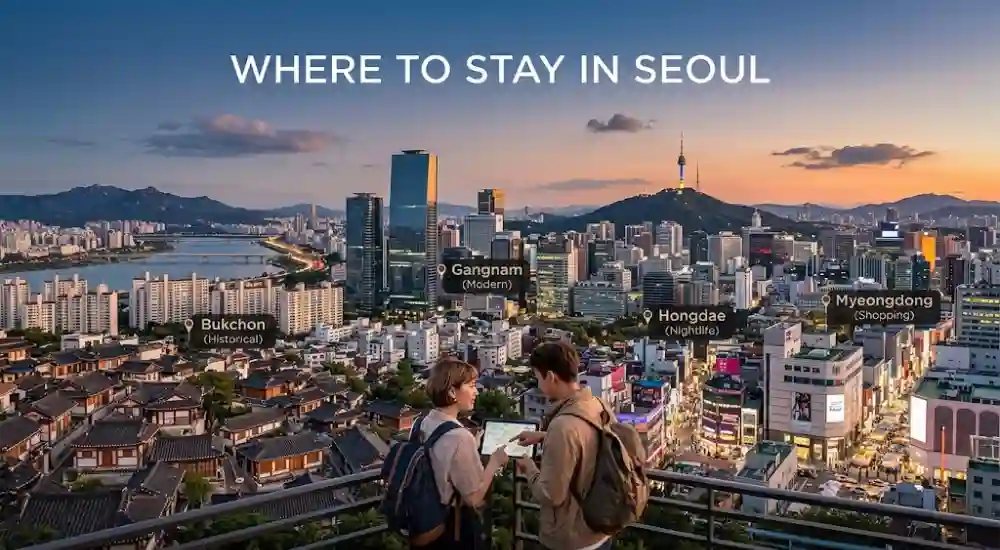
Choosing a neighborhood matters more in Seoul than in many cities, because the subway makes almost anywhere convenient — the real question is what kind of mornings and evenings you want.
| Neighborhood | Best For | Trade-Off |
| Myeongdong | First-timers, central shopping access | Busy, touristy after 5 p.m. |
| Hongdae | Nightlife, younger travelers, budget stays | Can be loud on weekends |
| Gangnam | Modern comfort, business travel | Higher prices, less “traditional” feel |
| Insadong / Jongno | Palace and hanok proximity, culture-focused trips | Fewer late-night dining options |
| Itaewon | International food scene, easy English navigation | Slightly removed from the palace circuit |
What a Trip to Seoul Actually Costs
Costs vary widely by travel style, but as a rough planning baseline for 2026: budget travelers can manage on roughly $50–70/day (hostel-level lodging, street food, public transit, mostly free/cheap attractions), while mid-range travelers should plan for $120–180/day (comfortable hotels, sit-down meals, one paid attraction daily). These are directional estimates, not quotes — always check current listings before finalizing a budget.
<a name=”faq”></a>
Frequently Asked Questions
How many days do you need in Seoul?
Three full days covers the major palaces, a hanok village, and a market or shopping district without rushing. Add a fourth or fifth day for a theme park visit or the DMZ day trip, and a full week lets you slow down enough to add neighborhoods like Seongsu or a Bukhansan hike.
Is Seoul expensive to visit?
Seoul can suit almost any budget. Public transportation, street food, and several major attractions cost very little, while hotels and dining vary widely and can climb quickly toward the upscale end. Mixing free palace-adjacent activities with a few paid experiences keeps daily spending manageable.
Do you need a car in Seoul?
No — the subway and bus network reaches nearly every neighborhood in this guide, and traffic often makes driving slower than transit anyway. A car only becomes genuinely useful for certain trips outside the city, and even then, organized tours or trains usually cover the same ground more easily.
Is Seoul family-friendly?
Yes. Clean, largely stroller-manageable transit combines with a strong mix of theme parks, interactive museums, and parks to make family travel here easier than in many major cities. Balancing active stops with deliberate rest breaks makes the biggest difference for younger children.
What is the best month to visit Seoul?
April–May and October generally offer the mildest weather, cherry blossoms or fall foliage, and the most comfortable sightseeing conditions — they’re also the most crowded and expensive months, so book accommodations early. Winter brings lower prices and thinner crowds, at the cost of genuinely cold temperatures.
Are Seoul’s palaces free to visit?
Not automatically, but two easy workarounds exist. Wearing a complete hanbok outfit gets you free entry any day, and many palaces also waive fees on designated Culture Days. Standard admission is modest even without either option — typically a few thousand won per palace.
Do you need a passport for the DMZ tour?
Yes. A physical passport is required for any DMZ tour, and photocopies or phone photos aren’t accepted at checkpoints. Full-day tours including the Joint Security Area typically require advance passport registration for military clearance, so plan this early.
Do I need a visa to visit South Korea?
Visa and entry-authorization requirements depend on your nationality and change periodically — U.S. citizens have historically needed a K-ETA (Korea Electronic Travel Authorization) for short visits. Check the current requirement for your passport directly with Korea’s official immigration resources before booking flights, since this is exactly the kind of detail that shifts year to year.
Is English widely spoken in Seoul?
English signage is common on the subway, in major shopping districts, and at most tourist attractions, though it’s less consistent in traditional markets and smaller local restaurants. A translation app and Naver Map go a long way toward closing that gap.
Is tipping expected in South Korea?
No — tipping is not customary in Korea, including at restaurants, in taxis, or for tour guides. Attempting to tip can occasionally cause confusion rather than appreciation; service charges, where applicable, are already built into the price.
Conclusion
The travelers who leave Seoul happiest aren’t necessarily the ones who checked off every palace on this list — they’re the ones who paired one or two icons with an unplanned afternoon in a neighborhood like Seongsu, or a quiet hour by the Han River with nowhere specific to be.
Start with the palaces and a hanok village to get your bearings, then build outward toward a theme park, a hike, or the DMZ based on how much time you actually have. Grab a T-money card on day one, keep your itinerary loose enough to wander, and let Seoul’s subway handle the rest.