Tokyo isn’t a single city center the way Paris or London is — it’s a loop of distinct neighborhoods strung along the JR Yamanote Line, each with its own personality. Working out where to stay in Tokyo matters more than in most cities, because the “wrong” neighborhood doesn’t ruin your trip, but it does mean longer commutes, higher prices for the same room quality, or evenings that feel quieter or louder than you wanted.
This guide covers the neighborhoods that actually work as a home base — Shinjuku, Shibuya, Asakusa, Ginza, Ueno, Roppongi and more — along with realistic travel times from Narita and Haneda airports, what a room actually costs in each area, and the single rule that makes choosing easy: stay near a station on the Yamanote Line loop or a major subway interchange, and almost everything else falls into place. Once you’ve picked a base, pair this guide with our roundup of the best places to visit in Tokyo and our 5-day Tokyo itinerary to start planning your days.
Quick Answer
For most first-time visitors, Shinjuku or Shibuya is the best base — both are major rail hubs on the Yamanote Line with huge hotel selection and put the whole city within one train ride. If you’d rather wake up somewhere quieter with old-Tokyo character, Asakusa is the best value alternative, and Ginza or Tokyo Station/Marunouchi suit travelers who want upscale, central and calm.
TL;DR
- First-timers: Shinjuku or Shibuya — maximum convenience and choice
- Budget travelers: Asakusa, Ueno or Ikebukuro — 15–30% cheaper than Shinjuku for similar quality
- Families: Asakusa (space, calmer streets) or Ueno (museums, parks, larger rooms)
- Luxury/business travelers: Ginza or Marunouchi, near the Shinkansen hub
- Nightlife: Shinjuku (east side) or Shibuya, though both get loud on weekends
- Getting around: Stay within a 5-minute walk of a Yamanote Line or major metro station
- Reservation needs: Book 4–6 months ahead for cherry blossom season and autumn foliage
How to Choose Your Base in Tokyo
Tokyo’s public transport is extensive but can be genuinely confusing on a first visit, mixing JR lines, the Tokyo Metro, and the Toei subway under different fare systems (though a Suica or Pasmo IC card smooths most of this out). The single most reliable rule: choose a hotel within a five-minute walk of a Yamanote Line station or a major interchange. Do that, and the rest of the city stays within easy reach regardless of which specific neighborhood you pick.
| Travel Style | Best Area(s) | Why |
|---|---|---|
| First-time visitor | Shinjuku, Shibuya | Best transit hubs, widest hotel choice, full Tokyo energy |
| Traditional atmosphere / budget | Asakusa, Ueno | Old-town streets, temples, 15–30% cheaper rooms |
| Luxury / business | Ginza, Marunouchi | Five-star hotels, Shinkansen access, refined dining |
| Families | Asakusa, Ueno | Parks, museums, quieter side streets, larger rooms |
| Nightlife / art | Shinjuku (east), Shibuya, Roppongi | Bars, clubs, late-night energy, museums (Roppongi) |
| Multi-city travelers | Tokyo Station / Marunouchi | One-transfer access to every Shinkansen line |
Shinjuku — Best All-Around Base for First-Timers
Shinjuku Station is, by most counts, the busiest railway station in the world, handling over 3 million passengers daily. That single fact explains why so many first-time visitors end up here: from Shinjuku, you can reach almost anywhere in Tokyo on a direct line with no transfers. The neighborhood itself splits into two distinct moods — the neon chaos of Kabukicho and Golden Gai to the east, and the calmer skyscraper district and Shinjuku Gyoen park to the west.
- Best for: First-timers, solo travelers, anyone who wants unmatched transit connections
- Vibe: East side is loud and neon-lit; west side is calmer and business-oriented
- Price range: Roughly ¥12,000–25,000 mid-range, with capsule and budget options from ¥3,500
- Watch out for: Light sleepers should avoid the immediate Kabukicho area, where bars stay lively until dawn on weekends.
Shibuya — Best for Sightseers Who Move Around Constantly
Shibuya anchors one of Tokyo’s strongest multi-line subway junctions, and its famous scramble crossing has become a symbol of the city itself. It suits travelers who plan to be out exploring most of the day and just need a convenient, well-connected place to sleep.
- Best for: First-timers, couples wanting a livelier romantic base, trend-focused travelers
- Vibe: Youthful, fashion-forward, constantly in motion
- Price range: ¥12,000–25,000 depending on property tier, a slight premium over Asakusa for the international profile
- Watch out for: Weekend nights get loud around the station and Center Gai; families with young children may prefer a slightly quieter side street.
Asakusa — Best Value and Traditional Atmosphere
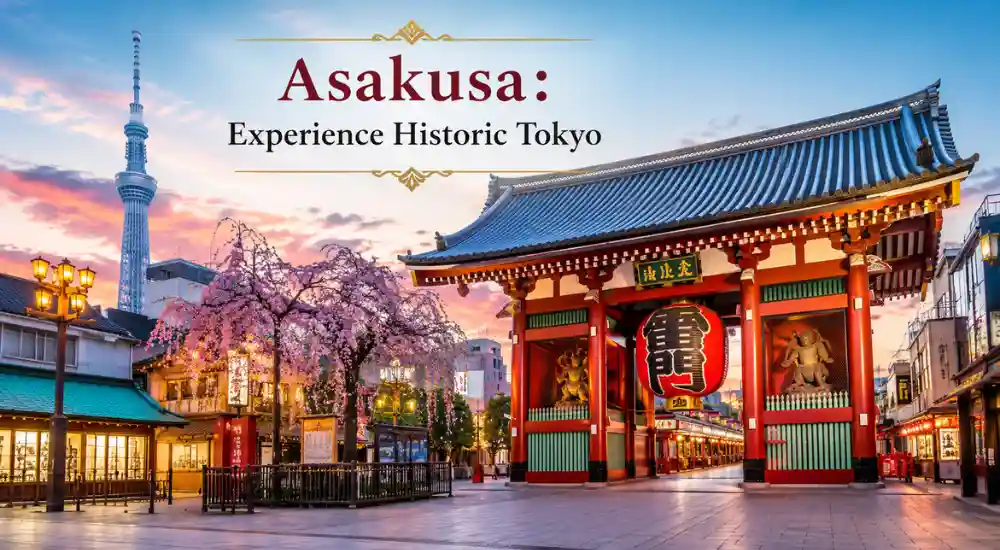
Asakusa is Tokyo’s old town, built around Senso-ji Temple, with traditional shopping streets, old-school izakayas and a nostalgic feel that’s a world apart from Shinjuku’s neon. It’s also an easy jumping-off point for day trips like Kawagoe, Tokyo’s “Little Edo”. It also happens to be Tokyo’s best-value neighborhood for accommodation, running roughly 15–30% cheaper than equivalent hotels in Shinjuku or Shibuya.
- Best for: Budget travelers, families, anyone whose itinerary focuses on east Tokyo (Ueno, Akihabara, the Skytree, Ryogoku’s sumo arena)
- Vibe: Traditional, quieter, residential side streets alongside a busy tourist core near the temple
- Price range: Hostels ¥2,500–4,000, budget hotels ¥6,000–12,000, mid-range ryokan ¥15,000–30,000
- Good to know: Asakusa quiets down noticeably after 10 p.m., making it one of the better choices for families with children.
Ginza — Best for Luxury and Business Travelers
Ginza is Tokyo’s most polished address: department stores, flagship boutiques, and some of the city’s most celebrated restaurants, all a short ride from the Tokyo Station Shinkansen hub. It’s quieter at night than Shinjuku or Shibuya, which luxury travelers and families both tend to appreciate.
- Best for: Luxury travelers, business visitors, couples wanting an elegant, refined base
- Vibe: Polished, upscale, calm evenings
- Price range: Rates start around ¥22,000 and climb quickly toward ¥50,000+ for luxury properties
- Trade-off: Fewer late-night options than Shinjuku or Shibuya — that’s largely the appeal for this crowd.
Tokyo Station / Marunouchi — Best for Shinkansen and Multi-City Trips
The area around Tokyo Station has seen major redevelopment recently, with new hotel openings continuing to raise the district’s profile. Its core advantage is unbeatable: it’s the terminus for nearly every Shinkansen line, making it the natural base for travelers combining Tokyo with day trips to Hakone, Kamakura or Nikko, or onward travel to Kyoto and Osaka.
- Best for: Business travelers, Shinkansen day-trippers, multi-city itineraries
- Vibe: Broad, pleasant streets; more corporate and quieter at night than Shinjuku or Shibuya
- Price range: Mid-range ¥15,000–25,000, luxury ¥30,000–100,000+
Ueno — Best for Museums and Budget-Conscious Families
Just west of Asakusa, Ueno centers on a large park with a major zoo, several world-class museums and the bustling Ameyoko market street. It consistently delivers some of the best room rates among Tokyo’s central districts, without sacrificing much in terms of transit access.
- Best for: Families (zoo, museums, larger rooms), budget travelers
- Vibe: Practical, unpretentious, green space nearby
- Price range: Similar to Asakusa — among the most affordable in central Tokyo
Roppongi (and Azabujuban) — Best for Nightlife and Art
Roppongi is best known for its nightlife and a cluster of major museums (the Mori Art Museum among them), making it a strong pick for travelers who want late-night energy alongside culture. Neighboring Azabujuban offers a calmer, more residential alternative within easy reach of the same area.
- Best for: Nightlife and art lovers, travelers wanting an international, cosmopolitan feel
- Vibe: Buzzy after dark, museum-dense during the day
- Good to know: Consider Azabujuban specifically if Roppongi’s nightlife reputation doesn’t match your trip.
Ikebukuro — Best Hidden-Value Pick
Ikebukuro rarely tops first-timer lists, but it’s arguably Tokyo’s most underrated base for budget travelers: hotels consistently price lower than Shinjuku or Shibuya while offering essentially identical transit access via the Yamanote Line.
- Best for: Budget travelers who don’t need to be near specific landmarks
- Vibe: Local, less touristy, strong shopping and dining scene
Where to Stay Based on Who’s Traveling
| Traveler Type | Best Neighborhoods |
|---|---|
| First-time visitors | Shinjuku or Shibuya |
| Couples and honeymooners | Ginza (elegant) or Shibuya (lively) |
| Families | Asakusa (tradition) or Ueno (value + museums) |
| Luxury travelers | Ginza, Marunouchi |
| Budget travelers | Ueno, Ikebukuro, Asakusa |
| Nightlife and art lovers | Roppongi, east Shinjuku |
| Business / multi-city travelers | Tokyo Station / Marunouchi |
Getting from the Airport to Your Neighborhood
Tokyo has two airports: Haneda (HND), about 15 km from central Tokyo and used by most domestic flights plus a growing number of international routes, and Narita (NRT), roughly 60 km outside the city and still the main hub for many international carriers and budget airlines. Check which airport your flight uses before booking a transfer, since the difference in travel time is significant.
| From | To | Typical Time | Typical Cost |
|---|---|---|---|
| Haneda | Shibuya | ~30–40 min (Keikyu + Yamanote) | ~¥580 |
| Haneda | Shinjuku | ~40–55 min | ~¥730–870 |
| Haneda | Asakusa | ~30–40 min (through-service, no transfer) | ~¥600–700 |
| Narita | Shinjuku | ~65–90 min (Skyliner + Yamanote, or N’EX direct) | ~¥2,700–3,250 |
| Narita | Nippori/Ueno | ~40–75 min | ~¥1,060–2,580 |
These are approximate figures pulled from current train operator guides — actual times depend on which specific line and connection you take, so confirm your exact route once you know your hotel’s nearest station.
What Hotels Actually Cost by Neighborhood
| Area | Budget/Capsule | Mid-Range | Luxury |
|---|---|---|---|
| Asakusa / Ueno / Ikebukuro | ¥2,500–6,000 | ¥8,000–15,000 | ¥18,000–35,000 |
| Shinjuku | ¥3,500–7,000 | ¥12,000–25,000 | ¥25,000–60,000+ |
| Shibuya | ¥4,000–7,000 | ¥12,000–25,000 | ¥25,000–60,000+ |
| Ginza / Marunouchi | Limited | ¥18,000–30,000 | ¥30,000–100,000+ |
These are typical seasonal ranges rather than fixed prices — rates swing 30–100% higher during cherry blossom season (late March–mid-April) and autumn foliage (November), so book 4–6 months ahead if your trip falls in either window. January, June and late summer tend to offer the lowest rates of the year.
Best Time to Visit Tokyo
Cherry blossom season (late March to mid-April) and autumn foliage (November) are Tokyo’s most popular — and most expensive — windows, often 30–100% above regular rates. Golden Week (late April–early May) sees heavy domestic travel and should be avoided if flexible. For a calmer, cheaper trip with still-pleasant weather, June (early rainy season) or September offer a reasonable trade-off, while January and February bring the lowest prices of the year alongside cold but manageable conditions.
Common Mistakes to Avoid
- Booking far from a Yamanote Line station: Even a well-reviewed hotel becomes inconvenient if it’s a long walk or multiple transfers from the loop line.
- Assuming Narita and Haneda have similar transfer times: Narita can take 60–110 minutes to central Tokyo; Haneda is often half that. Confirm which airport you’re flying into before booking a late check-in.
- Booking during cherry blossom or autumn foliage season without planning ahead: Popular hotels sell out completely 3–4 months in advance during these windows.
- Choosing Shibuya for families with very young children: The late-night crowds and compact room sizes can make it more stressful than Asakusa or Ueno.
- Ignoring room size expectations: Tokyo hotel rooms, even mid-range ones, run smaller than Western equivalents — check square meters, not just star rating, before booking.
- Overpaying for Ginza or Shinjuku when Asakusa or Ueno would work fine: Unless you specifically want the nightlife or shopping proximity, the 15–30% savings in east Tokyo neighborhoods add up fast on longer stays.
Frequently Asked Questions
What is the best area to stay in Tokyo for first-time visitors?
Shinjuku and Shibuya are the two strongest choices — both sit on the Yamanote Line with extensive hotel options and put the entire city within easy reach.
Is Asakusa or Shinjuku better for a first trip?
Shinjuku offers unmatched transit connections and full Tokyo energy; Asakusa offers a calmer, more traditional atmosphere at a noticeably lower price. Many first-time visitors choose Shinjuku for convenience or Asakusa for value and character — both work well.
How many days do you need in Tokyo?
Four to five nights is a reasonable minimum to see the major districts without rushing; a full week allows time for day trips to Hakone, Kamakura or Nikko.
Do I need to choose between Narita and Haneda hotels?
Your hotel choice doesn’t need to match your airport, but it’s worth checking travel time from whichever airport you’re flying into, since Haneda transfers are typically much faster than Narita transfers.
Is Tokyo expensive to stay in?
It’s more affordable than many visitors expect — budget business hotels start under ¥5,000 a night, and even mid-range hotels in central areas often run cheaper than equivalent properties in London or Paris.
Where should families with children stay in Tokyo?
Asakusa and Ueno both offer larger rooms, quieter side streets, and proximity to parks and museums, making them more practical than Shibuya or Shinjuku’s nightlife-heavy cores.
Do I need a JR Pass to get around once I’ve chosen a neighborhood?
Not necessarily for staying within central Tokyo — a Suica or Pasmo IC card covers the Yamanote Line, subways and buses. A JR Pass becomes worthwhile mainly if you’re planning Shinkansen trips beyond the city.
How far in advance should I book a Tokyo hotel?
Four to six months ahead for cherry blossom season or autumn foliage; three to four weeks is usually sufficient outside those peak windows.
Final Thoughts
Choosing where to stay in Tokyo comes down to a simple trade-off: convenience and energy in Shinjuku or Shibuya, value and old-town character in Asakusa or Ueno, or polish and calm in Ginza or Marunouchi. None of these are wrong choices — the Yamanote Line loop connects them all closely enough that a 20–30 minute train ride separates almost any two neighborhoods on this list.
Pick the neighborhood that matches your priorities — cost, atmosphere, or proximity to specific sights — confirm it sits near a Yamanote Line or major metro station, and book early if your trip falls during cherry blossom or autumn foliage season. For inspiration on filling your days, see our full guide to things to do in Tokyo. From there, Tokyo’s transit system does most of the remaining work for you.